


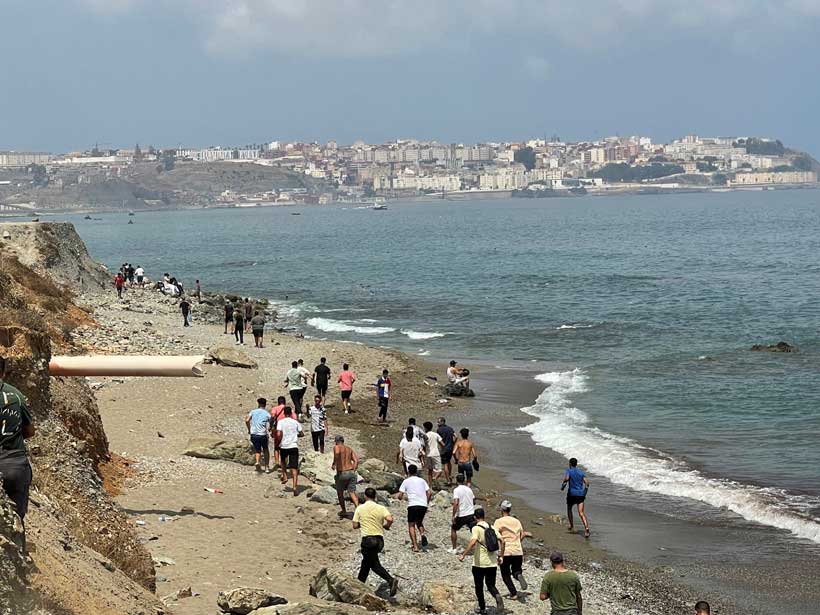
Spanish border workers warned authorities weeks before a mass migrant rush into the North African enclave of Ceuta that arrivals were increasing and could escalate, but unions say the government failed to take timely action.
More than 70,000 migrants attempted to enter Ceuta on July 29 and 30, according to Spanish and Moroccan authorities. At least 94 deaths were confirmed, with Spain reporting 80 deaths and Morocco recovering 14 bodies. Human rights groups said the actual toll could be higher.
Warnings Came Weeks Earlier
Border workers’ unions said they repeatedly warned Spanish authorities after a court ruling on June 29 clarified that migrants could only be immediately pushed back if they crossed a physical barrier. Migrants entering by sea did not fall under the same provision.
The ruling, combined with videos showing migrants successfully reaching Ceuta and information circulating on social media, encouraged more people to attempt the crossing.
Stay ahead of the geopolitical week.
MD Briefing delivers expert analysis across five global fronts — the Indo-Pacific, energy, geoeconomics, European security, and the Middle East — every Monday morning. Free.
Spanish Civil Guard union AUGC described the situation as an “explosive cocktail” involving the ruling, criminal networks and social media.
Reuters reviewed six written statements and letters sent by border unions to Spanish authorities between July 10 and July 23.
The unions warned that the ruling had created a legal loophole and called for clear instructions, additional personnel and stronger border protocols.
Unions Warned of Rising Sea Arrivals
In a July 23 letter to Ceuta’s police chief, the SUP police union highlighted “constant arrivals by sea” and warned that the increasing numbers were placing pressure on border personnel.
The union also called for a temporary reception centre.
Spanish authorities said they assessed several options following the court ruling and installed a floating barrier on August 1, two days after the mass arrival.
The Interior Ministry said the barrier was put in place 48 hours after authorities decided to install it, following the July 30 surge.
Morocco Also Faced Growing Pressure
Moroccan and Spanish border officials had reportedly observed increased attempts to cross from mid-July.
Morocco, which receives EU funding to help control migration, only introduced stronger measures such as checks at transport hubs one to two days before the mass crossing, according to accounts cited by Reuters.
Significant reinforcements were sent only after the number of migrants attempting to cross reached tens of thousands.
Riccardo Fabiani of the International Crisis Group described the lack of earlier action as a potential policy failure.
A senior Moroccan official said Rabat had asked Spain whether the court ruling could create problems but declined to say what response it received.
Social Media and the “Pull Factor”
Spanish authorities blamed the mass rush partly on misinformation about the court ruling circulated by criminal networks.
Morocco also monitors social media for calls to organise collective crossings and increases border controls when such activity is detected.
The episode has therefore highlighted how quickly legal changes and information circulating online can influence migration routes and border movements.
Questions Over Europe’s Border Strategy
The events in Ceuta have raised broader questions about Europe’s reliance on neighbouring countries to control migration.
Morocco receives substantial European financial assistance for border management, while Spain and Morocco have continued to describe their cooperation as important.
The European Commission said it would continue working with both countries to strengthen border controls and could provide additional financial support.
Moroccan officials, however, have argued that Europe must do more to deter migrants from attempting dangerous crossings in the first place.
Analysis
The Ceuta crisis exposes a vulnerability in Europe’s externalised migration system: legal uncertainty, social-media mobilisation and delayed coordination can rapidly overwhelm border controls.
The warnings from Spanish border unions suggest that authorities were aware of rising pressure well before the mass crossing. The central issue, therefore, is not simply whether Spain or Morocco could have prevented the rush, but whether existing European border-management arrangements are capable of responding quickly when legal and political conditions change.
The episode also demonstrates the limits of relying on neighbouring states to contain migration. Morocco plays a major role in Europe’s border strategy, but the events show that cooperation can still leave gaps in responsibility when large-scale movements emerge.
Ultimately, the Ceuta episode places renewed pressure on Spain, Morocco and the EU to develop clearer legal protocols, faster intelligence-sharing and coordinated responses to sudden migration surges, rather than relying primarily on emergency measures after a crisis has already begun.
With information from Reuters.
