On 20 June, Donald Trump posted that there would be no tolls in the Strait of Hormuz during the sixty-day ceasefire, and none after it, with one exception. Tolls could be charged, he wrote, by and for the United States, if the deal was not completed, in payment for services rendered as the Guardian Angel to the countries of the Middle East, and for the reimbursement of costs past, present and future.
The sentence echoes, strangely, an argument it could not have meant to make. In “War Making and State Making as Organized Crime,” Charles Tilly held that protection always carries two meanings at once. In the comforting one, a strong power shields the weak from a danger it did not make, at a price no higher than a rival would charge. In the ominous one, it charges for relief from a danger it has a hand in, and the only firm line between the two is who holds the authority to decide that the threat is real and the price is fair. Protector and racketeer, in his account, are divided less by what they do than by the right to call it legitimate.
Tilly drew the point from the making of states at home, where the protection sold to the ruled was slowly tamed into lawful taxation by a bargain, a say in the price in exchange for paying it. What the strait shows is that protection, the same trade carried on between nations, never struck that bargain. A guardian that invoices its protection is that thesis spoken aloud by the state it describes. There is no toll at Hormuz yet, no booth, no rate, only a sentence about something that might happen. What moved that day was the face. The water did not move at all. The Guardian Angel turned, for a moment, to show the other one.
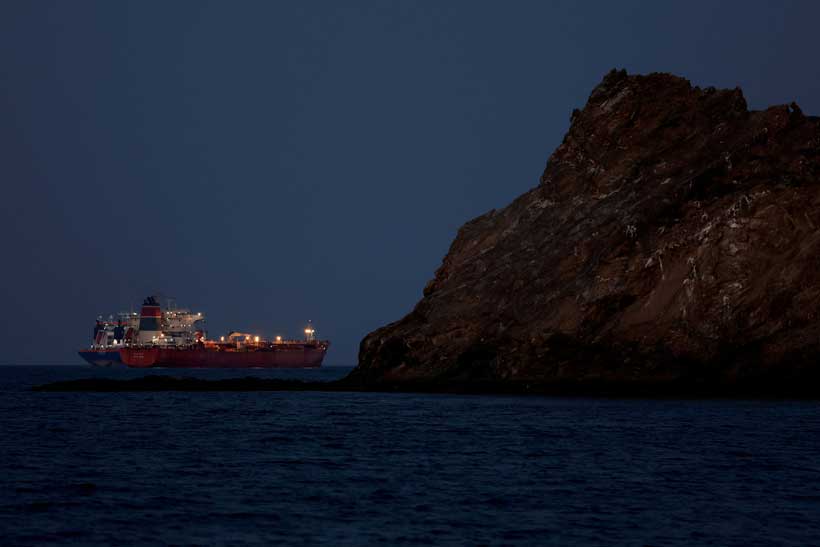
For most of a century the protection was the comforting kind, and it took that form by giving itself away. The United States Navy patrolled the approaches to Hormuz from its base in Bahrain, kept the lane open through the tanker war of the 1980s, escorted ships that came under fire, and held the passage open to every flag that used it. A Japanese tanker, a French one, an American one passed under the same guarantee, and none of them received an invoice. That the service was offered to all and billed to none was itself the mark of an order. It was the Navy that carried the cost because carrying it was part of what it meant to be the power that held the system together. The price was always there. The guarantor paid it, and the silence around the payment was precisely what kept it a guarantee.
Stay ahead of the geopolitical week.
MD Briefing delivers expert analysis across five global fronts — the Indo-Pacific, energy, geoeconomics, European security, and the Middle East — every Monday morning. Free.
In that one post, the president recasts the same presence as a service the United States might sell to the protected. Nothing on the water changes. The patrols stay where they are, the ships pass as before, and only the words around them turn. A navy that kept the strait open as a public good becomes, in the telling, a protection business that bills paying clients, the countries of the Middle East, after the fact. Guardian Angel is the name the business gives itself. The charge is described as reimbursement, dated back across decades, as though the protection had been a loan all along and the moment to call it in had simply arrived. What is new is that it now carries a price, and that the price, for the first time, faces the protected, where it had always faced the protector.
Renaming the toll a fee is the move itself, and it does precise legal work. The law of the sea bars a toll on a strait used for international navigation, and when the idea first surfaced in April the International Maritime Organization, the European Commission and the Greek prime minister, whose country owns Europe’s largest fleet, all called it unlawful. But the same law, in Article 26, permits a coastal state to charge for specific services rendered to the ship, a phrase practice has filled with pilotage, towage, the safe routing of ships. A fee for services is therefore not a euphemism laid over a toll. It is the doorway through which an unlawful toll is carried out as a lawful charge, and everyone with a claim to the water now passes through it.
Iran calls its levy a maritime service fee. The June post calls the American one payment for services rendered. Toll has become the single word no party will speak, because it is the one charge the law forbids. And the rename exacts a price of its own in the saying. A fee for protection makes sense only if protection is the kind of thing that can be sold, so in calling it lawful they concede that the guarantee has become a product. The legitimation and the confession are one sentence.
Who may charge is the whole question, and the answer is not symmetrical, which is Tilly’s point exactly. The same act draws opposite verdicts according to who performs it. Oman, reported to be weighing a fee along its own coast, was warned to behave or be destroyed, and the Treasury vowed to target anyone who helped collect such a fee. Washington, which in April proposed to split a toll with Iran as a beautiful thing and by June had reserved one for itself, calls the identical charge a service rendered. What changes is who is allowed to perform it, a right one power claims and denies to the rest on pain of force, so the same fee reads as sovereignty in the patron’s hands and as revolt in the client’s. What the patron monopolizes is the right to price the water.
This is why, as I see it, the Gulf arrangements were a patron and its clients, equals in name only. One power shaped the order so its clients would behave predictably, and in doing so kept itself the point the region turned on. That place carried every right, the right to price the water chief among them, a return the position always held and the patron is only now moving to draw. It held only so long as the price went unspoken. The riparian states are now testing the rule from beneath. Iran insists it will administer the strait under its own sovereignty. It routes ships onto lanes of its own choosing, so the passage it charges for can be called a service, never a toll. Oman moves between a working group with Tehran and public promises of free passage, and Washington rules them both out of bounds while keeping the exception it wrote for itself.
There is a harder side to the comforting account, and the present makes it plain. The danger the United States would charge to relieve sits in a strait that the war it is itself fighting has unsettled. In the weeks around the post the ceasefire buckled, Iran fired on ships in the lane, American aircraft struck back to keep it open, and the two sides pulled apart to talk again, so the protection the post priced has already been performed under fire. The claim does not depend on anyone having manufactured the danger by design. It is enough that the party charging for protection is also a party to the disturbance that makes it necessary, which is the ominous meaning of protection stated as plain fact and without accusation.
None of this is improvisation. The National Security Strategy of December 2025 declares the era of holding the world up for free over, instructs allies to pay far more for their own defence, and presses past the old promise of burden-sharing to a harder demand for burden-shifting. It names the chokepoints of the Middle East among the country’s core interests, things to be kept from a rival’s hold, and it pledges in the same breath to preserve free navigation in every vital sea lane, a pledge a toll would break. The defense strategy that followed in January put the premise into practice, pressing Gulf partners to take primary responsibility for their own defence and naming a recent Red Sea campaign a restoration of freedom of navigation for American vessels, the common good now named for one flag.
So the strait is not the doctrine carried out. It is the doctrine broken at the one point where it made a promise, going further than the text itself will, from asking allies to fund the guarantee to charging the world to pass through the strait.
The event, as I read it, is the naming of the toll, and that is the part the daily news cannot touch. To name a fee, even one made conditional on the deal failing, even one that never arrives, is to say aloud the price that was always there. A guarantee is made of nothing but what is said and believed about it, and the only party entitled to describe this one has changed the words. By keeping the charge conditional the president prices the option and leaves the service free for now, so the guarantee is quoted and left unbilled. The water is untouched. The relationship was never in the water.
The post only says quietly what others have said openly. Graham has spelled out the whole sequence, taking the strait by force if the talks fail, charging all who pass to fund the operation, obliterating Iran should it contest the claim, while the president has named the endpoint himself, an Islamic Republic that would cease to exist. The reading no longer rests on a single sentence on a single night. It rests on a steady position, and while none of it is bound to harden into a settlement, the direction runs one way.
The force that once made its name stopping anyone from charging at Hormuz now proposes to charge there itself. The last time a power claimed a strait toll as of right, the Danish dues on the Sound, it was the rising United States that refused to pay and pressed to have them abolished, on the ground that no toll on an international passage had any basis in law. The power that helped break the strait tolls more than a century and a half ago now turns the other face to the same kind of water it once kept free. Both faces were always the angel’s. The post only chose which one to show.