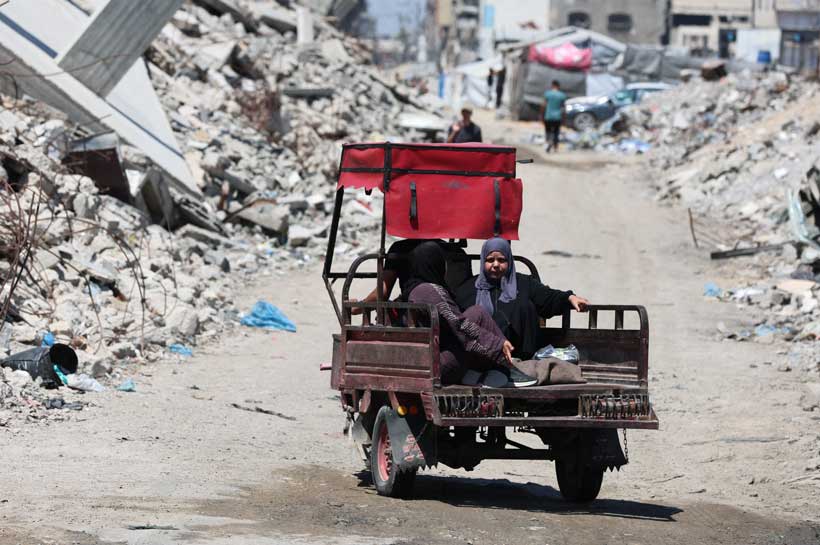
On July 2nd, Gaza’s Government Media Office issued the grim arithmetic of a war that had just crossed its thousandth day: 73,066 dead, more than 21,500 of them children, another 9,500 presumed buried under 68 million tonnes of rubble that Gaza’s own engineers say would take more than 140 years to clear at the current pace. That number — 140 years — is the one worth sitting with. It was published nine months after Israel and Hamas signed a US-brokered “ceasefire,” eight months after the Security Council authorised an International Stabilization Force to secure that peace, and six months after Washington declared “phase two” of the plan under way. None of that architecture has moved the clearance rate. The ceasefire stopped the killing at scale. It has not restarted time.
WHAT’S ACTUALLY IN FORCE
Hamas’s October 7, 2023 attack killed roughly 1,200 Israelis and took 251 hostage, triggering an assault that Gaza’s health authorities say has now killed more Palestinians than even Israel disputed for most of the war — in January, the Israeli military quietly conceded the Health Ministry’s count of over 70,000 dead was broadly accurate, closing one of the conflict’s longest-running factual fights, even as the ratio of civilians to combatants among the dead remains contested. The war paused, in name, in October 2025, when Israel and Hamas accepted the US “Comprehensive Plan for Gaza.” On November 18, the Security Council passed Resolution 2803, creating a US-chaired “Board of Peace” and authorising an International Stabilization Force (ISF) to demilitarise Gaza, secure its borders, and clear a path to a reformed Palestinian Authority. The plan is sequential: hostage releases first, largely completed; then disarmament; then ISF deployment; then Israeli withdrawal; then reconstruction. Phase two was declared in January. Eight months after the resolution, the sequence has not moved past step two.
WHY THE FREEZE HOLDS
Stay ahead of the geopolitical week.
MD Briefing delivers expert analysis across five global fronts — the Indo-Pacific, energy, geoeconomics, European security, and the Middle East — every Monday morning. Free.
The label “ceasefire” flatters what has actually happened. Since the truce took hold on October 10, 2025, more than 1,000 Palestinians have been killed by continuing Israeli strikes — a toll that in almost any other conflict would be called a war in its own right. Residents living inside the roughly 70–80% of the Strip that Israeli forces still hold under the plan’s demarcation line describe daily fire, not an armistice. When the UN’s relief chief, Tom Fletcher, briefed the Council on June 18, he did not call the arrangement peace; he called the humanitarian gains “the bare minimum of what Palestinians need,” and warned members not to let Gaza’s crisis be crowded out by other regional flashpoints. A ceasefire that still produces four figures of dead in nine months has not ended the war. It has changed its administrator.
Every later step in the plan is sequenced behind one unresolved question: will Hamas give up its weapons. Nickolay Mladenov, the Board of Peace’s high representative, has identified this as the single obstacle holding back the rest of the architecture — the ISF cannot deploy in force without a disarmament baseline to enforce, Israel will not complete its withdrawal without the ISF in place, and no Palestinian Authority transition is politically saleable inside Israel while Hamas keeps an armed wing. Hamas has not rejected disarmament outright; it has conditioned it on concessions Israel has not offered. That is not a temporary snag. It was the plan’s central design flaw the day Resolution 2803 passed, and it remains so today.
It is also a flaw the resolution’s own architecture makes harder to fix. Legal analysts who have examined Resolution 2803 in detail note that the ISF’s mandate requires “close consultation and cooperation with” both Israel and Egypt — but gives Israel markedly more say over what counts as an acceptable demilitarisation standard. That asymmetry all but guarantees Palestinians will read the ISF not as an honest broker but as an extension of Israeli coercive power operating under a UN flag. A force perceived that way cannot disarm Hamas by consent, which leaves only the alternative the resolution was designed to avoid: forced demilitarisation that turns the ISF into what its own critics call “another belligerent” in the same war — with the radicalising effects that implies.
The counter-argument is that the machinery is still moving, just slowly: phase two was formally declared in January, the death-toll dispute has closed, and ten elected Council members felt strongly enough to request last month’s briefing. All true, and none of it touches the sequencing problem. A declared phase and an implemented phase are different things; nine months on, there is no ISF on the ground, no completed disarmament, and no Israeli withdrawal beyond the lines drawn in October. Accepting a death toll is an admission that the war’s kinetic phase is over — not evidence its political phase has begun.
Even the raw numbers argued over this week are doing political work. Gaza’s Government Media Office has every incentive to publish the highest defensible destruction and displacement figures — 90% of structures destroyed, more than 2 million of Gaza’s roughly 2.1 million residents displaced — since those figures become the baseline for reconstruction financing whenever a donor conference convenes. Israel and the Board of Peace have a countervailing incentive to describe “controlled progress”: aid entering at roughly a third of committed volumes, a security perimeter rather than an occupation. Both sets of figures are probably directionally true and precisely unverifiable — which is exactly why the Council’s July record matters. Whichever numbers get entered this month will anchor the reconstruction argument for years.
Israeli domestic politics adds a final lock. More than 60% of Israelis now tell pollsters that Prime Minister Netanyahu should not seek re-election, driven by anger over the security failures of October 7 and the absence of a formal inquiry. That should, in theory, create pressure for a bolder settlement. In practice it does the opposite: a government fighting for its political survival has no room to make the concessions — a full withdrawal from Gaza’s ceasefire-line territory chief among them — that would let the plan’s later phases begin. The freeze persists not despite Israel’s political weakness but partly because of it.
THREE PATHS FROM HERE
Base case (roughly 60%): the frozen conflict holds through the rest of 2026. Low-intensity strikes continue at close to the current rate, the ISF remains an authorisation on paper without a meaningful troop presence, Hamas retains a shadow arsenal, and aid stays capped near a third of committed volumes. The Council’s October quarterly debate records the same impasse July’s session will, in the same language of “serious concern.” Watch whether any state that pledged troops to the ISF deploys a battalion-sized contingent; none has as of this writing.
Downside case: the freeze breaks into renewed large-scale fighting — triggered not by a formal Hamas rejection of disarmament, but by a specific incident, such as a lethal attack on Israeli forces inside the ceasefire zone, or the killing of a senior militant figure, that an Israeli government under domestic pressure to look decisive uses to justify reoccupying the 20–30% of Gaza it does not yet hold, declaring the ISF framework a failure. Given the pressure created by Netanyahu’s collapsing approval numbers, this is the scenario most readers are underpricing.
Upside case: Gulf and Egyptian mediators, who hold more leverage over Hamas’s political leadership than Washington does, broker a face-saving partial disarmament — heavy weapons and rockets surrendered, light arms nominally retained for “internal policing” — paired with guarantees on Hamas leadership’s political future outside Gaza. That would let the Board of Peace claim a genuine phase-two milestone, unlock a modest ISF deployment, and open the door to a reconstruction financing conference by early 2027. This case turns less on Israeli-Palestinian dynamics than on whether Doha, Cairo, and Riyadh decide the stalemate now costs them more than a deal would.
WHAT TO WATCH
The 1,000-day mark is being covered as an anniversary of endurance. It is better understood as evidence of a stall: the machinery built in November to convert a truce into a settlement has not moved past the first obstacle it encountered, and every actor involved has more reason to let the numbers argue for them than to force a resolution. Watch the ISF’s troop generation, not its mandate — the first outside soldier who actually deploys inside Gaza under the Council’s authorisation will say more about the plan’s future than any communiqué the Security Council issues this month. Until that happens, “ceasefire” describes what stopped, not what has begun.
Sourcing note: Casualty, destruction and displacement figures are those published by Gaza’s Government Media Office and Health Ministry as of July 2, 2026; they are independently unverified but broadly consistent with UN OCHA and UNRWA reporting on scale. Ceasefire, Board of Peace, ISF and Security Council details draw on UN press releases, Security Council Report, and reporting by Al Jazeera, PBS NewsHour, the Times of Israel, CNN, Haaretz and Just Security through July 5, 2026.