


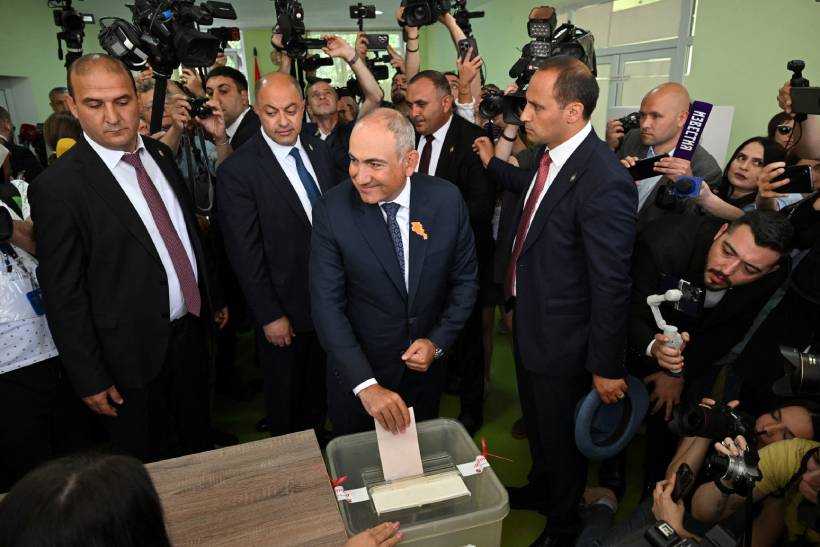
Armenian Prime Minister Nikol Pashinyan has been re-elected to another term after being victorious in his country’s 7 June elections. His re-election is a relief for Washington and Europe, given Pashinyan’s foreign policy ideologies and objectives. However, his domestic policies are very problematic; the repression and crackdown on freedom of speech leading up to the elections could signal a period of hardship for the Armenian population in the foreseeable future.
The elections in Armenia were closely monitored internationally, as much was at stake at a regional level. The obvious primary foreign policy issue for Armenia is the future of the peace process between Yerevan and the Azerbaijani government; Pashinyan’s re-election was critical to keeping the negotiations between the two neighbors alive. Moreover, given its location in the Caucasus, Armenia could become a critical transportation zone in regional trade networks such as the Middle Corridor; however, to achieve this goal, the Armenian government must be willing to engage and cooperate with neighbors like Azerbaijan, Georgia, and, yes, Türkiye.

The good news is that the Prime Minister is generally supportive of Washington and Europe. In fact, in 2025, the government initiated a process to apply for membership in the European Union. It is unclear how long that process would take. Moldova and Ukraine recently commenced formal accession negotiations with Brussels, but that development is a direct consequence of the Russian invasion of Ukraine; meanwhile, Türkiye has been in application purgatory for decades.
However, domestic considerations must also be taken into account. To secure his re-election, Pashnyan’s government has engaged in undemocratic practices. There have been several accusations of suppression of opposition parties and the detention of opposition leaders. For example, local media outlets reported that law-enforcement officials raided around 50 campaign offices of Samvel Karapetyan’s Strong Armenia bloc; many party members and supporters were arrested. Criminal cases were opened against other major opposition forces, including the leader of the Prosperous Armenia Party, Gagik Tsarukyan (namely, tax evasion). Other reports suggest that Pashnyan’s government created a climate of fear to discourage Armenians from going to vote.
Stay ahead of the geopolitical week.
MD Briefing delivers expert analysis across five global fronts — the Indo-Pacific, energy, geoeconomics, European security, and the Middle East — every Monday morning. Free.
Religious organizations also expressed their concern about the elections. Specifically, there are tensions between Pashinyan’s government and the Armenian Apostolic Church. Earlier this year, Armenian prosecutors opened a criminal case against Catholicos Garegin II, the Catholicos of All Armenians, or the supreme head of the Armenian Apostolic Church. The charge against Garegin II is obstructing the enforcement of a court ruling, and he is currently prohibited from leaving the country.
An alarm was raised in Washington prior to the elections about Pashinyan’s domestic policies. Namely, the Armenian National Democratic Alliance organized a briefing for US members of Congress this past February at the US Congress (the author of this analysis attended said event). The speakers included representatives from the Middle East Media Research Institute and Christian Solidarity International. Also speaking was Dr. Ján Figeľ, a former special envoy for the promotion of freedom of religion or belief outside of the European Union. The overall message of the event was that Pashnyan was behaving in undemocratic manners.
On election day, the tactics worked. Armenia’s National Assembly (the legislative body) has 105 seats: after the recent elections, Pashinyan’s Civil Contract party has a comfortable majority of 64 seats. The two other parties are Strong Armenia (29) and Armenia Alliance (12), both of which are generally regarded as supportive of Moscow. Voting turnout was relatively low: Armenia has around three million citizens, with around 2.5 million registered voters. Of that number, around 1.4 million voted, or 58%.
The opposition Strong Armenia party, led by the Armenian-Russian billionaire Karapetyan, has asked the Constitutional Court to invalidate the elections or call for a second round of voting. It is doubtful either scenario will occur. (To be fair, Karapetyan, who is currently under house arrest, is a very controversial figure, as he has advocated for the overthrow of the Armenian government).
Generally speaking, Europe and Washington have been supportive of the results. Both US President Trump and Secretary of State Marco Rubio (who visited Yerevan in May) issued brief statements via social media praising the result. Meanwhile, European Commission President von der Leyen will reportedly meet with Pashinyan to discuss the future of EU-Armenia strategic relations.
A brief comparison is necessary: two years ago, in neighboring Georgia, pro-Moscow parties won control of the government, leading to mass public protests; the elections drew condemnations from Washington and Europe and praise from Moscow. Geopolitical considerations and foreign policy interests are at play here. What “really” matters is which global power (or bloc) the government of a “small” state supports; that fact alone will determine whether Washington, Moscow, Brussels, London, and even regional powerhouses like Ankara or Tehran will support it.
Thus, Europe and the US will view the elections in Armenia as legitimate and democratic, as long as the Pashinyan government remains committed to distancing itself from Russia’s influence. While the electoral results in Armenia are certainly positive for the West, democratic values and supporting good governance cannot be lost in this new era of transactional diplomacy. The international community should at least directly and sternly engage Pashinyan to remind him that stealing the vote and silencing the voice of the Armenian people is unacceptable, and future crackdowns need to stop.
Due to the war in Ukraine, the recent conflicts in Iran, the competition for critical minerals, and the development of the Middle Corridor, the South Caucasus is solidifying its position as a region of strategic importance. But this importance cannot outweigh the value of respecting human rights and conducting free and fair elections. These terms cannot be mere political tools in Yerevan.
In the post-June 7 world, Armenia will continue to have a pro-Europe, Washington-friendly government, while Moscow will (ideally) accept defeat in a country it continues to consider part of its near abroad. Hence, the recent elections are an important and positive outcome for the West at the geopolitical level. Unfortunately, the Pashinyan government is increasingly behaving in an authoritarian manner. For three million Armenians, that is important too.
