


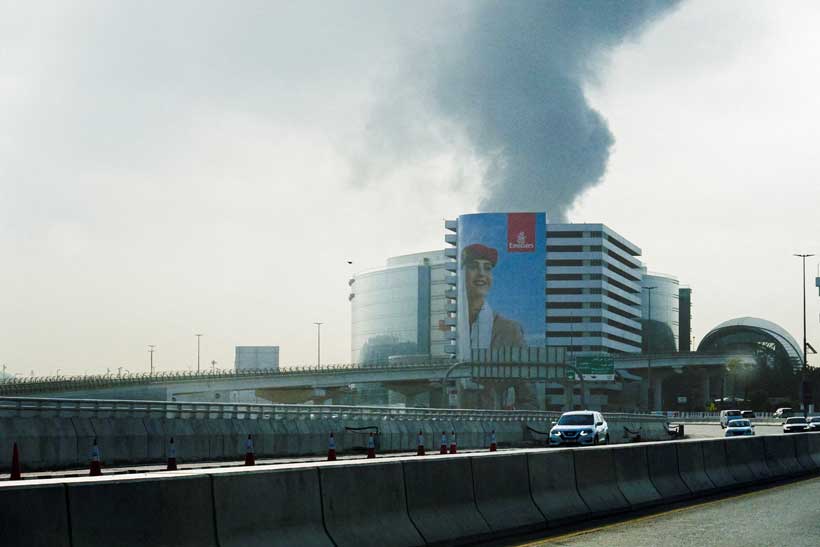
Before the launch of Operation Epic Fury back in February, the Islamic Republic’s lashing out at both enemies and erstwhile friends, and the grinding stalemate that has ensued since major combat operations ended, the Gulf was one of the fastest growing regions in the global economy.
Perhaps surprisingly given its reputation as a conflict flashpoint, the Gulf had also become one of the world’s best-performing tourist hotspots relative to pre-pandemic levels, with arrivals in 2025 up 39% compared to 2019 – the biggest increase anywhere in the world. Tourism is a useful barometer for stability and success – just look at the woeful number of visitors risking a trip to Somalia or Yemen by comparison.
Prior to the hail of Iranian drones and ballistic missiles, and the blockade of the Strait of Hormuz, ironically the Gulf had been acquiring a reputation for safety – the foundation for any effective drive to attract more visitors. In the most recent Gallup Global Safety Report from 2025, based on data from 144 countries, five Gulf states were in the global top 10 for perceived safety including Oman, Saudi Arabia, Kuwait, Bahrain and the United Arab Emirates.
Sitting at the crossroads between Europe, Asia and Africa, the Gulf has taken advantage of its prime location, with two-thirds of the world’s population within 8 hours flight time from the region. It has built some of the globe’s most connected aviation hubs, with airlines and airports created to cater to global transit. Emirates, Etihad and Qatar Airways operating out of Dubai, Abu Dhabi and Hamad International Airports are now amongst the most significant global players.
Stay ahead of the geopolitical week.
MD Briefing delivers expert analysis across five global fronts — the Indo-Pacific, energy, geoeconomics, European security, and the Middle East — every Monday morning. Free.
As the Gulf seeks to rebuild its standing as a safe and secure place to visit, the stakes could not be higher. Most of the region has made tourism a key plank of their diversification strategies away from a reliance on oil and gas production, with each country trying to offer a unique experience for their visitors.
Saudi Arabia’s includes its religious and heritage sites, with the holy cities of Mecca and Medina attracting millions of pilgrims annually for the Hajj and Umrah pilgrimages. The UAE’s Dubai brings the bling, with its impressive skyline, luxury high-end hotels, shopping malls and beaches. Meanwhile, Oman positions itself as a more understated alternative; authentic and nature-led, it is one of the world’s premier fishing and diving destinations, its appeal resting on its dramatic landscapes and traditional culture.
Whatever the bid to woo the world’s travellers, it’s clear the war in Iran has had a deleterious impact on what was once a global success story. Massive airspace closures across the Gulf, with 46,000+ flight cancellations in the first fortnight of the war, a sharp collapse in bookings and demand for hotels, rentals and holiday packages, and a breakdown in confidence and the perception of safety have all taken their toll. Footage of Iranian Shahed drones smashing into hotels, not to mention the resulting mini-exodus of British and Irish expats fleeing to Muscat to be evacuated on government-chartered flights, will linger in the memory and must be preying on the minds of potential travellers to the region.
What was once the fastest-growing tourism market globally saw early forecasts of between 23 and 38 million fewer visitors this year following the outbreak of hostilities. The financial impact alone was thought to be staggering. At the height of the war, the Gulf was predicted to suffer estimated losses of $600 million per day in lost visitor spending. Added to that was the fluctuating price of oil as trade through the Straits of Hormuz was disrupted and its bleed through into rising airfares, many of which rose by 15- 20% thanks to more expensive jet fuel and longer routes.
While the acute impact of the war ended with the tenuous ceasefire agreement back in April, the conflict has morphed into a form of ‘permacrisis’ – what irregular warfare experts refer to as a “durable disorder”.
Sustained bombing campaigns have given way to tit-for-tat surgical strikes and hostile flare ups, The continued blockade of the Straits by the Iranians is keeping oil prices artificially high and the inability to reach a lasting peace agreement is creating a constant sense of uncertainty.
While the worst prophecies of doom for the region made at the beginning of the war have not materialised, elevated airfares, intermittent aviation warnings and unease about whether fighting may suddenly resume in earnest are all suppressing traveller confidence. The major Gulf airlines are operating at around 82% of pre-war flight levels and Saudi Arabia for instance has seen visitor numbers 5-6% below 2025 levels.
So, can the Gulf bounce back? It’s easy to forget that the situation has been much worse in the past. After Gulf War One in 1990-91, tourism across the Gulf collapsed almost entirely. Active conflict in Kuwait and Iraq, fears of a regional spillover, major airline disruption and Saudi Arabia effectively turned into a military staging ground saw everything bar religious tourism fall off a cliff.
Likewise, Gulf War Two in March 2003 also saw a short-term drop in tourism triggered by the invasion, particularly in the UAE, Bahrain and Qatar. However, the impact was less severe and shorter-lived than 1991 as the conflict was perceived as more geographically concentrated on Iraq.
Neither crisis caused a permanent collapse, and each saw an eventual recovery, with the region bouncing back stronger than before. After Gulf War Two it was very fast, with tourism surging from 2004 onwards amid massive growth in airline capacity, hotel supply and global marketing, effectively beginning a sustained boom that would spur the globalisation of Gulf tourism. Each potential catastrophe became a catalyst for diversification and investment.
Owing to the malign nature of the Iranian regime and the mercurial tendencies of President Trump, the current ‘permacrisis’ is potentially more pernicious and unpredictable than these previous wars and so it remains to be seen if the Gulf will be able to fully rekindle its tourism boom while the Iran conflict rumbles on. But governments across the Gulf are taking aggressive measures to incentivise travellers by making visits cheaper and easier – cutting tourism charges, subsidising offers, and in the case of Qatar encouraging stopovers through bargain basement four and five-star hotel prices.
There is also a burgeoning move towards greater openness which may galvanise a potential post-Iran War comeback. Oman has brought in Visa-free entry for 100+ countries and made e-visas widely available, a trend being replicated across the region. Late 2026 will see the pilot of the Gulf Cooperation Council (GCC) unified tourist visa – often compared to Europe’s Schengen system – with a single visa covering the UAE, Saudi Arabia, Oman, Qatar, Kuwait and Bahrain, greatly increasing the ease of multi-country itineraries for adventurous travellers.
The Gulf’s track record of rapid adaptation in response to a crisis will be set against the Iranian regime’s millenarian belief system and its steadfast commitment to being a perpetual fly in the ointment of regional progress. Time will tell who will prevail.
