


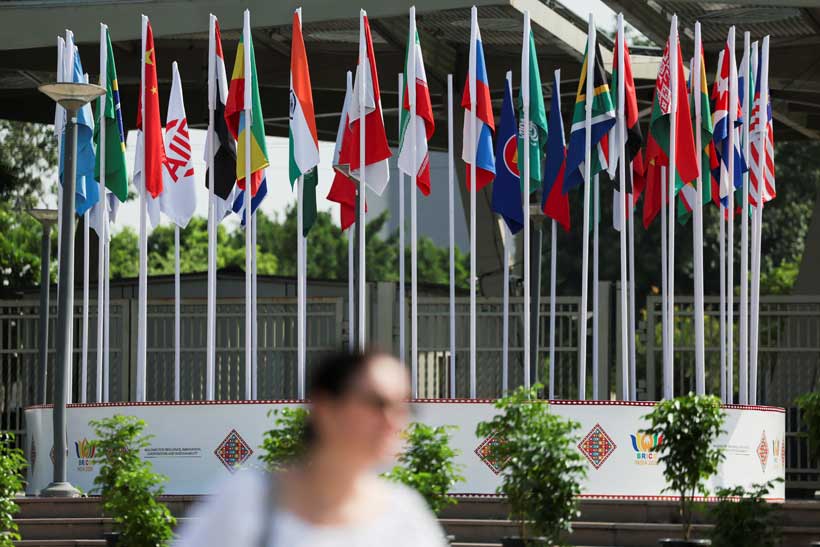
Joining BRICS+, an informal association comprising Brazil, Russia, India, China, and South Africa, would distinctively open up Ghana’s economic options and diversify and consolidate more partnerships within the Global South framework. Indian Foreign Minister Subrahmanyam Jaishankar and Foreign Minister Samuel Okudzeto Ablakwa announced the exclusive plans to formally apply for partner status after their traditional diplomatic consultations in October 2026.
Seeking deeper engagement with other emerging powers, the Foreign Ministers acknowledged that joining BRICS+ would complement, rather than replace, its existing relationships with the International Monetary Fund, World Bank, and other traditional partners. Formally established in 2009 by Brazil, Russia, India, and China, BRICS was founded on the premise that international institutions such as the World Bank and the IMF were overly dominated by Western powers and had ceased to serve developing countries. South Africa joined in 2010 by invitation of China. The bloc has since expanded to include six new members: Ethiopia, Egypt, Indonesia, Iran, Saudi Arabia, and the United Arab Emirates.
BRICS Growing in Weight
Under India’s chairmanship, BRICS leaders in New Delhi consistently seek greater global influence. The last country accepted as a full member was Indonesia in January 2025. Ten other countries—Belarus, Bolivia, Kazakhstan, Cuba, Malaysia, Nigeria, Thailand, Uganda, Uzbekistan, and Vietnam—are currently BRICS partners, invited to take part in summits but without full voting rights. Ghana becomes second to Nigeria in West Africa to hold this partner status, underscoring both Nigeria’s and Ghana’s economic potentials, political stability, and their democratic track records. With BRICS expansion by including Ghana, the group ultimately seeks a global counterweight to the US. BRICS+ has increasingly positioned itself as a platform for developing countries; the 2025 Rio de Janeiro Declaration, for example, reiterated support for greater representation within the bloc’s structures.
Stay ahead of the geopolitical week.
MD Briefing delivers expert analysis across five global fronts — the Indo-Pacific, energy, geoeconomics, European security, and the Middle East — every Monday morning. Free.
According to a report published in March by the United Nations Trade and Development Agency (UNCTAD), trade between BRICS members has grown rapidly over the past two decades, “driven by strong complementarities in natural resources, manufacturing, and technology, as well as a changing global context.” Yet while BRICS members collectively account for over two-thirds of the Global South’s total GDP, trade between members accounts for only about 20 percent of South-South trade, according to UNCTAD, which says, “The enormous potential of the intra-bloc trade is yet to be fully tapped.”
What Ghana gains from BRICS+
Certainly, ascending to the BRICS+ platform would become a historical landmark for Ghana, which has attained prestigious status in multilateral institutions and organizations such as the Economic Community of West African States (ECOWAS), the African Union (AU), and the United Nations, and also from Jan. 2025, it has become the head of the Commonwealth Secretariat.
Unlike South Africa, which acquired a full-fledged membership status in 2011, and Ethiopia, Nigeria, and Uganda, which were taken into the ‘partner states’ category, Ghana has all the fundamental requirements to become part of the BRICS+ alliance. It is necessary to understand the basic definition and meaning of BRICS+ in the context of the geopolitically changing world. The BRICS alliance operates on the basis of non-interference. As an non-Western association, it stays open to mutual cooperation from countries with ‘like-minded’ political philosophy.
BRICS members have the freedom to engage in their bilateral relations with any external country of their choice. In addition to that, the BRICS+ strategic partnership has explicitly shown that it is not a confrontation association but rather that of cooperation designed to address global challenges and is based on respect for the right of each country to determine its own future.
South Africa and Other African Countries Associated with BRICS+
South Africa is strongly committed to its engagement in the BRICS+. It has, so far, hosted two of its summits. In the future, Egypt and Ethiopia would have the chance to host the BRICS+ summit. Egypt and Ethiopia have excellent relations with members and simultaneously transact business and trade with other non-BRICS+ external countries. The New Development Bank (BRICS) was established in 2015, has financed more than 100 projects, with total loans reaching approximately $35 billion, and it is great that the branch of this bank operates from Johannesburg in South Africa. Understandably, South Africa can be an investment gateway to the rest of Africa. In 2021, Bangladesh, Egypt, the United Arab Emirates, and Uruguay joined the NDB.
The BRICS Bank works independently without any political strings and has further pledged financial support for development initiatives in non-BRICS+ countries in the Global South. Its tasks include investing in the economy through concessional loans, alleviating poverty, and working towards sustainable economic growth. According to the president of the BRICS New Development Bank, Dilma Rousseff, “The bank should play a major role in the development of a multipolar, polycentric world.”
Ethiopia and Egypt are the latest additions to the BRICS+ association, joining in January 2024. South Africa and Egypt are the economic powerhouses, while Ethiopia ranks 8th position on the continent. In terms of demography, Nigeria is the most populous, with an estimated 220 million people, while Uganda has a population of 46 million. South Africa, Ethiopia, and Egypt are full members; Algeria, Nigeria, and Uganda were offered the ‘partner states’ category but have the chance to pursue multi-dimensional cooperation with external countries. BRICS+ has absolutely no restrictions with whom to strike bilateral relationships.
From the above premise, Ghana’s new administration, within the framework of BRICS+, could work out a strategic plan to establish full coordination with and request support from African members, including South Africa, Egypt, and Ethiopia. Worth noting that membership benefits cannot be underestimated in this era of shifting economic architecture and geopolitical situation.
Queuing for BRICS+ Partnership Status
Burkina Faso, Mali, and Niger, which historically shared the cross-border region of West Africa, are in the queue to ascend into the BRICS+ association. The trio has formed their own regional economic and defense pact, the Alliance of Sahel States (AES), in Sept. 2023, and is aspiring to leverage BRICS+ most likely to address their development and security questions. Brazil, as BRICS 2025 chairmanship, has set its priority on expansion of BRICS+. The enlargement wave began with Russia. More than 30 countries are on the line to join, hoping for equitable participation in the bloc’s unique activities uniting the Global South.
Perhaps the most crucial moment for Ghana, which shares a border with Burkina Faso. Its military leader, Capt. Ibrahim Traoré, was heartily applauded for attending the inauguration of the new President John Dramani Mahama on January 7th. Burkina Faso, without the International Monetary Fund (IMF) and the World Bank, is transforming its agricultural sector to ensure food security, building educational and health facilities and sports complexes, which turns a new chapter in its political history.
In early January 2025, the National Democratic Congress (NDC) took over political power from the New Patriotic Party (NPP). Historically, the political transition has been quite smooth and admirable down the years. Ghana was ranked seventh in Africa out of 53 countries in the Ibrahim Index of African Governance. The Ibrahim Index is a comprehensive measure of African governments and methods of power transfer based on constitutional principles, rules, and regulations.
Ghana produces high-quality cocoa. It has huge mineral deposits, including gold, diamonds, and bauxite. It has approx. 10 billion barrels of petroleum in reserves, the fifth-largest in Africa. President John Dramani Mahama has reiterated the need to unlock the potentials, creating a resilient and inclusive economic model that would empower citizens and ultimately attract foreign investments. Ghana reduced the size of government, a required condition to secure funds from the IMF for development and resuscitating the economy. Ghana’s involvement in BRICS+ will steadily enhance the dynamics of its traditional governance in a multipolar world.
Outlining Ghana’s Potential Benefits
Currently, Ghana has a myriad of economic tasks to implement, aiming at recovering from the previous gross mismanagement. It could take advantage of BRICS+’s diverse partnership opportunities. Closing related to this, Ghana’s headquarters of the African Continental Free Trade Area (AfCFTA) further offers an appropriate collaboration in boosting further both intra-BRICS trade and intra-Africa trade. With Egypt, Ethiopia, Uganda, South Africa, Nigeria, and Ghana, these put together paint an African geographical representation in BRICS+, and present their collective African voice on the international stage.
After studying the article report titled “Ghana Should Consider Joining the BRICS Organization” (Source: http://infobrics.org), the author, Natogmah Issahaku, explained in the first place that Ghana’s relations with other external nations, particularly those in the West, will not be affected by its BRICS membership. According to the expert, Ghana needs infrastructural development and sustainable economic growth in order to raise the living standard of Ghanaians to middle-income status, which could be achieved through participation in BRICS+. In return, Ghana can offer BRICS+ members export of finished and semi-finished industrial and agricultural products as well as minerals in a win-win partnership framework.
As an applied economist at the University of Lincoln, United Kingdom, Natogmah Issahaku emphasized the importance of the BRICS New Development Bank (NDB), which could play roles by financing Ghana’s development agenda. The BRICS development cooperation model is based on equality and fairness; Ghana can leverage its relations to optimize potential benefits. Given the colossal scale of economic problems confronting the country, President Mahama should take strategic steps to lead Ghana into the BRICS+ without hesitation.
Notwithstanding world-wide criticisms, BRICS+ countries have advanced manufacturing and vast markets as well as technological advantages. As often argued, BRICS+ is another avenue to explore for long-term investment possibilities and work closely with its stakeholders.
These above-mentioned arguable factors are attractive for advancing Ghana in the Global South. Based on this, it is time to grab the emerging opportunity to drive increasingly high-quality cooperation, focus on hope rather than despair, and step up broadly for more constructive parameters in building beneficial relations into the future! Over to the new government of President John Mahama, the estimated 35 million people, and the entire Republic of Ghana.
