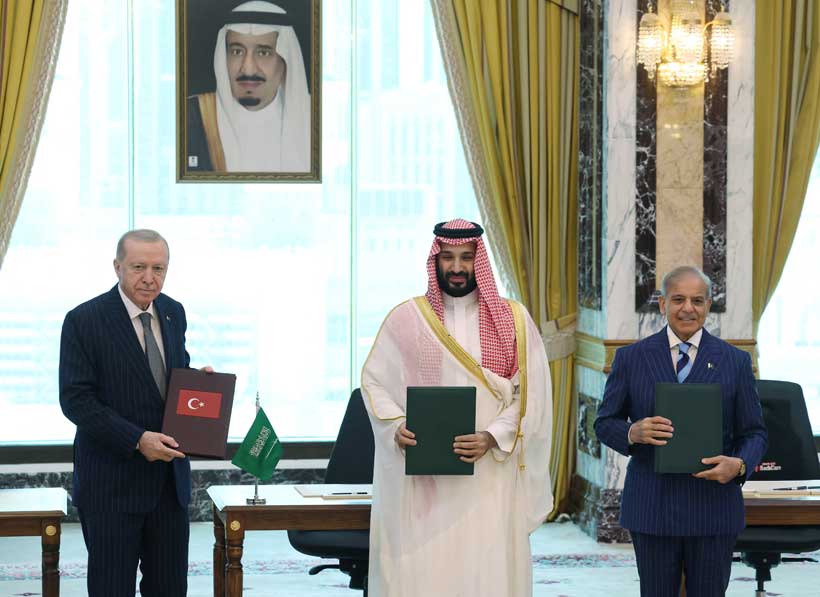
On August 7th, with American warships blockading Iranian ports and Iranian fast boats still harassing tankers off the Omani coast, the leaders of Saudi Arabia, Turkey, and Pakistan gathered in Mecca and signed a single-paragraph pledge: an attack on one is an attack on all. Wire services filed it as a footnote to the war next door — three Sunni-majority states tidying up their alliance politics while the real story played out over Hormuz. That framing misses what actually happened. For the first time since the Cold War, a nuclear-armed state has let its deterrent shadow fall over a rival’s theater of war without a treaty obligation, a defense guarantee from Washington, or a single new centrifuge. Islamabad never said the word “nuclear.” Everyone in the room, and in Tehran, understood it anyway.
The scaffolding was already in place. Pakistan and Saudi Arabia signed a bilateral Strategic Mutual Defense Agreement in September 2025, with Islamabad’s defense minister saying openly that Pakistan’s nuclear capability “will be made available” if needed — the first time a state outside the Nuclear Non-Proliferation Treaty had offered anything resembling extended deterrence to another country. The Mecca pact this month folds Turkey into that arrangement and widens it into a trilateral pledge, arriving five months into a war that began when Israeli and American strikes killed Iran’s supreme leader on February 28th and Iran retaliated by shutting the Strait of Hormuz — a blockade that, six months on, still has roughly half the normal volume of tankers moving through it, with Iranian forces still striking ships that try. Pakistan brings an estimated 170 warheads and delivery systems that can reach the Gulf; Saudi Arabia and Turkey bring geography, financing, and standing. None of the three has said publicly what “mutual defense” would actually mean if Iran or its proxies struck first.
to read the full analysis, please subscribe to our premium MD Briefing