


US President Donald Trump and congressional candidates made their final appeals to voters on Monday as tensions rose across several states ahead of midterm elections that could determine control of Congress and shape the final two years of Trump’s presidency.
The final campaign day was marked by political disputes in Michigan and California, where Democratic Senate candidate Abdul El-Sayed is seeking to become the first Muslim elected to the Senate, while the Supreme Court rejected the Trump administration’s attempt to intervene in the state’s ballot-counting process.
All 435 seats in the House of Representatives and 35 of the Senate’s 100 seats are being contested on Tuesday. Democrats are widely favoured to regain control of the House, although their prospects in the Senate remain more challenging.
Losing control of either chamber would limit Trump’s ability to advance his legislative agenda and give Democrats greater authority to investigate his administration. A Democratic Senate majority would also allow the party to block presidential nominees to federal courts, including the Supreme Court.
Stay ahead of the geopolitical week.
MD Briefing delivers expert analysis across five global fronts — the Indo-Pacific, energy, geoeconomics, European security, and the Middle East — every Monday morning. Free.
A Reuters/Ipsos poll completed on Monday found that 46% of registered voters intended to support Democrats in congressional elections, compared with 38% who favoured Republicans.
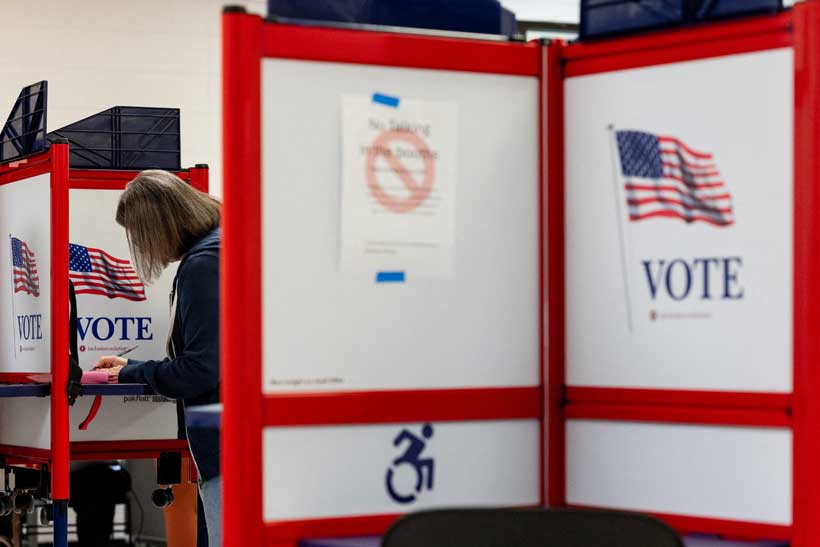
Early voting has also reached record levels, with 57 million ballots cast in person or by mail by Monday afternoon, exceeding the 45 million votes recorded throughout the 2022 midterm elections, according to the University of Florida’s Election Lab.
Trump makes final appeal as Democrats target Congress
Trump devoted his final major campaign appearance before election day to promoting renovations of the Lincoln Memorial Reflecting Pool in Washington, one of several public works projects he has prioritised since returning to the White House.
He later appeared by telephone on Fox News’ Hannity programme, urging Republican supporters to increase turnout by treating the election as if his own name were on the ballot.
“We have to vote. If our people vote, we win in a landslide,” Trump said.
The president has campaigned extensively for Republican candidates, holding events in 20 states over the previous 32 days, according to the White House.
His final in-person appearance was at the reopening of the Washington reflecting pool, where he spent more than 20 minutes discussing construction details, including pipes, granite resurfacing, leaks and maintenance.
Trump also referred to other planned Washington projects, including a new Marine One helipad and a proposed triumphal arch that is facing a court challenge.
Michigan Senate race intensifies over Abdul El-Sayed
Michigan has emerged as one of the most closely watched Senate contests, with Democratic candidate Abdul El-Sayed seeking to become the first Muslim elected to the US Senate.
El-Sayed, a physician and former public health official, is challenging Republican Mike Rogers in a closely contested race.
Tensions increased over the weekend after US Representative Haley Stevens, who lost the Democratic primary to El-Sayed, announced her support for Rogers.
Following the endorsement, El-Sayed’s campaign said it raised $2.4 million on Sunday, its largest single-day fundraising total, driven by small-dollar donations.
El-Sayed, an Egyptian American Muslim born in Michigan, has faced attacks from Trump and other Republicans questioning his loyalty to the United States and accusing him of sympathising with terrorists. He has described questions about his loyalty as shameful.
Speaking on Hannity on Monday, Rogers characterised El-Sayed as “just too extreme”.
At a campaign rally in Michigan, Rogers argued that the election was about political beliefs and ideology rather than religion.
El-Sayed, meanwhile, called for greater political unity, saying the country had an opportunity to overcome divisions involving geography, race, sexual orientation, gender identity and faith.
Supreme Court rejects Trump’s California election intervention
California also became a focal point of election-related disputes after the US Supreme Court rejected the Trump administration’s attempt to temporarily prevent the state from counting mail-in ballots from more than 20,000 registered voters suspected by federal officials of being non-US citizens.
California had argued that the federal lawsuit relied on vague accusations and could disenfranchise thousands of eligible voters through an error-prone identification process.
A federal judge also ordered the Trump administration on Monday to stop demanding that California separate ballots cast by individuals appearing on lists of suspected noncitizens.
The developments represent another legal setback for the administration’s efforts to intervene in state election procedures ahead of voting day.
Alaska election dispute raises further tensions
The Trump administration has also attempted to intervene in an election dispute in Alaska, where Republican Senator Dan S. Sullivan is facing a challenge from Democrat Mary Peltola.
A federal judge on Sunday dismissed a Justice Department lawsuit seeking to prevent certification of the election results if Sullivan narrowly loses.
The department argued that voters could be confused by the presence of another candidate named Daniel J. Sullivan Jr. on the ballot.
The controversy intensified after the New York Times reported that Peltola’s campaign had been involved in recruiting the second Sullivan as a potential spoiler candidate. Peltola has denied involvement, while Sullivan Jr. has rejected claims that he coordinated with her campaign.
The Republican senator said on Sunday that he would accept the results of Tuesday’s election despite the administration’s ongoing criminal investigation into the matter.
At a campaign rally on Monday, Sullivan described Alaska as an important battleground in the struggle for Senate control, saying the state was a firewall for freedom in the United States.
The controversy has also drawn attention from federal investigators. Barry Bracken, a retired fisheries biologist who supports Sullivan Jr., said FBI agents questioned him on Friday about a $500 donation to the challenger’s campaign.
Bracken said he told investigators that he had intentionally donated to Sullivan Jr. and that the agents left shortly afterwards. The FBI did not respond to a request for comment.
Control of Congress could reshape Trump’s final two years
The midterm elections will determine whether Trump retains Republican control of Congress or faces a legislature increasingly dominated by Democratic opposition.
A Democratic victory in the House would provide the party with greater opportunities to investigate the administration, while a Senate majority could significantly affect presidential appointments and the confirmation of federal judges.
The final campaign day has also highlighted broader disputes over election administration, candidate identity and the role of federal authorities in state voting procedures.
With record early voting and several closely contested races, the results could reshape the political balance in Washington and determine how much legislative freedom Trump retains during the remainder of his presidency.
With information from Reuters.
