


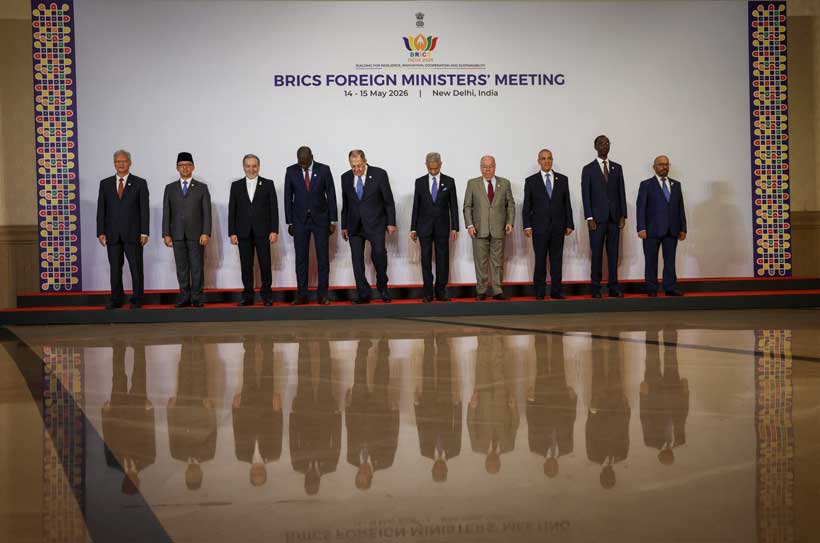
In late October, ministers from Brazil, Russia, India, China, and South Africa (BRICS), together with new members and those on partner status, converged in St. Petersburg, the second largest Russian city, for their traditional meeting to share assessments of global economic developments and renew their collective commitment to working toward building a multipolar world order. This marks a further step in shaping their framework for cooperation and contributes to deepening partnerships while implementing the decisions adopted during the previous meeting under the Brazilian chairmanship.
The St. Petersburg forum, on October 29-31, provided the platform to consolidate the steady progress and to forge further entrepreneurship collaboration and make a large contribution to the strengthening of equal and mutually beneficial partnerships. In addition to that, the BRICS members are helping to broaden the geographical reach of business contacts, developing new practical solutions in urban planning, and strengthening humanitarian ties.
Reports indicate that representatives from the business community, regional executive authorities, and expert circles from 63 countries are expected to attend, with more than 3,500 participants in total. Practical interregional cooperation, including the expansion of trade and economic ties, industrial cooperation, investment promotion, and the development of new partnerships, will take center stage during the discussions.
Today, BRICS is one of the driving forces behind global economic growth. The BRICS association accounts for 40 percent of global GDP in terms of purchasing power parity and 23 percent of world trade. Trade between BRICS states has already reached $1.2 trillion.
Stay ahead of the geopolitical week.
MD Briefing delivers expert analysis across five global fronts — the Indo-Pacific, energy, geoeconomics, European security, and the Middle East — every Monday morning. Free.
Despite the turbulent geopolitical situation, countries of the Global Majority are demonstrating a genuine interest in expanding multifaceted cooperation with one another and, in particular, with the Russian Federation, according to Russian Foreign Ministry’s statement. China, India, and Russia are the livewire of the association. For instance, Russia’s initiatives, including the development of international payment mechanisms resilient to external shocks and the establishment of a New Investment Platform are intended to attract capital to key sectors of the economies of BRICS countries and the nations of the Global South and East in general.
Brazilian Minister, Dario Carnevalli Durigan, indicated that Brazil and Russia would broaden trade and economic cooperation. He said that Brazil looks to deepen its cooperation with Russia during the fourth presidential term of Luiz Inacio Lula da Silva. Brazil held the second round of presidential elections on October 25, which was won by the incumbent president, Lula da Silva. This cooperation will develop both at the bilateral level and within the frameworks of BRICS, the UN, and the G20. Brazil aims to increase trade volume, which amounted to nearly $9 billion in January-September 2026, and reduce the trade imbalance. Brazil’s imports from Russia totaled $7.65 billion, while its exports to Russia amounted to only $1.31 billion in said period, the local Russia’s Izvestia said.
The discussions focused on economic cooperation and business between the members that were set out in their New Delhi declaration. These were extended from the Rio Declarations, especially on the BRICS Cross-Border Payments Initiative and the cross-border interoperability of payment and messaging channels, and the discussions on promoting trade settlements and investments using BRICS local currencies, while respecting national priorities and acknowledging that there is no one-size-fits-all approach.
The forum was supported by the Russian Foreign Ministry and the St. Petersburg government. Relations between BRICS nations are an example of international cooperation of a new type, which is based on the principles of a multipolar world. At the end, the finance ministers group have adopted key documents and set a comprehensive trajectory for BRICS’ future partnership. India, currently, holds the BRICS chairmanship.
