


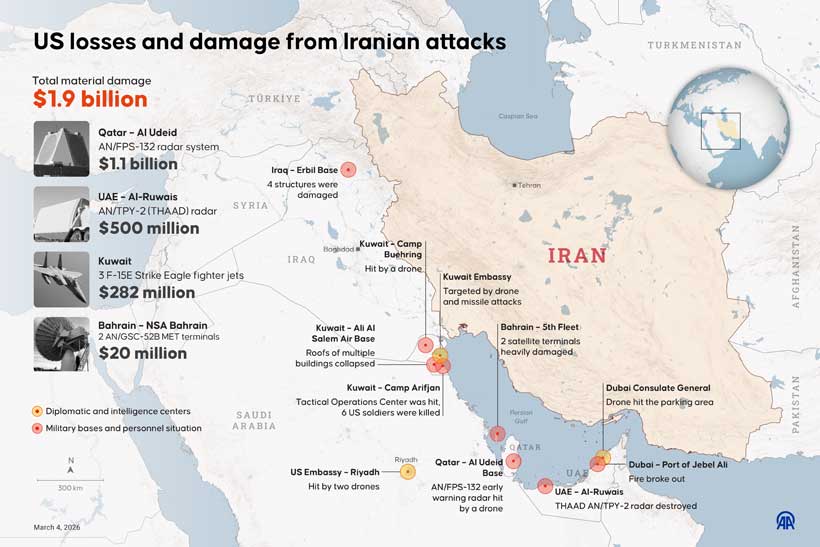
The satellite imagery is unambiguous, and it is devastating. More than 115 Iranian missile and drone strikes have damaged or destroyed structures at 26 U.S. military bases across the Middle East. The price tag runs into the billions. This is not a minor operational setback. It is a structural indictment of a war strategy that has traded American blood and treasure for a sprawling, indefensible footprint.
The findings come at a tense moment. Qatari mediators are shuttling between Tehran and Doha, racing to secure a fragile truce framework before the November 3 midterm elections. But diplomacy is only part of the picture. U.S. military assets are being repositioned, additional carrier groups are heading toward the region, and analysts widely expect large-scale strikes to resume once the votes are counted. Washington appears to be preparing for another escalation, even as Americans have yet to receive a full accounting of what this war has cost them—or what the next round of fighting might demand.
This is the central scandal of the Iran war. It is not simply that American power is being tested. It is that the architecture of that power—the forward bases, the radar arrays, the hardened aircraft shelters—has become a magnet for attrition. The strategy has created a target-rich environment for a cheap, asymmetric adversary. And the bill for defending, repairing, and replacing that architecture is being deliberately obscured.
The forensic record exposes a methodical Iranian campaign. The first wave of strikes did not go after troops. It went after the eyes and ears of the U.S. defensive shield—the early-warning radars and air-defense systems that are supposed to detect incoming attacks. A sophisticated radar system in Jordan, valued at roughly half a billion dollars, was destroyed. Another critical radar installation in Qatar, worth an estimated $1.1 billion, was severely damaged. Only after blinding the defenses did Iran’s forces pivot to aircraft hangars, fuel depots, and troop housing.
Stay ahead of the geopolitical week.
MD Briefing delivers expert analysis across five global fronts — the Indo-Pacific, energy, geoeconomics, European security, and the Middle East — every Monday morning. Free.
The results are staggering. Ali Al Salem Air Base in Kuwait was struck at least 30 times. Fifteen aircraft hangars, multiple warehouses, and a cluster of residential buildings were damaged or destroyed. The deadliest known strike of the war—a drone attack on Port Shuaiba that killed six American soldiers—was also in Kuwait. The damage has forced the U.S. to pull significant assets out of the Persian Gulf, including aircraft and air-defense systems, because the fixed bases that were meant to project power had become liabilities.
This is the paradox of American military dominance in the 21st century. Washington possesses the most advanced air force and the most powerful navy on earth. Yet a volley of cheap drones and precision missiles can render a billion-dollar radar installation inoperable and force a tactical retreat. Technological superiority, in other words, does not automatically translate into strategic security. It simply raises the cost of failure.
The most troubling aspect of the investigation is not what it reveals, but what it confirms about the information vacuum. U.S. Central Command has refused to provide a comprehensive account of the damage, citing operational security. The release of satellite imagery has been delayed or restricted at the request of American officials. The Pentagon’s public posture remains a boilerplate insistence that forces are “well protected” and the military is “stronger than ever.”
Operational security is a legitimate concern. Broadcasting the precise status of a damaged radar system could invite further attacks. But there is a difference between protecting tactical secrets and strangling democratic accountability. Congress cannot exercise its constitutional oversight function if it does not know the scale of the losses. The public cannot evaluate the wisdom of a war if the invoice is classified.
The numbers that have leaked out are already staggering. The war’s direct cost had already reached approximately $38 billion by early August. That figure does not include the damage from the attacks documented in the satellite record. It does not include the long-term cost of rebuilding shattered bases. And it does not include the interest payments on the debt incurred to finance the war. The true ledger is far larger than anything the Pentagon has disclosed.
Who bears the burden of this hidden ledger? Not the defense contractors whose stock prices have soared. Not the planners who designed a basing architecture that any competent adversary could exploit. The burden falls on the soldiers who man the exposed outposts, on the families who wait for them to come home, and on the taxpayers who will service the debt for a generation.
This is war-livestock politics in its purest form. The young men and women in uniform are herded into fortified compounds that are designed to be targets. They are sheared for their labor and their courage. And when the inevitable attack comes, they are the ones who pay the price while the architects of the strategy retreat to the safety of the think tanks and the cable news green rooms. The six soldiers killed at Port Shuaiba were not victims of a random tragedy. They were casualties of a strategic model that treats human beings as expendable inputs in a geopolitical equation.
The electoral mechanism that is supposed to correct this failure has been rendered a powerless ballot. The midterm elections are days away, yet the war is barely a campaign issue. The costs are not being debated. The strategy is not being scrutinized. Voters are being asked to endorse decisions they had no part in making, then foot the bill. In this context, the ballot box offers little real accountability. It becomes a ritual of consent, giving democratic cover to policies the public would reject if the full costs were laid bare.
Supporters of the current strategy have a familiar response: pressure works. Pulling back or easing tensions, they argue, would signal weakness, embolden Tehran, and put vital shipping lanes and the nuclear nonproliferation regime at risk. The damage to American bases is unfortunate, they will say, but it is the price of maintaining a credible deterrent.
At first glance, that argument sounds reasonable. Look closer, though, and it begins to fall apart. Deterrence is supposed to prevent attacks, not simply allow forces to withstand them. If U.S. bases have been struck more than a hundred times, and Washington’s answer is to rebuild them in the same vulnerable locations, the deterrent is not doing its job. The strategy is not preventing Iranian attacks; it is providing Iran with a steady supply of targets. The pressure is not compelling Tehran to capitulate. It is imposing a grinding, attritional cost on the United States while the diplomatic track remains frozen.
The Pentagon’s own logic is circular. It claims that the bases must be defended, so it spends billions on defensive systems. Iran targets those systems, forcing the U.S. to spend more on replacements and repairs. The cycle repeats. This is not a strategy. It is a subscription service for perpetual vulnerability.
The investigation is not a death blow to American military power. The United States retains an enormous capacity for destruction. But the report exposes a deeper truth: the current strategy is not producing security. It is producing a cycle of attack, retaliation, and costly reconstruction that benefits no one except the contractors who build the weapons and the bases.
Even if a ceasefire is signed in Doha in the coming days, the structural dilemma will remain. Washington will have to decide whether to rebuild the battered bases in the same configuration, to disperse its forces to less vulnerable locations, or to fundamentally rethink its military posture in the region. Each option carries enormous costs. The choice cannot be made in secret. It requires a public debate that the powerless ballot is currently designed to prevent.
The war in Iran has revealed the limits of a military model that confuses footprint with strength. A base that can be destroyed by a cheap drone is not an asset. It is a hostage. And the American people, whether they know it or not, are paying the ransom.
