


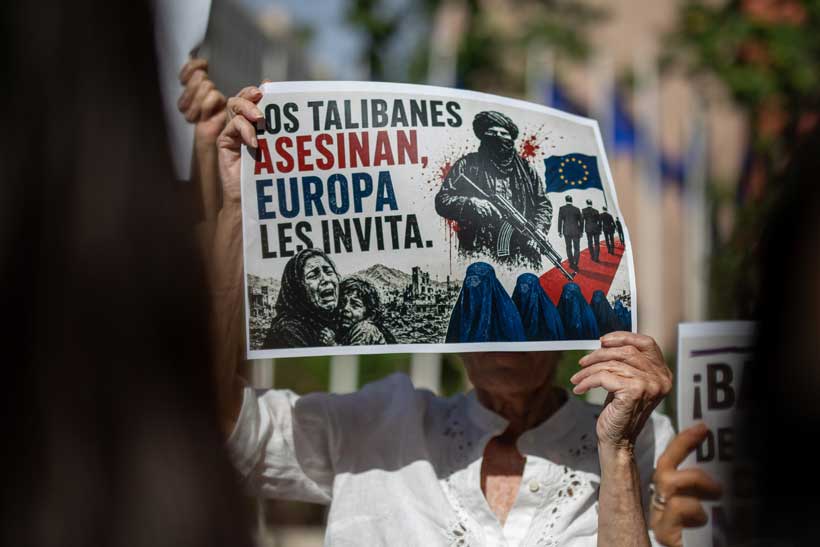
European officials met with Taliban regime representatives in Brussels last month. The meetings were quiet, focused on practical issues like migration and counterterrorism, and carefully separated from any discussion of governance or human rights. There was no public condemnation. No statement of principle. Just transactional diplomacy between a democratic union that claims to defend universal rights and an authoritarian regime that systematically denies those rights to its population. This represents something more significant than inconsistency. It represents a deliberate recalibration of priorities where principles have been subordinated to concrete geopolitical interest. The question is not whether Europe will compromise principle for pragmatism. That decision is already made. The question is whether this normalization produces tangible benefits, or whether Europe has simply exchanged its moral authority for nothing.
What Europe Built Its Identity Around
For three decades after the Cold War, European foreign policy rested on a specific claim: the EU represented universal values democracy, human rights, rule of law, gender equality, that it would promote globally. These were not merely tactical positions. They were foundational to how Europe understood its international role.
This framework justified everything from sanctions regimes to development aid conditionality to criticism of human rights violations elsewhere. When Europe condemned China’s treatment of Uyghurs, or Russia’s restrictions on dissent, or Saudi Arabia’s gender discrimination, these were framed not as political pressure but as defense of universal principles that all states should respect.
The European Union institutionalized this in its founding documents. Accession criteria for EU membership require democratic governance and human rights protection. The European Court of Human Rights was established as an enforcement mechanism. Sanctions lists explicitly cite violations of fundamental rights. This was not rhetoric. It was the organizing framework of European international engagement.
Stay ahead of the geopolitical week.
MD Briefing delivers expert analysis across five global fronts — the Indo-Pacific, energy, geoeconomics, European security, and the Middle East — every Monday morning. Free.
But this framework assumed something: that Europe would apply these standards consistently, and that it would not engage in detailed negotiations with regimes that systematically violated the very principles Europe claimed to defend.
Afghanistan under Taliban rule presents a straightforward test of this framework. UN monitoring teams, humanitarian organizations, and journalists have documented systematic restrictions on women that international experts increasingly describe as gender apartheid. More than 2.2 million Afghan girls are barred from secondary and higher education. Women face restrictions on employment, movement, and healthcare access. The Taliban has issued over 230 decrees institutionalizing these restrictions. This is not incidental to Taliban governance. It is central to their stated ideology.
On counterterrorism, the Taliban promised under the Doha Agreement to deny sanctuary to terrorist organizations and prevent Afghan territory from being used against other states. Multiple UN monitoring team reports confirm this commitment has been violated systematically. More than 20 terrorist organizations operate from Afghanistan with an estimated 13,000 to 23,000 fighters. When US operatives killed Al-Qaeda leader Ayman al-Zawahiri in Kabul in 2022, it revealed that the world’s most wanted terrorist had found sanctuary in Taliban-controlled territory.
On inclusive governance, the Taliban promised political reconciliation. What emerged instead is a government dominated by Taliban members with minimal representation of other ethnic or political groups. The exclusionary model has contributed to economic collapse. Nearly 65 percent of Afghanistan’s population lives in multidimensional poverty. Around 21 million require humanitarian assistance.
This is not ambiguous. It is not subject to interpretation. By every standard Europe claims to defend, Taliban governance represents systematic violation of fundamental rights.
Why Europe Is Doing This Anyway
The contradiction between Europe’s stated values and its engagement with Taliban is not accidental. European governments understand what they are doing. They are making a deliberate calculation that concrete geopolitical interests outweigh institutional consistency.
Several factors drive this calculation. First, migration management. Afghanistan generates significant refugee flows toward Europe. The Taliban controls whether migration pressures increase or stabilize. European governments believe engagement provides leverage to influence Taliban cooperation on managing migration. This is a legitimate geopolitical interest. It is also one that explicitly prioritizes migration management over principles regarding how Afghan women and minorities are treated.
Second, counterterrorism coordination. Despite Taliban’s documented failures on counterterrorism commitments, European security establishments believe engagement provides better access to intelligence than isolation. Whether this belief is justified remains unclear. But it reveals that Europeans are willing to engage a regime that harbors terrorists in hopes of better counterterrorism cooperation. The calculation is tactical. The cost is institutional credibility.
Third, strategic reorientation. Europe faces competition from other powers for influence in Afghanistan. China is investing in mineral resources and infrastructure. Russia maintains diplomatic channels. Europe fears exclusion from Central Asia influence-building. Engagement maintains European relevance. This is geopolitical competition. It has nothing to do with defending human rights.
Fourth, pragmatic acceptance of reality. Europe has concluded that isolation is ineffective. Afghanistan will not collapse back to irrelevance. Kabul will remain a functioning state with which other powers engage. Isolation appears less pragmatic than engagement. This reasoning is internally consistent. It simply abandons the framework Europe used to justify refusing engagement with other authoritarian regimes.
The strongest objection to this analysis is that geopolitical pragmatism is necessary and inevitable. All states face tradeoffs between principles and interests. Europe is not unique in making compromises. This is true. But Europe is unique in having built its international identity explicitly around defending universal principles. The compromise becomes significant precisely because Europe claimed these principles were non-negotiable.
The deeper issue is that Europe’s engagement produces specific institutional signals. When Europe engages Taliban while maintaining sanctions on other regimes for less severe violations, it establishes that human rights violations are negotiable depending on strategic convenience. Every authoritarian regime observing this dynamic learns that systematic repression carries limited diplomatic cost if you control something Europe wants. Every statement Europe makes about human rights becomes less credible. Every young Afghan woman observing that the world has normalized restrictions on her rights learns that international pressure has limits.
Three Paths Forward to 2027
The transaction succeeds (40% probability). Europe’s engagement produces concrete results: Taliban cooperation improves migration management, providing meaningful reduction in refugee pressure on Europe. Intelligence sharing on counterterrorism operations improves slightly. China and Russia do not significantly outpace European influence-building in Afghanistan. Europe can argue that engagement worked and that pragmatism was justified. The normalization of Taliban continues without explicit acknowledgment that values have been abandoned. The institutional cost persists but becomes difficult to measure.
The transaction fails (45% probability). Europe’s engagement produces minimal tangible benefits. Taliban cooperation on migration remains inadequate. Counterterrorism intelligence sharing is marginal. China and Russia continue building influence faster than Europe. Europe has normalized a repressive regime while gaining nothing. This scenario produces maximum institutional damage: Europe has demonstrated that it will abandon principles for potential benefits that never materialize. It also demonstrates that Europe’s commitments to human rights are conditional. This teaching echoes through authoritarian regimes globally.
Escalating contradiction (15% probability). Domestic European pressure builds against normalization of Taliban. Parliament members, human rights organizations, and Afghan diaspora communities push back on engagement without conditions. A specific atrocity or new repressive decree becomes public enough to force European response. Europe attempts to recalibrate, claiming conditions for continued engagement. Taliban refuses and breaks off talks. Europe is forced to choose between acknowledging principle abandonment or re-engaging without conditions. The contradiction becomes unavoidable.
What Success Actually Looks Like
Europe’s gamble assumes that engagement produces concrete benefits while avoiding obvious costs. The benefits, if they materialize, would be real: reduced migration pressure, intelligence access, diplomatic relevance in Central Asia. These are legitimate interests.
The costs are less visible but potentially significant. Every Taliban normalization teaches other regimes that systematic repression no longer carries meaningful diplomatic cost. Every European statement about human rights becomes less credible. Every inconsistency between sanctions on some regimes and engagement with Taliban undermines European moral authority.
The test comes from a simple question: does European engagement with Taliban actually produce the benefits Europe claims to be seeking? If migration cooperation measurably improves, if counterterrorism intelligence proves actionable, if Europe gains meaningful influence in Afghanistan, then Europe can argue the pragmatic calculation was correct. If engagement produces minimal benefits while Taliban continues human rights violations, then Europe has simply normalized repression in exchange for nothing.
Current indicators suggest the latter is more likely. Taliban has already failed to deliver on counterterrorism commitments. There is limited reason to expect different behavior in response to new engagement. But Europe is proceeding anyway, betting that short-term migration management benefits outweigh long-term institutional costs. Watch whether this produces concrete European foreign policy wins by 2027, or whether Europe discovers it has abandoned principles for minimal return.
