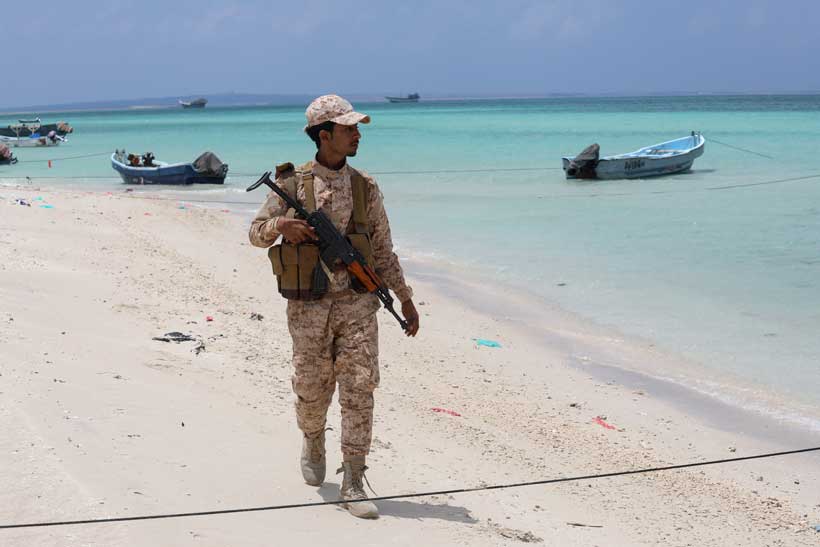
On Tuesday, three Houthi ballistic missiles slammed into the Tihamah, an Egyptian-owned cargo ship easing through Bab-el-Mandeb’s eighteen-mile channel. A fourth missile hit the rescue boats that came for survivors. Six people died — the first shipping fatalities of the year-old US-Iran war, and the clearest evidence yet that the Houthis’ three-week-old blockade of the strait is not a bluff. Wire services filed it as one more Red Sea incident, a paragraph below the day’s real story: whether Washington and Tehran are any closer to reopening the Strait of Hormuz. That framing has it backward. Hormuz has been closed for months, its closure fully absorbed into an $87 oil price and a diplomatic deadlock nobody expects to break soon. Bab-el-Mandeb is where the next shock is actually going to come from — and almost nobody is positioned for it.
The war that shut Hormuz began on February 28, when US and Israeli strikes killed Iran’s supreme leader and Iran retaliated by choking the strait to a trickle: a single vessel transited on August 9, against a pre-war average of 73 a day, and war-risk insurance has surged to roughly thirty times its pre-war level. Brent, which traded near $70 in January, has settled in the high $80s — high, but not catastrophic, because Saudi Arabia found a workaround. Its East-West pipeline now runs at full capacity, sending roughly five million barrels a day to the Red Sea port of Yanbu, bypassing Hormuz entirely. That pipeline is the reason oil isn’t at $150. But Yanbu is not the end of the journey: cargo bound for Asia, the market that matters most, still has to clear Bab-el-Mandeb. On July 20, three weeks before the Tihamah was hit, the Houthis declared that route a war zone too, after a Saudi airstrike on Sanaa’s airport collapsed the fragile truce that had briefly held Yemen’s civil war in check.
The reason this matters more than Hormuz is arithmetic, not geography. Hormuz’s disruption is fully priced. Every trading desk, insurer, and central bank scenario has been built around a closed Hormuz for months — that is why the market’s answer to a war that shut down roughly fifteen million barrels a day of normal transit is $87 oil, not triple digits. The marginal risk left in the system is not “what if Hormuz stays closed”; everyone already assumes it does. The marginal risk is “what if the workaround fails too.” And the workaround runs through Bab-el-Mandeb.
The US Navy is already behaving as though it believes this, even while its public messaging stays fixed on Hormuz. In April, the USS George H.W. Bush carrier strike group took a six-thousand-mile detour around Africa’s Cape of Good Hope rather than cross Bab-el-Mandeb — no American carrier has attempted that transit since the USS Dwight D. Eisenhower in December 2023. Washington currently has three carrier strike groups in the theater, the largest Middle East naval deployment in more than two decades, and it is routing its most valuable ships around the very strait it insists is secondary to Hormuz. That is the tell.
Stay ahead of the geopolitical week.
MD Briefing delivers expert analysis across five global fronts — the Indo-Pacific, energy, geoeconomics, European security, and the Middle East — every Monday morning. Free.
The same quiet hedge is visible on land. AFRICOM’s public line is that the US is not seeking new basing in the Horn of Africa, consistent with the administration’s broader retrenchment instincts. Privately, its commander visited Somaliland’s Berbera port — a deep-water harbor with one of Africa’s longest runways — in November, and Somaliland’s representatives say a delegation has come every month since. The rationale officials cite privately is not Somalia’s al-Shabaab insurgency, which the US continues to bomb at a pace of roughly one strike a week regardless. It is Bab-el-Mandeb. Washington is positioning for a problem it will not yet admit, in public, that it has.
What makes the next twelve months genuinely dangerous is that this is happening in a neighborhood that is destabilizing on three fronts simultaneously, each one draining the attention and capacity that would otherwise go toward securing the strait’s approaches. Ethiopia’s federal army and Tigrayan forces fought a four-day battle in early August barely inside Sudan’s border — Tigrayan fighters’ bodies were recovered from a river that marks the international boundary, and artillery fire hit refugee camps housing people who had already fled one war. The 2022 peace deal that ended a conflict which killed an estimated 600,000 people is fraying in real time, and Sudan, already consumed by its own civil war, is absorbing the fallout. None of that is happening in Yemen. But it is happening in the same theater, competing for the same limited pool of American, Gulf, and UN crisis-management bandwidth, at precisely the moment that bandwidth is needed on the water. And the Gulf coalition that would normally lead a coordinated response to a Houthi blockade is still nursing its own wound: Saudi Arabia effectively ended the UAE’s separate military presence in southern Yemen with airstrikes on Emirati-backed separatists in December, a rupture that a shared Houthi threat has not been enough to repair.
The obvious objection is scale: Hormuz historically carries around fifteen million barrels a day, Bab-el-Mandeb a fraction of that, so surely Hormuz remains the bigger story. That is true in gross terms and beside the point for positioning over the next year, because Hormuz’s worst case has already happened and been absorbed by markets. Bab-el-Mandeb’s has not. The Tihamah attack was the first time in this war the Houthis demonstrated they could kill people aboard a moving target inside the strait — a capability escalation, not a one-off — and no one has yet repriced for what happens if that capability is turned specifically on a Yanbu-loaded tanker, or a US Navy vessel.
Three paths from here, and only one of them stays quiet.
Base case (roughly 60% probability): the Houthis continue calibrated, deniable pressure — occasional strikes like the one on the Tihamah — enough to keep insurance premiums elevated and a share of shipping diverting around Africa, without a formally declared, total closure. Yanbu-linked cargo keeps moving, at a discount and with sporadic disruption; Brent grinds into the $90s or touches $100 without spiking. Ethiopia and Sudan cycle through further flare-ups on the pattern of early August — enough to keep the Horn unstable and off Western front pages, not enough to force a crisis response. This depends on the Houthis calibrating to maximize leverage in Yemen’s internal politics without inviting the kind of overwhelming US-Saudi retaliation that would jeopardize the political track they still want to win.
Downside case: within the next few months, a Houthi strike — with or without deeper Iranian coordination — hits a Yanbu-originated tanker or a US Navy escort directly inside Bab-el-Mandeb, the logical next target given the Tihamah precedent. Insurers pull coverage entirely, the way they already have for Hormuz; Riyadh’s last working export route to Asia effectively closes; Brent spikes past $120. At the same time, Ethiopia-TPLF fighting escalates into open war, the 2022 deal formally collapses, and Sudan is pulled deeper in. Washington, consumed by a Hormuz negotiation that still hasn’t concluded, has no spare bandwidth to stabilize the Horn and cedes basing leverage in Somaliland to whoever moves first — plausibly China, which already anchors a base across the strait in Djibouti.
Upside case: either the stalled Hormuz talks produce a partial reopening, which would immediately relieve pressure on Bab-el-Mandeb by restoring Gulf oil’s normal route, or — more plausible on a twelve-month horizon — a hardened US-Saudi response specifically degrades Houthi missile and drone stocks following the Tihamah killings, restoring enough shipping confidence to ease the blockade without a broader Yemen settlement. Either resolves the tail risk without the dramatic diplomatic breakthrough markets are actually waiting for, on the strait everyone is actually watching.
The market’s attention is fixed on the strait that already broke. The one that hasn’t broken yet — but is being actively tested by a force that just proved it will kill to close it, in a neighborhood coming apart at three other seams at the same time — is the one investors, insurers, and policymakers should be pricing for now, not after it happens. Watch the Lloyd’s Joint War Committee listings: if Bab-el-Mandeb gets upgraded to Hormuz’s risk category in the coming weeks, insurers — not diplomats — will have told you first that the strait nobody was watching has become the only one that matters.