


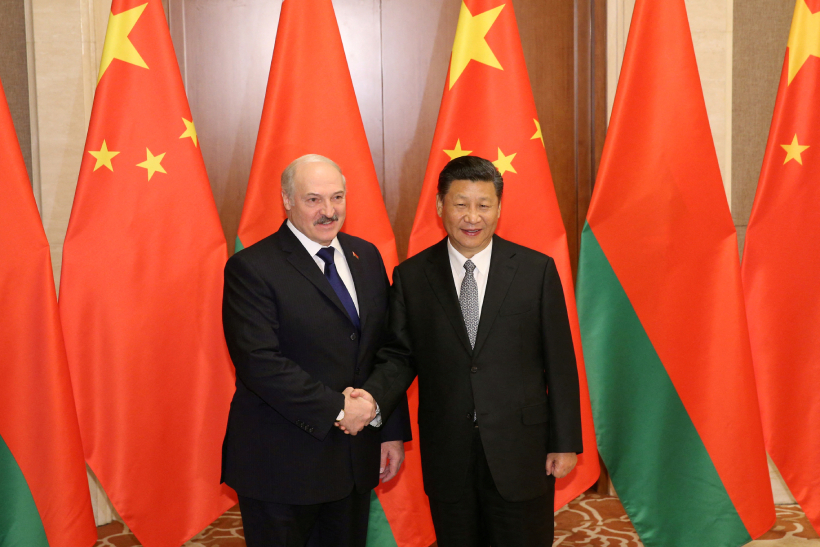
Alexander Lukashenko had quite an unusual week. On June 19, Volodymyr Zelenskyy gave him a public ultimatum: remove the Russian signal relay stations on Belarusian territory that were helping guide Shahed drone strikes on Ukrainian cities, or Ukraine would destroy them itself. By June 22, the stations had quietly stopped functioning. On June 26, Lukashenko flew to Russia for a two-day closed meeting with Putin at the Valdai residence: no press, no readout, no documents signed, no official statement afterward. And today, Monday June 30, he is in Beijing meeting Xi Jinping, where China’s Foreign Ministry has declared relations between the two countries to be at their “historic peak.”
Three meetings in eleven days and each one is more significant than the last. The sequence tells a story that the individual readouts do not, and reading it carefully matters because it touches on some of the most consequential questions currently in play around the Ukraine war, Lukashenko’s survival calculus, China’s expanding role in the conflict, and what is happening on NATO’s most exposed eastern flank.
The Ultimatum That Changed Lukashenko’s Week
Ukrainian intelligence identified four relay facilities in Belarus’s Brest and Gomel regions, positioned near the Ukrainian border, functioning as signal boosters for Russian Shahed drone pilots. The equipment extended the operational range and targeting precision of drones that had been killing Ukrainian civilians throughout the spring. Zelenskyy’s ultimatum was unusually specific and unusually public, he named the regions, described the equipment, set a seven-day deadline, and said clearly that if Lukashenko did not act, Ukraine would act for him.
What followed was revealing on multiple levels. Belarus did not officially acknowledge the relay stations existed, it did not announce removing them. It simply stopped them functioning, and Ukrainian Border Guard Service reported a measurable decline in Russian attack drones entering airspace via Chernihiv Oblast within days. Zelenskyy confirmed on June 25 that the stations had ceased operating, though he stopped short of claiming they had been physically removed. The Belarusian silence on the matter was itself a message: Lukashenko was complying with Kyiv’s demand without admitting he had done so, threading a needle between Ukrainian pressure and Russian expectations with a delicacy that tells you something important about how he reads his own position right now.
Stay ahead of the geopolitical week.
MD Briefing delivers expert analysis across five global fronts — the Indo-Pacific, energy, geoeconomics, European security, and the Middle East — every Monday morning. Free.
That same day, before flying to Moscow, Lukashenko asked the Russian ambassador “not to drag” Belarus into the war. A man who has spent four years providing Russia with territory, airspace, and logistical support for its Ukraine campaign was now asking Moscow to give him some distance. Something had shifted in his calculation, and the public nature of the task suggests he wanted that shift to be visible.
What Happens at Valdai Stays at Valdai
The meeting between Putin and Lukashenko on June 26 in Valdai was unusual even by the standards of a relationship that has never been marked by transparency. On takeoff, the Belarusian presidential aircraft switched off its transponder over the Tver region. The M-11 road was closed for a while near the house. The Kremlin confirmed the meeting after Lukashenko had already returned to Belarus and reporter Peskov, in a statement, said the meeting was focused on the “Union State agenda, trade, economic cooperation, security in the region”. He didn’t mention any documents being signed and said there would be no press conference.
Meetings between leaders that generate no public communication typically involve either an agreement too sensitive to disclose or a disagreement too serious for either party to put on record. The second is much more likely, especially given the time since the end of the war: After quietly following Zelenskyy’s ultimatum, Lukashenko reaffirmed his desire to remain on the sidelines. Since the earliest days of the invasion, Putin reportedly has desired more Belarusian military assistance. Has resisted this several times and has always stated that Belarus would not let its troops into the fighting if there was no attack on Belarus itself. Relay stations were one area where it was hard to distinguish between support for Russia and involvement in its conflict, and Lukashenko’s willingness to cooperate with Kyiv, but not with them, reflects a hint as to where he has placed the line. Was it a signal taken by Putin or did he defy it, that’s probably what the closed meeting was about and that’s probably what’s being hidden by the lack of any readout.
From Moscow to Beijing in 72 Hours
The sequence from Valdai to Beijing in less than a week is what elevates this story beyond a standard Belarus-Russia bilateral update. Lukashenko is not an autonomous actor, his regime’s survival depends on Russian political, economic, and security support in ways that leave him very little room to maneuver independently. When he flies directly from a closed meeting with Putin to a high-profile state visit in Beijing, where Xi receives him at the Diaoyutai state guesthouse and declares relations are at their “historic peak,” the visit is functioning as something more than bilateral courtesy.
China-Belarus trade surpassed $5 billion last year, growing 33% year-on-year, making Beijing the most significant economic diversification away from exclusive Russian dependency that Lukashenko has managed. Xi pledging to “continue providing assistance within its capacity for Belarus’ development and construction” and calling for both sides to “maintain strategic communication” is the language of a relationship that Beijing wants to deepen precisely because Belarus’s position; bordering NATO’s eastern flank, hosting Russian nuclear-capable missiles, sitting at the geographic intersection of the conflict — gives China intelligence value, diplomatic presence, and leverage in the European security conversation that it would not otherwise have.
The “historic peak” framing from the Belarusian presidential channel is doing specific diplomatic work simultaneously in several directions. It signals to Moscow that Minsk has alternatives worth protecting. It signals to Brussels and Washington that Beijing is present in the European security equation in ways that Western policymakers have been slow to fully account for. And it signals to Lukashenko’s own audience that Belarus has options beyond what Moscow is offering, which matters domestically in a country that has been watching its sovereignty gradually erode under Russian pressure since 2020.
What the Oreshnik Deployment Actually Means for Europe
Belarus borders Poland, Lithuania, and Latvia, three NATO members on the alliance’s eastern flank, the same flank that European defense planners have been spending the past two years trying to reinforce. It hosts the Oreshnik, Russia’s latest nuclear-capable intermediate-range hypersonic ballistic missile system, deployed there as part of the deepening military relationship between Minsk and Moscow. Zelenskyy, beyond the relay station ultimatum, has warned that Belarus is simultaneously expanding road infrastructure, building ammunition storage sites, and constructing fuel depots near the Ukrainian border that serve no purpose he can identify as civilian.
The Oreshnik deployment is the detail that changes the character of everything else happening on the Belarus-Ukraine border. It is not a tactical weapon. It is a system capable of striking targets across a significant portion of European NATO territory, and its presence in Belarus means that any military response to Belarusian escalation would need to factor in nuclear risk in a way that has no close precedent in recent European security planning. For the Baltic states, which are already operating on the assumption that Russian aggression is a planning reality rather than a remote contingency, the combination of Oreshnik missiles and deepening Belarusian-Russian military integration is the threat that sits underneath every other conversation about European defense.
What Zelenskyy’s ultimatum tested was whether Lukashenko would comply with Ukrainian demands or whether Moscow’s influence over Minsk had become total. The compliance, quiet, deniable, but real suggests Lukashenko retains some independent maneuvering room even as the structural pressures on him push toward deeper Russian entanglement. Whether that room is enough to matter, and whether he will use it when it becomes more expensive to do so, is the question that the Valdai meeting almost certainly addressed without resolving.
Beijing’s Interest in Minsk Goes Beyond Trade
A leader whose survival depends entirely on one patron is vulnerable in ways that a leader with two patrons is not, and Lukashenko has been working systematically since 2020 to ensure that China occupies enough of the second-patron role to be genuinely useful. The Belt and Road investments, the trade growth, the bilateral cooperation frameworks,all of it reflects a deliberate Belarusian effort to give Beijing enough of a stake in Minsk’s stability that Chinese support becomes a genuine counterweight to Russian demands.
From Beijing’s side, the calculation is different but complementary. China has been presenting itself as a neutral party in the Ukraine war while maintaining relationships that make it anything but neutral in practice. Supporting Russia’s war economy through trade, deepening ties with Belarus as a Russian ally, while simultaneously offering to mediate between the parties, this is the same triangulated positioning that served Beijing well during the Iran war, and the Belarus visit fits neatly into that pattern. A China that is simultaneously deepening ties with Minsk, supporting Moscow economically, and claiming to want peace has maximum diplomatic flexibility and minimum commitment. The “historic peak” language costs nothing and buys considerable positioning.
The most specific question China brings to the Belarus relationship is intelligence. Belarus’s geography gives anyone with access to Minsk’s surveillance infrastructure a listening post at the edge of NATO’s eastern flank, with visibility into Polish, Lithuanian, and Latvian military movements, communications, and logistics. Whether Chinese intelligence access to Belarusian systems is part of what Xi and Lukashenko are discussing today is not something either government will confirm. The analysts noting that China may be playing a larger role in the conflict than is visible from the outside tend to point to exactly this dimension, the information value of the Belarus relationship rather than the trade value.
The Pattern Underneath the Diplomacy
Taken individually, each of the three meetings this week is explicable on straightforward terms. Lukashenko complied with a Ukrainian ultimatum to reduce his military exposure. He flew to Putin to manage a relationship he cannot afford to rupture. He flew to Xi to deepen ties with a partner who offers him what Moscow cannot. But the sequence, compressed into eleven days, at a moment when Belarus is under more pressure from multiple directions than at any point since 2020, tells a more specific story about where Lukashenko thinks he is and what he thinks he needs.
He needs Russia not to demand more than he can give without losing the maneuvering room he has left. He needs China to provide enough economic and diplomatic support that Moscow knows he has somewhere else to go. And he needs Ukraine to believe that he is not unconditionally aligned with Russian military objectives, which is what the relay station compliance was designed to demonstrate. Whether all three of those needs can be satisfied simultaneously, across relationships that pull in fundamentally different directions, is the question that the next phase of the Ukraine war will begin to answer. The closed meeting at Valdai suggests at least one of those relationships is under more strain than the public posture indicates. The Beijing visit suggests Lukashenko is responding to that strain by making the alternative relationship more visible.
That is not a stable equilibrium. It is a man trying to stay relevant to multiple powers simultaneously in a conflict that is making neutrality progressively harder to sustain. The relay stations are off. The Oreshnik is still there. The road infrastructure near the Ukrainian border is still being built. The meeting at Valdai produced no statement. And Lukashenko is in Beijing today, declaring the relationship at its historic peak, two days after a conversation with Putin that nobody is allowed to know about.
