


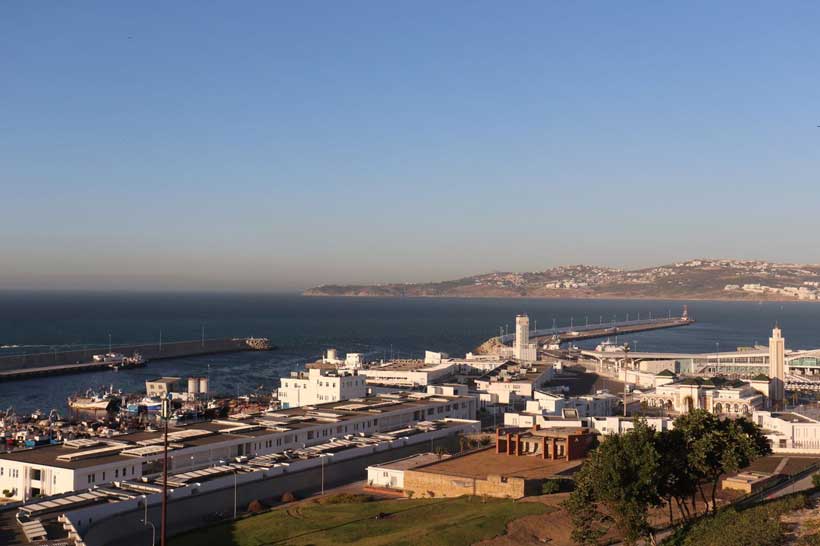
There’s a narrow passage between two continents where roughly 300 ships pass through every single day, one every five minutes. This is the Strait of Gibraltar, and it does more than connect the Atlantic to the Mediterranean, it controls access to it. More than 10% of the world’s maritime trade moves through this gap, which comes to just 14 kilometers at its narrowest point. If you stand on the Spanish coast on a clear day, you can see Morocco with your own eyes. It’s that close and that proximity is exactly why Tanger Med, just across the water, has grown into one of Africa’s largest container ports. Close the strait, even briefly, and the shock would hit dozens of economies at once.
For most of the past two decades, the world has talked about Morocco’s maritime ambitions in the singular: Tanger Med, the transhipment giant that turned the western entrance to the Mediterranean into one of the busiest stretches of water on Earth. That story is no longer big enough to capture what is happening.
Shipping lines forced around the Cape of Good Hope by instability in the Red Sea have spent two years rediscovering how much the world’s trade still depends on a handful of maritime gateways. Gibraltar is one of them and on its southern shore, Morocco has quietly stopped behaving like the operator of a single very good port, and started behaving like the architect of Africa’s principal Atlantic gateway, one that runs from the Mediterranean, through the Atlantic, into the Sahel.
That shift deserves more attention than it has received, and not only for what is being built. The more interesting question is whether the governance is keeping pace with the concrete.
Stay ahead of the geopolitical week.
MD Briefing delivers expert analysis across five global fronts — the Indo-Pacific, energy, geoeconomics, European security, and the Middle East — every Monday morning. Free.
From port to platform
Morocco’s recent strategy marks a real shift in economic geography. Tanger Med is no longer a final destination, but a stepping stone in a larger system. The basic facts about Tanger Med are well known: it’s one of the Mediterranean’s premier transhipment hubs, backed by automotive and aerospace manufacturing, logistics parks and customs procedures built for speed. What seems to be less understood is the second-order decision Rabat made some years ago, when it decided to move beyond simple port operations and into the role of a visionary.
“Tanger Med was never going to be the end of Morocco’s maritime story. It was the opening chapter.”
As a result, Morocco’s objective has evolved from managing a successful port to creating an interconnected network where its Atlantic strategy facilitates trade across entire borders.
Morocco’s Atlantic strategy: from follower to leader
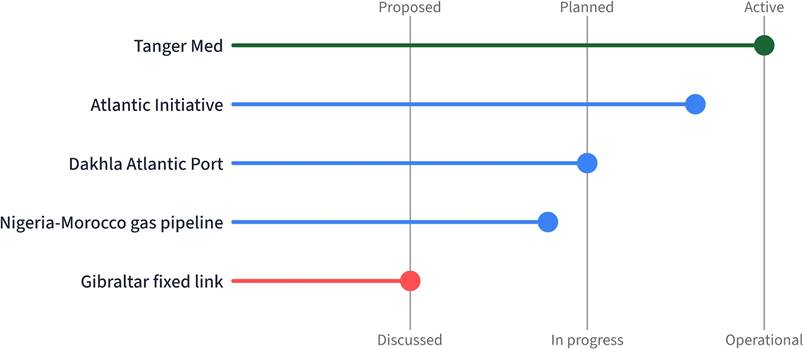
Figure 1. The five visible pieces of Morocco’s Atlantic strategy sit at very different stages of maturity, from an operating hub to an idea still under discussion.
Building the Atlantic spine
In the world of global affairs, there is a recurring idea that periodically captures headlines: a rail tunnel beneath the Strait of Gibraltar. While a feasibility study completed in 2025 confirmed the tunnel is technically achievable, it is still a project of the future. However, Morocco is not staying still and rather than waiting on a northern link to Europe, Morocco is actively looking south and west linking Tanger Med to the Atlantic and beyond. Morocco’s critical pieces of infrastructure range from, for example, the planned Dakhla Atlantic Port which would give Morocco a second deep-water anchor further down its own coastline to the Nigeria–Morocco Gas Pipeline, threading through more than a dozen coastal jurisdictions. The Atlantic Initiative aims to give landlocked Sahel states a stake in the same network, turning a Moroccan port strategy into a regional one. In addition, expanded rail connectivity is meant to bring all of it together into a single corridor rather than a string of separate projects.
Morocco’s Atlantic strategy

Figure 2. Read as a sequence rather than a list, Morocco’s Atlantic strategy moves from a Mediterranean base, outward along the coast, and then inland toward the Sahel and a multimodal network.
Infrastructure is not governance
Morocco’s projects are not just about the ports and pipelines, they are as much governance projects as energy and engineering ones. A pipeline that crosses more than a dozen jurisdictions needs a regulatory regime as much as it needs steel. A port built on a landlord model needs a legal architecture that investors and insurers can actually price. Similarly, an arbitration law that Morocco updated in 2022 only matters if practitioners and counterparties trust how it will be applied.
“For shippers, insurers, and financiers, legal questions should be treated as ‘compliance and due-diligence’ matters rather than political arguments.”
By treating legal risk as a manageable commercial variable rather than a political debate, Morocco is attempting to create an environment where the underlying business case for these massive projects remains stable regardless of the political environment.
This is precisely the gap the Global Academy for Future Governance and its partners such as Modern Diplomacy has in mind when it talks about “governance corridors”: the institutional layer of law, regulation and dispute resolution that determines whether a physical corridor actually functions, or merely exists.
Morocco’s place on the map
Morocco’s strategy is unique when compared to other major African infrastructure projects. While Egypt is evolving the Suez Canal into an industrial ecosystem whereas Angola and Zambia are rehabilitating a colonial-era railway into the Lobito Corridor, and East Africa is knitting together ports, rail and pipelines of its own, most of these emerging “blue lines” connect a single coast to its intermediate hinterland. But, Morocco differentiates itself through continuity where Morocco runs in one continuous line from the Mediterranean, around the Atlantic seaboard, and into the Sahel. That is a more ambitious bet and a more demanding governance problem than any single port can solve alone.
Africa’s blue lines
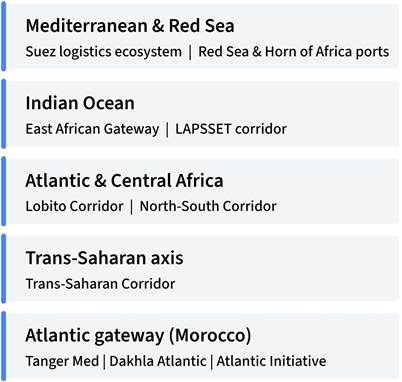
Figure 3. Most of Africa’s emerging blue lines connect a coast to its own hinterland. Morocco is unusual in running continuously from the Mediterranean to the Atlantic to the Sahel where one corridor crosses three regions, not three corridors confined to one each.
The test ahead
When the Global Academy for Future Governance convenes its inaugural Global Maritime Governance Forum (GMGF) in Gibraltar this September, Morocco’s Atlantic strategy should be read as more than a regional infrastructure update. It is a live test of whether a governance framework can keep pace with a continental ambition and whether the legal, regulatory and dispute-resolution architecture can be built as deliberately as the ports and pipelines themselves.
Morocco has already answered the engineering question. The governance question is still open and it is the one that the GMGF, and the practitioners gathering for it, should spend their time on.
