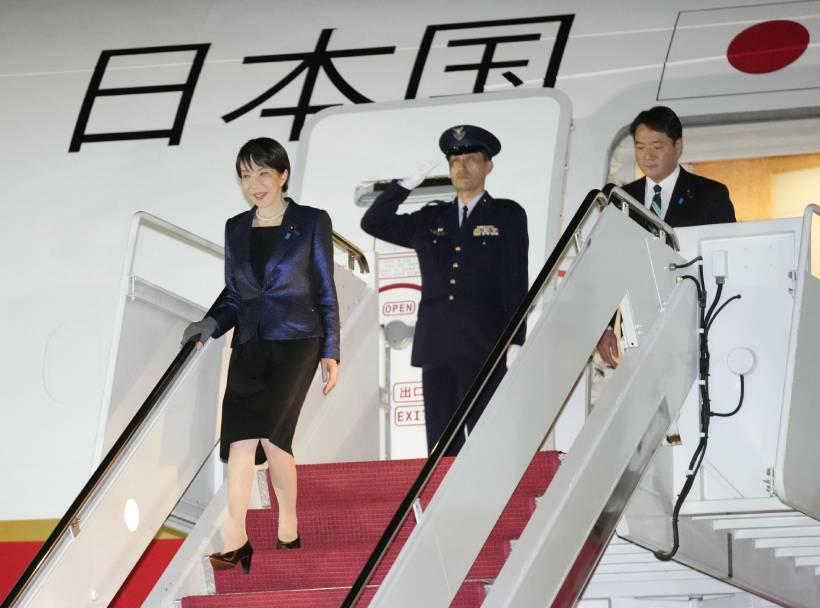
Japanese Prime Minister Sanae Takaichi used an “existence-threatening crisis” as a pretext to intervene in the Taiwan issue, which ultimately enraged China and subjected Japan to the shock of a “rare earth supply cutoff.” As China turned off the rare earth tap, Japan internally put on a show of composure, claiming the situation was under control to reassure its people. However, its continuous international appeals to resist China wielding the “rare earth cudgel” against Japan could hardly conceal that the current rare earth shock is bound to create a genuine “existence-threatening crisis.”
Beijing intends to use Tokyo as a negative example to deter other countries from crudely interfering in the Taiwan issue—and the power to define what constitutes “crude” lies entirely in China’s hands. Consequently, Tokyo is getting an early, firsthand taste of what an “existence-threatening crisis” actually feels like.
The effects have been two-sided. On the positive side, the pan-Western bloc has indeed toned down its rhetoric regarding the Taiwan issue, particularly the Trump administration in the United States and the South Korean government. Furthermore, Europe has slowed down its narrative that uses the Taiwan issue to emphasize “democracy vs. authoritarianism.” China’s Southeast Asian neighbors have expressed a middle ground through silence, with only Singapore attempting at one point to act as a peacemaker to reconcile China and Japan, which triggered criticism from the Chinese public.
On the negative side, the first island chain nations, led by the United States, have not slowed down their containment efforts in practice. Instead, they have formed a tighter, more cohesive stance and are actively making military deployments. Regarding critical minerals, the pan-Western bloc now feels a more urgent need to cooperate to counteract China’s “rare earth threat.”
Stay ahead of the geopolitical week.
MD Briefing delivers expert analysis across five global fronts — the Indo-Pacific, energy, geoeconomics, European security, and the Middle East — every Monday morning. Free.
Ultimately, China’s current offensive against Japan is a play for a “time window.” This is because, despite the pan-Western bloc banding together to build a defensive network, it remains difficult for them to decouple from China regarding critical minerals over the next 5 to 10 years.
This is the second time Japan has faced a rare earth supply cutoff, the last time being in 2010. Over the past 15 years, Japan has tried every possible way to break its reliance on rare earths, yet its dependency has only dropped from 90% to 60%. Currently, Japan has temporarily buffered the shock by relying on its precocious rare earth stockpiles.
It is worth noting that the so-called “rare earth supply cutoff” is not comprehensive. China has explicitly cut off dual-use rare earths to Japan but maintains a flexible review system for civilian-use rare earths. Japan’s most vital export industries, such as automotive, electronics, and precision equipment, have not been completely cut off; however, they have encountered severe uncertainty. As everyone knows, what corporations fear most is uncertainty, which causes a premature freeze on corporate investments and orders.
As time passes, the more Tokyo opposes Beijing on military and diplomatic fronts, the stricter the rare earth controls will become. From January to April 2026, China’s exports of seven categories of controlled rare earth products to Japan fell by 34% year-on-year. The drop in the single month of March reached 88%, and April saw an 82% decline. Exports to Japan of heavy rare earths like dysprosium and terbium, which are used in magnets for electric vehicle motors, dropped to zero starting in January, while the export volume of yttrium fell by over 90% during the same period.
Tokyo’s anxiety is reflected in the relevant reporting by the Nikkei. Japanese media are deeply influenced by politics and generally tend to downplay crises. The Nikkei is Japan’s most neutral media outlet, but it is no exception. Regarding the rare earth shock, the Nikkei delivered two messages around the time of this year’s G7 summit: first, that the United States demanded China resume rare earth exports to Japan; second, that China’s rare earth controls have little impact on the Japanese automotive supply chain.
Regarding the U.S. appeal, the Nikkei adopted a gossip-style reporting mode because neither China nor the U.S. publicly confirmed this request. This shows that while the Trump administration intended to ease the pressure on its ally, it also did not want to offend China in the process—after all, the U.S. does not have enough rare earths for its own use either. Naturally, the appeal was ineffective, and Beijing used the opportunity to publicly reject it while reiterating the legitimacy of its controls.
Regarding the impact of rare earth controls on the Japanese automotive supply chain, the Nikkei adopted an analytical mode that downplayed the situation, listing only supply chain manufacturers that do not heavily rely on rare earths. It avoided mentioning those Japanese firms hit hard by the rare earth shortage, such as NdFeB permanent magnet manufacturers (Shin-Etsu Chemical, TDK, and Hitachi Metals/Proterial), drive motor manufacturers, and electric power steering motor suppliers.
From this, it is evident how the Japanese media is trying to buy time for the government and suppress public discontent. However, the pressure is very real, the impact is worsening by the day, and paper cannot wrap fire forever.
According to various analyses, Japan will exhaust its rare earth stockpiles in the second half of 2026. In the first half of 2027, the manufacturing costs of related industries will rise “with the naked eye” (visibly). If the situation does not ease by the second half of next year, the electrification of the Japanese auto industry will be significantly impeded; combined with the spillover effects on other sectors, this could account for over 35% of the total negative impact on Japan’s GDP growth.
Currently, the single largest drag on Japan’s GDP growth comes from the uncertainty of Middle Eastern energy, which is roughly estimated to constitute about 50% of the total economic pressure. The second is imported inflation and consumption contraction caused by the depreciation of the Japanese yen, accounting for roughly 27% of the total drag on GDP. The rare earth shock contributes about 15-20% to this negative impact, while U.S. tariffs account for approximately 10%.
According to an assessment by the Nomura Research Institute, if the rare earth controls persist for three months, Japan will suffer a loss of about 660 billion yen (approximately 4.2 billion USD), dragging down annualized nominal and real GDP by about 0.11%. If it lasts for a year, the loss will reach 2.6 trillion yen, and the drag on GDP will expand to 0.43%.
Due to a lack of transparency, Japan’s rare earth stockpiles are difficult to compare with its oil reserves. Regarding the latter, Japan can sustain itself for about 150 days on inventory; however, regarding the former—especially heavy rare earths—its safety stock is far lower than that of oil. Oil has alternative energy sources, but rare earths have none.
In other words, time is running out for Japan. In the second half of 2026, rare earths are expected to gradually leap to become the “single largest source of pressure,” weighing heavier than the pressure brought by energy and currency depreciation, creating an “existence-threatening crisis situation” that will be felt by every citizen in Japan.
The impact Japan faces on the military front is even greater than that on private enterprises, and this is the core focus of Beijing’s pressure on Tokyo.
China’s Announcement No. 1 of 2026 (January 6) was not just about rare earth controls; it was a comprehensive ban on the export of all dual-use items to Japanese military users and for military purposes. This covers over 700 types of materials, including rare earths, special metals, electronic components, chemicals, and high-precision machine tools, while plugging loopholes for third-party re-exports.
Geopolitically, the U.S. strategy of “inward contraction” means Japan must inevitably embark on a path of military expansion and strategic autonomy. However, the supply cutoff of resources from China will cause Japan’s militarization pace to slow down to a “visibly noticeable” degree.
Specifically, sensors, electronic equipment, batteries, motors, high-performance magnets, high-temperature-resistant materials, special alloys, high-frequency semiconductors, radar, sonar systems, and missile systems required for Japanese military hardware are all within the damage scope of China’s supply cutoff. While this will not stop Japan from expanding its military, its pursuit of autonomy will suffer severe cost increases and R&D delays.
Japan is almost entirely dependent on Chinese supplies for heavy rare earth elements such as dysprosium (Dy) and terbium (Tb), which are required for missile guidance systems and fighter jet engines. Its inventory of missile guidance components is estimated to last for only six months of production. Critical equipment such as submarine silencing motors and phased array radars face performance degradation risks due to material shortages. The production of each F-35 fighter jet requires about 417 kilograms of rare earth materials. These are the key areas where China is “choking the neck” of Japan.
Furthermore, drone systems, which are considered indispensable in future warfare, are facing the greatest impact.
The importance of the origin of rare earth permanent magnets inside drone motors and actuators is now becoming on par with batteries and electronic equipment. In response, Japan is expanding its long-range attack drone program, yet it has encountered a magnet material supply cutoff at this exact moment.
Of course, the batteries, communication equipment, and flight control systems in the drone supply chain also require rare earths. It can be said that by falling out with China, Japan has effectively cut off its path to independent drone development. True, the United States will not sit idly by and watch the drone systems of the first island chain be choked by China, but it also lacks an effective solution.
In terms of U.S.-Japan cooperation, JOGMEC, representing Japan’s Ministry of Economy, Trade, and Industry (METI), reached an agreement with the Canadian company REALloys to license and transfer Japan’s rare earth separation and magnet manufacturing technologies to North America. This covers upstream minerals in Saskatchewan, midstream separation facilities in Saskatoon, and downstream magnet production in Ohio. The significance is that Japan is trading technology for a production footprint in North America, while simultaneously helping the U.S. make up for its deficiency in magnet manufacturing capability. However, while strengthening manufacturing capabilities, the U.S. must ensure a normal supply of rare earths—something that is unlikely to be achieved within the next 10 years.
In terms of multilateral cooperation, Japan is a member of the U.S.-led FORGE (Forum for Geostrategic Resource Cooperation) and PIPIR (Partnership for Indo-Pacific Industrial Resilience), with the former covering 55 countries and the latter 16. Despite the grand momentum, they face three major constraints: the U.S. lacks sufficient stockpiles for itself, alternative solutions are costly and time-consuming, and the speed of supply chain restructuring is far too slow.
Ultimately, the initiative remains in China’s hands. Within the next 5 to 10 years, Japan’s desire to shift its economic focus toward the military-industrial industry is unlikely to be fulfilled.
Japan’s “existence-threatening crisis” does not stem from the Taiwan issue itself, but rather from Tokyo perceiving the Taiwan issue as its own existence-threatening crisis. This strategy might serve the internal political needs of the Japanese right wing, but it clearly damages Japan’s national interests. In this regard, the sacrifice of private enterprise interests is merely collateral damage.
To put it simply, this is a crisis of Japan’s own making. Interestingly, the people of Taiwan have not felt a war crisis at all and have no idea what the Japanese are so nervous about.