


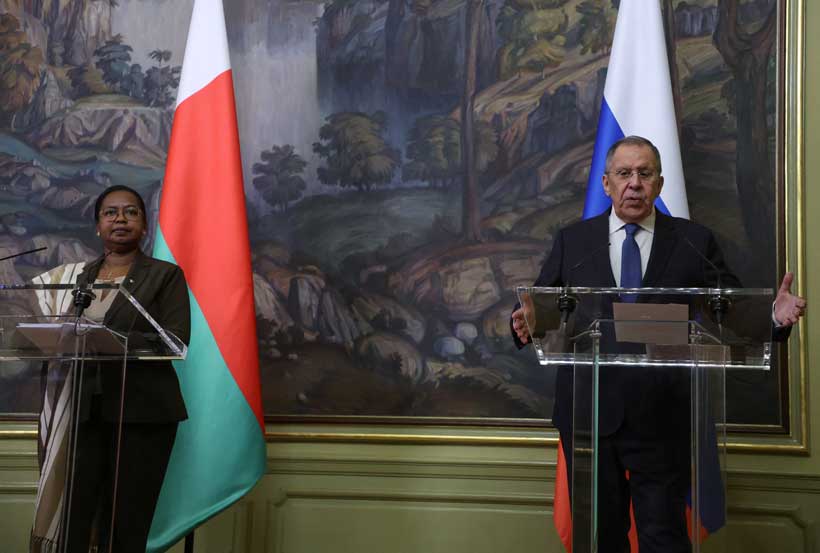
Bilateral diplomacy and economic cooperation between Russia and the southern African island of Madagascar have taken an incredible transitional phase in mid-June, characterized by the official working visit by Foreign Minister Alice N’Diaye to Russia’s capital city, Moscow. As always, the trip was on the invitation of Russia’s Foreign Minister, Sergey Lavrov, and planned as part of the preliminary preparations for the forthcoming third Russia-Africa summit slated for October 2026.
In the introductory statement, Lavrov described Madagascar as an old friend in Africa in terms of bilateral relations and when it comes to promoting the principles of multipolarity through joint efforts and reshaping multifaceted cooperation with this southern African island. The island has a distinctive history. Following a series of political crises and military coups in 2009, Madagascar underwent protracted political transitions, with constitutional governance restored in January 2014. The period thereafter was marked by frequent changes in leadership. In 2025, however, a series of mass protests resulted in another military coup and the ultimate installation of Michael Randrianirina as president of the military junta.
Notwithstanding the existing initial obstacles, Russia and the Kremlin, however, consider the new military government under Michael Randrianirina an emerging platform to quietly build a mutual political dialogue and simultaneously to maintain intensive economic ties, including military-technical cooperation with the new Malagasy authorities. A London-based Africa analyst described the new phase of the Russia-Madagascar relations as “a geopolitical maneuver and a breakthrough to establish a competitive military advantage in the country.” And the agreements aim to bolster military capabilities, and this will grossly be more beneficial to Russia trading its military-technical brands.
By tradition, Russia does not interfere in African countries’ internal affairs, and thus it does not recommend for them to adopt genuine steps toward democracy. Rather, it views the continued military domination as an unshakable condition to negotiate for military deals to earn revenue for its budget. Russia adores the Alliance of Sahel States (Burkina Faso, Mali, and Niger) and also relations with the Central African Republic, with which it has an excellent military agreement since 2017.
Stay ahead of the geopolitical week.
MD Briefing delivers expert analysis across five global fronts — the Indo-Pacific, energy, geoeconomics, European security, and the Middle East — every Monday morning. Free.
In February 2026 in the Kremlin, President Vladimir Putin held serious talks with President for the Re-Foundation of the Republic of Madagascar, Michael Randrianirina. It was an official visit of the new leader of Madagascar to Moscow. Following the Russian-Malagasy talks held at that highest level, President Putin issued instructions to the relevant agencies, which are consistently working to implement them. Government delegations representing the defense ministry and the ministry of mines and strategic resources of Madagascar expressed preparedness and discussed and signed military deals between Russia and Madagascar. Following that, Russia also highly appreciated the fact that the prime minister of Madagascar, Mamitiana Rajaonarison, attended the first International Security Forum, which took place in the Moscow Region in May 2026.
As logically planned, Foreign Minister Sergey Lavrov maintained his plan to sustain diplomacy and improve political dialogue. According to official reports posted on the ministry website, in June 2026, Lavrov held talks with his Madagascar counterpart, Alice Ndiaye, and comprehensively reviewed the current state and prospects for the future of Russian-Malagasy relations. Both sides reaffirmed their commitment to deepening political dialogue and broadening collaboration across the trade and economic, educational, cultural, and other spheres. The importance of intensifying joint efforts to enhance the legal framework underpinning bilateral relations was underscored.
In the discussions, both ministers expressed mutual interest in bolstering bilateral cooperation and noted Russia’s engagement, particularly with regional integration organizations in Africa. While stressing solidarity with the people and leadership of Madagascar, Lavrov listed sectors and agreed to coordinate where Russian companies have interests, “as promising opportunities in areas such as energy, transport, geological exploration, and the extraction and processing of natural resources.”
Lavrov said, “We are stepping up work on improving the legal and treaty framework of bilateral relations. Several draft agreements that clearly meet the interests of both sides are currently under discussion. Russia is helping the Malagasy to address pressing socio-economic challenges and train specialists for various fields.”
According to Lavrov’s explanation, the Soviet Union pursued a strategy of supporting industrialization. Now, as relations with Africa have taken on a new dimension since the early 2000s and opportunities have emerged to fill them with specific projects, Russia is returning to the strategy aimed at ensuring self-sufficiency across Africa. The third Russia-Africa summit, in Moscow, in October will be devoted to specific steps to implement this strategy. On top of traditional areas such as energy, including nuclear energy, and food security and technology in agriculture, its agenda will also generally include digital technologies and, importantly, the development of reliable and independent payment systems.
Aggregate bilateral trade with Africa has increased to approximately $30 billion, soon to be compared to modest figures just 15 to 20 years ago. But the set economic parameters and broad goals—unachievable previous policy goals since the first summit held in October 2019—are primarily due to Africa’s own bottlenecks, such as administrative bureaucracy, corruption, and ineffective mobilization of resources. It is believed that Russia is not a charitable organization. In practical terms and assessment, African leaders should not blame Russia for their own underperformance and pace of development. Related to this, Lavrov explicitly pointed out that Russia is implementing a program known as “debt-for-development swaps.” Back in those early post-Soviet days, Russia wrote off the bulk of African countries’ debt to Russia in the amount of over $20 billion. The remaining small amounts have, in most cases, been converted into debt-for-development format, which therefore implies that the funds they owed to Russia would be used for joint investment projects in the economies of the respective African countries.
Russia is also focusing on education. Madagascar’s Foreign Ministry and Russia’s MGIMO University signed a memorandum of cooperation aimed at expanding training opportunities for Malagasy diplomats and civil servants. “There is interest in such internships at our diplomatic academy, and we will support it in every possible way and strive to meet the expectations of our friends,” Lavrov said, explaining further that “Moscow’s approach remains focused on supporting African sovereignty and economic self-sufficiency,” and stating that Western countries have profited from Africa’s natural resources while doing little to promote local industrial development, contrasting this with the Soviet Union’s role in building industries, education systems, and healthcare infrastructure across the continent.
In addition to the African Union, Russia has cooperation agreements in place with other African organizations. And that Russia’s cooperation with Madagascar will be intensified. It therefore looks forward to the President of Madagascar, Michael Randrianirina, whose participation was confirmed by Foreign Minister Alice N’Diaye during the bilateral meeting.
Approximately 69% of the population lives in abject poverty, struggling to survive along the threshold of one dollar per day. As of 2025, the agriculture sector constituted 29% of the GDP, with manufacturing at 15%. Madagascar’s other sources of growth have been tourism, agriculture, and the extractive industries. The fishing sector represents $800 million, or 6% of GNP, and directly employs 200,000 people.
Tourism focuses on the niche ecotourism market, capitalizing on Madagascar’s unique biodiversity, unspoiled natural habitats, national parks, and lemur species. An estimated 365,000 tourists visited Madagascar, but largely unknown and unpopular for the huge potential Russian tourists. Developing Russian tourism to the southern islands, one has to navigate the long distance, which is currently without direct flights; nearly 1.94 million people experience high levels of acute food insecurity. Access to clean water is a critical issue, as Madagascar remains a water-stressed country, with climate shocks and infrastructure gaps exacerbating the crisis. It’s worthless to mention tourism infrastructure along the ocean and on the main island due to improper national planning and lack of development vision by the state authorities.
In 2025, the population of Madagascar was estimated at 32 million; approximately 39.3% were younger than 15 years of age, 57.3% were between the ages of 15 and 64, and 3.4% were aged 65 and older. Chinese, Indian, and Comorian minorities are present in Madagascar, as well as a small European (primarily French) populace. There are only a hand-finger-counted few Russians. Madagascar is classified as a least-developed country by the United Nations. Despite substantial economic growth since the early 2000s, income disparities have widened, and quality of life remains low for the majority of the population. Madagascar is a member of the African Union (AU) and the Southern African Development Community (SADC).
