


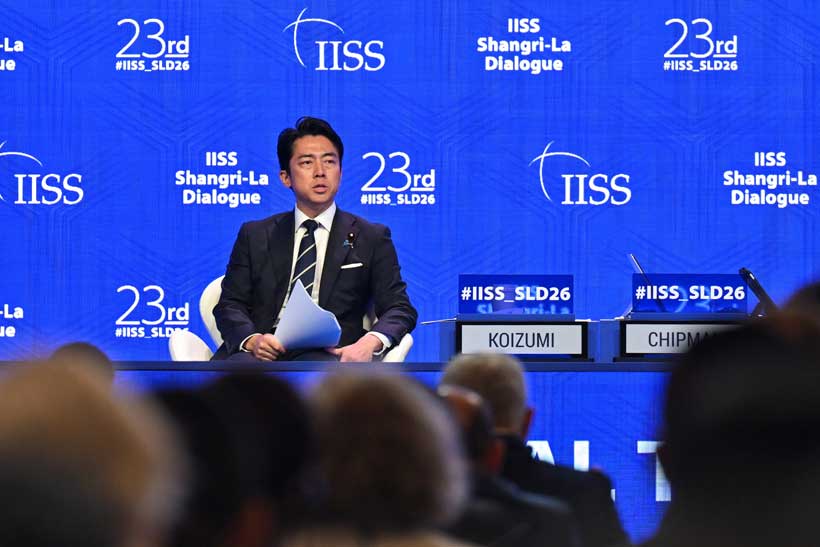
At this year’s Shangri-La Dialogue, Japanese Defense Minister Shinjiro Koizumi publicly pushed back against Beijing’s increasingly harsh criticism of Japan. He remarked that it was strange for China possessing a vast arsenal of nuclear weapons and strategic bombers to accuse Japan of embracing “new militarism.”
The distinction in wording, however, deserves closer attention. The term most frequently used by Chinese officials is not “new militarism” but “neo-militarism”. While the difference may appear semantic, it reflects two fundamentally different understandings of Japan’s security transformation.
On one level, this may represent a deliberate battle of narratives aimed at third-party audiences. Yet the linguistic gap may also reveal a deeper problem: China and Japan increasingly interpret the same developments through entirely different historical and strategic lenses, making it difficult for either side to understand the other’s core concerns.
Similar Words, Different Worries
Stay ahead of the geopolitical week.
MD Briefing delivers expert analysis across five global fronts — the Indo-Pacific, energy, geoeconomics, European security, and the Middle East — every Monday morning. Free.
Narrative matters, especially in international relations.
The phrase “new militarism” suggests a relatively straightforward accusation: Japan is expanding its military capabilities in response to growing geopolitical pressures and allowing security concerns to play a larger role in policymaking. Rising defense expenditures, the relaxation of restrictions on lethal arms exports, and the strengthening of security partnerships would all fit within this interpretation. Even countries that once suffered under Japanese imperial rule may view such developments as understandable responses to an increasingly challenging security environment. Japan’s liberal democratic institutions and the U.S.-Japan alliance are widely seen as safeguards against any return to prewar militarism.
China’s use of “neo-militarism,” however, conveys a far more serious allegation. The issue is not the quantity of weapons Japan possesses but the historical trajectory those developments are perceived to represent. In Beijing’s interpretation, militarization becomes dangerous when military expansion is increasingly linked to national identity, political ideology, and social mobilization, the same combination of forces that ultimately produced Japanese imperialism and fascism in the first half of the twentieth century. From this perspective, China worries that Japan is gradually rejecting the post-1945 order centered on the UN system established after its defeat in WWII. The concern is that Japan is slowly dismantling the institutional and normative constraints imposed after 1945.
China’s first concern is historical memory. China believes that Japan has never fully reckoned with its wartime past and that sections of the Japanese political establishment continue to downplay or even sanitize imperial aggression. Recurrent controversies surrounding the Yasukuni Shrine, history textbooks, and the issue of wartime comfort women are therefore interpreted not as isolated disputes but as evidence of an unresolved historical problem. From China’s perspective, a country that has not fully confronted militarism could potentially repeat past mistakes.
This explains why China’s 2025 military parade prominently highlighted the role of China, Russia, and North Korea in commemorating the eightieth anniversary of victory in the Anti-Fascist War and the War of Resistance Against Japan. The event was not merely a display of military power but an attempt to reinforce a particular narrative of the postwar order.
China’s second concern relates to the pace and nature of Japan’s security transformation. Under former Prime Ministers Shinzo Abe and Fumio Kishida, the gradual relaxation of postwar constraints was viewed in China as cautious and incremental. Prime Minister Sanae Takaichi, however, is often perceived as pursuing a more assertive and less restrained agenda. Chinese suspicions are heightened by Takaichi’s past criticism of the Murayama Statement, the landmark 1995 apology for Japan’s wartime aggression. Since taking office, she has accelerated defense modernization and expanded security cooperation with regional partners, presenting these initiatives as necessary steps to uphold a free and open international order based on the rule of law. Yet from China’s perspective, such policies could significantly complicate China’s ability to operate in nearby maritime areas.
Even more sensitive is Takaichi’s ambiguous position regarding Japan’s Three Non-Nuclear Principles. While she has not openly advocated abandoning them, neither has she defended them as unequivocally as previous Japanese leaders. Whether through an indigenous nuclear capability or deeper integration into U.S. nuclear deterrence arrangements, any movement toward a more flexible nuclear posture would be regarded in Beijing as a major strategic threat.
China’s third concern is rooted in contemporary geopolitics. China considers unification with Taiwan a core national interest. When Takaichi stated in November 2025 that a Taiwan contingency could constitute a survival-threatening situation, many in China interpreted the remark as a signal that Japan might intervene militarily in a future cross-strait conflict. Such statements inevitably evoke memories of Japan’s acquisition of Taiwan following the First Sino-Japanese War in 1895, fueling powerful nationalist reactions. At the same time, Japan’s ongoing military buildup in the southwest islands and the continued presence of U.S. forces in Japan are viewed by Chinese strategists as significant obstacles to any future use of force against Taiwan. Consequently, China has growing incentives to weaken Japan’s military potential and strategic influence.
The Cost of a Spiral
The danger lies not merely in conflicting interests but in mutually reinforcing perceptions.
Japan increasingly identifies China as its primary security threat and adjusts its policies accordingly. China, meanwhile, interprets many of Japan’s actions through the lens of historical memory and nationalism, viewing them as deliberate attempts to contain or target China. In response, China expands its military activities in the East China Sea, which in turn reinforces Japanese perceptions of a growing Chinese threat. The result is a classic security dilemma, one intensified by historical grievances.
Under such conditions, almost any incident can become a catalyst for escalation: Takaichi’s remarks on Taiwan, the passage of a Japanese naval vessel through the Taiwan Strait on the anniversary of the Treaty of Shimonoseki, or Chinese military aircraft directing radar systems toward Japanese forces.
At the same time, the erosion of political communication channels further exacerbates these risks. With the decline of traditionally China-friendly figures such as Toshihiro Nikai and the reduced influence of Komeito within the ruling coalition, many of the informal mechanisms that once facilitated dialogue have weakened. Chinese officials increasingly appear unconvinced that Japanese interlocutors can deliver meaningful political commitments, leading Beijing to adopt a cooler attitude toward requests for high-level exchanges. People-to-people interactions have also become more tightly managed.
Recent developments have only deepened the problem. Chinese Defense Minister Dong Jun’s continued absence from the Shangri-La Dialogue and the unexpected death of Yohei Kono, who had planned to visit China, have removed additional opportunities for engagement. The APEC summit scheduled to take place in Shenzhen later this year may therefore offer one of the few remaining opportunities for meaningful contact. Such engagement is unlikely to transform bilateral relations overnight, but at least, it could help both sides better understand each other’s concerns and reduce the risk of further miscalculation. In an era when strategic mistrust is increasingly shaped by competing historical narratives, preventing misperception may be as important as managing military capabilities themselves.
