


The recent diplomatic engagement between the United States and China, coupled with the Quad’s continuing leadership challenges, has reignited debate about the future of the Indo-Pacific security architecture. While these developments do not by themselves alter the balance of power in the Indo-Pacific, they offer useful insight into how Washington may be approaching its regional commitments in the coming years.
Trump’s visit to China
On May 13–15, U.S. President Donald Trump visited China for the first time in eight years. The summit resulted in several purchase agreements, setting up of two new bilateral boards and a shared commitment to what both sides called “constructive strategic stability”.
The renewed engagement between Washington and Beijing does not necessarily signify a fundamental change in their strategic geopolitical role. Nevertheless, it highlights the reality that major powers frequently adjust their priorities, compelling partner countries to constantly reassess their own strategic choices.
Stay ahead of the geopolitical week.
MD Briefing delivers expert analysis across five global fronts — the Indo-Pacific, energy, geoeconomics, European security, and the Middle East — every Monday morning. Free.
The invitation extended by Trump to Xi Jinping to visit the White House on September 24, 2026, suggests that both sides are interested in maintaining diplomatic engagement beyond the May summit. One notable aspect of the summit was reference to the “Thucydides Trap” by Xi Jinping a concept often invoked to describe the risks of conflict between a rising and an established power. While the summit did not produce any major breakthrough on core strategic disagreements, it suggested a willingness on both sides to stabilise relations in selected areas. Equally noteworthy was the limited public discussion on Taiwan particularly from US side, a longstanding source of tension between Washington and Beijing. Taken together, these developments reflect China’s increasing ability to shape the diplomatic agenda in its engagement with the United States.
These developments may lead policymakers in India to re-evaluate the long-term implications of relying heavily on the United States as a strategic partner. This assumes particular significance given the growing depth of India-US strategic cooperation, reflected in defence agreements like LEMOA (2016), COMCASA (2018) and BECA (2020). While renewed US-China engagement does not necessarily weaken India-US ties, it reminds New Delhi that foreign policy choices should not be based on assumptions of permanent alignment.
Quad’s Leadership Deficit
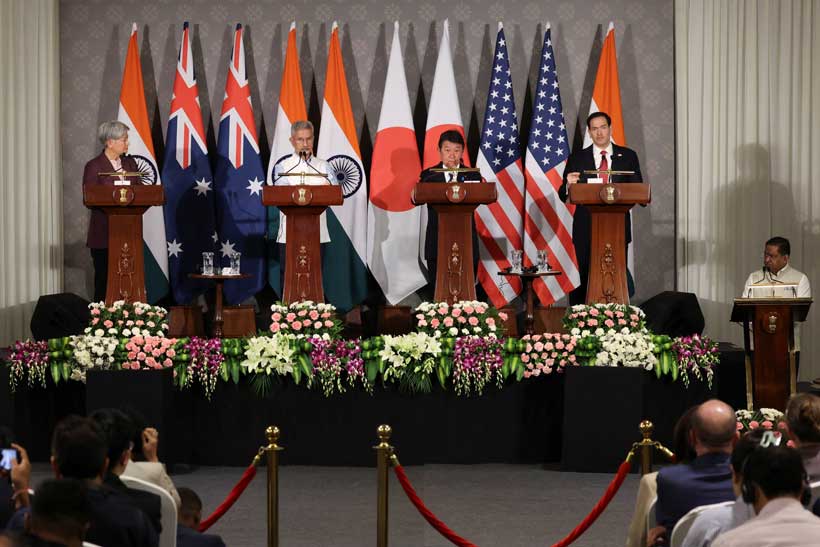
The Quad’s recent ministerial-level summit on May 26, 2026, in India provided a vital institutional cushion for a grouping dealing with its most turbulent phase since its revival in 2017. While the meeting of foreign ministers successfully rolled out working-level initiatives on maritime surveillance and critical mineral supply chains, it could not mask a deeper structural failure: the persistent inability to convene the heads of state. No consensus was reached on a date or location for the next Leaders’ Summit, leaving a glaring vacancy at the top of the alliance’s hierarchy. The last time the four national leaders met in person was nearly two years ago, in September 2024, under a completely different geopolitical landscape in Delaware, US.
Since that 2024 meeting, repeated attempts to schedule a standalone Leaders’ Summit throughout 2025 and early 2026 have collapsed in vain. While scheduling considerations may have played a role, the continued inability to convene a leaders’ summit raises questions about the priority currently accorded to the grouping within Washington’s broader foreign policy agenda. This shift is further evidenced by a statement from US Secretary of State Marco Rubio who noted that efforts are going on to plan a meeting on the side lines of another global forum and not a standalone meeting. The White House’s preference for direct bilateral meetings which was vividly illustrated by the recent high-stakes Trump-Xi summit that has reduced the emphasis on its commitment to minilateral architectures like the Quad. When top-level political capital is redirected away from collective regional security and toward bilateral arrangements, the Quad’s role loses prominence. Without the driving force of regular heads of state summits to provide political momentum, the grouping risks drifting from a premier geopolitical steering committee into a working-level forum.
Signals and Perceptions
The relationship was already under strain from previous remarks by Trump, who tried to claim credit for brokering a peace deal between India and Pakistan following the 2025 Pahalgam attack, in which India had retaliated against Pakistan under Operation Sindoor. India sharply rebuked his statements, asserting there is no role for any third party in resolving the conflict. New Delhi’s position has been unequivocal, peace was ensued through direct discussions with Pakistan, and the US played no part in it.
There is also a strange preference of Trump on having one-on-one relationship with state leaders rather than focusing on collective relations between the countries, This is clearly visible in his decision to call Pakistan’s Asim Munir his favourite field Marshal which undermines India’s position in seeing US as a long-term defence ally.
Avoiding Premature Conclusions
At the same time, it would be premature to interpret these developments as evidence of a fundamental shift in US strategy. The United States continues to maintain extensive security commitments across the Indo-Pacific, and strategic competition with China remains a defining feature of its foreign policy. Even so, recent developments suggest that India would be better served by planning for different strategic outcomes rather than assuming continuity in great-power relations.
Pragmatic Approach
The recent events coupled with some examples from history also shows that putting all eggs in one basket might bring strategic vulnerabilities in the long run. Over reliance on any single partner will put India’s interests in jeopardy, meaning India needs to recalibrate its strategy to maintain an equilibrium to balance its regional interests.
The recent diplomatic engagement between Washington and Beijing, and subsequent absence of leaders meet in Quad raises questions about the priority accorded to the Indo-Pacific within current US foreign policy. To counter any unilateral action of any country in the region it is imperative for India to look for other strategic alliances and groups with Japan, Australia and other like-minded countries. A trilateral grouping between India, Australia and Japan will provide for a new churning in the Indo-Pacific region, to check the power imbalance.
India should also work to strengthen its defence engagement with Australia to ensure the preservation of a free, open, and rules-based Indo-Pacific. For India, the wiser course may be to cultivate multiple strategic partnerships rather than rely too heavily on any one country.
