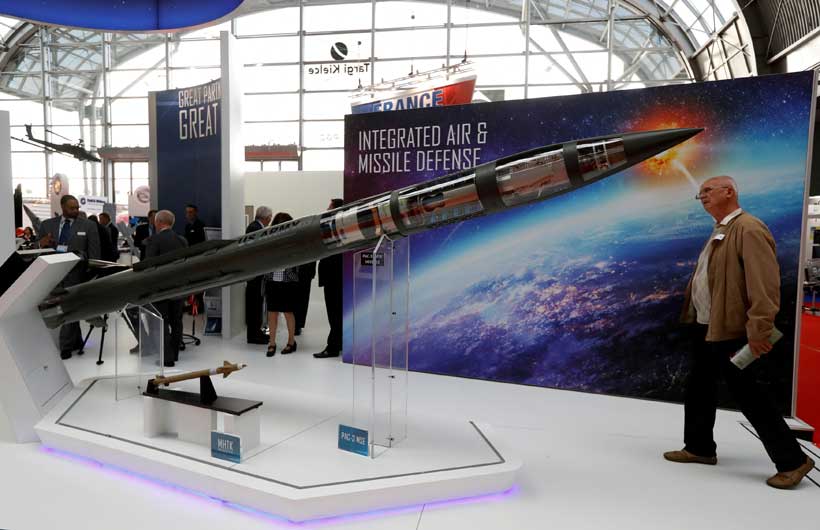
On July 23, Volodymyr Zelensky told Ukrainians that Raytheon wanted to help produce Patriot interceptors on Ukrainian-linked lines. Five days later, Lockheed Martin signed a second license, this one for the PAC-3 MSE — the hit-to-kill missile that has spent three years picking Russian ballistic warheads out of the sky over Kyiv. For a moment it looked like a watershed: the United States handing a country still absorbing nightly missile and drone barrages the blueprint to build its own air defense. Then, within days, the story came apart in public. US Ambassador Matthew Whitaker said Washington would not allow Ukraine to build PAC-3s at all. Donald Trump called the technology transfer “a hard thing to give away.” NATO’s own envoy said no agreement would close before winter. Something had clearly been decided. Nobody could agree on what.
The Patriot system is the closest thing the West has to a proven shield against ballistic missiles, and it is scarce almost everywhere it is needed. Roughly twenty countries now compete for a production line that turns out about 650 PAC-3 MSE interceptors a year worldwide — Lockheed Martin’s entire global output, shared among Ukraine, Israel, Taiwan, Gulf states and the US Army’s own depleted stocks. Russia, meanwhile, has been firing 55 to 60 Iskander ballistic missiles a month at Ukraine alone, before counting the nightly Shahed drone waves that push crews to expend scarce interceptors on cheaper threats out of necessity. The Pentagon has spent much of the past two years quietly rationing Patriot allocations across allies, reportedly diverting orders meant for Taiwan and Ukraine to replenish American stockpiles. Against that backdrop, “Ukraine will build its own Patriots” is not primarily a sovereignty story. It is a story about whether the system that makes Patriots for everyone else can keep up at all.
What the deal actually requires
Start with what was actually signed, because the headlines overstate it. Raytheon’s license covers the PAC-2 GEM-T, an older blast-fragmentation interceptor effective against aircraft and cruise missiles. Lockheed Martin’s covers the PAC-3 MSE, the missile that actually stops Iskanders and Kinzhals. Neither license includes the radar, the fire-control system or the launchers; those still come from existing Patriot batteries. And neither company has committed to building these missiles on Ukrainian soil in the near term. Reporting from Reuters and Ukrainian officials both point to Germany, which already runs its own PAC-2 line, as the likely first production site, with capacity shifting to Ukraine only “after the war ends.” What was announced in July, in other words, is not a factory. It is paperwork that keeps a door open.
Stay ahead of the geopolitical week.
MD Briefing delivers expert analysis across five global fronts — the Indo-Pacific, energy, geoeconomics, European security, and the Middle East — every Monday morning. Free.
Even so, the paperwork matters, because of what it concedes. Every PAC-3 MSE round carries a 24-month production lead time for the missile itself and 30 months for its solid rocket motor. Boeing manufactures every active radar seeker that guides it from a single facility in Alabama, capped at 650 to 700 units a year — a bottleneck no amount of Ukrainian factory floor changes. Aerojet Rocketdyne is the sole source for the motor. These are not obstacles a co-production agreement dissolves; they are structural limits on how fast the United States can arm anyone, Ukraine included. A government does not open its most tightly export-controlled missile program to a country still under nightly bombardment unless it has concluded that the existing pipeline, working alone, cannot meet demand. That is the admission buried in the announcement: not that Ukraine’s industrial base is ready, but that Lockheed’s and Raytheon’s are strained, and Washington needs help from a country it would ordinarily be supplying, not licensing.
The contradictions among American officials sharpen the point rather than undermine it. Whitaker’s flat denial that Ukraine would ever build PAC-3s, arriving days after Zelensky announced the license, is not really about Ukraine’s trustworthiness. A Republican congressional official close to the process gave the more candid version: the manufacturers are less worried about Ukraine leaking American technology to Moscow than about Ukraine improving on it and producing it “at scale, faster and for much less money.” That fear has a track record behind it. Fire Point’s Flamingo cruise missile, built in Ukraine during the war, reportedly costs around $600,000 — roughly a sixth of a Tomahawk and a fraction of a $2 million PAC-3 ACE round — while Ukraine’s home-grown Freyja interceptor is priced at roughly a fifth of the Patriot missile it is meant to substitute for. A country that has spent three years learning to manufacture air defense under fire, at a fraction of Western unit costs, is not the industrial partner a legacy prime wants loose inside its own supply chain. The reluctance is commercial before it is strategic.
The strongest objection to this reading is that Kyiv already produces a large share of its own weapons, so extending that into Patriots is a natural next step rather than a crisis signal. Zelensky puts the domestically produced share of Ukraine’s frontline weapons at close to 60 percent, up from roughly 40 percent a year earlier — drones, the Bohdana howitzer, the Neptune and Flamingo missiles. That is true, and it matters. But those are systems Ukraine designed and built from scratch under wartime pressure, with no legacy export-control regime standing in the way. Patriot is different: it is Washington’s most sensitive interceptor program, run by companies that have spent decades keeping production onshore for precisely the security reasons Whitaker cited. Handing over any piece of it, even nominally, to a country under active bombardment breaks with everything the export-control system was built to prevent. That the United States is doing it anyway — however slowly, however contested internally — says less about confidence in Ukraine than about how thin the interceptor pipeline has become.
Three ways this goes
What happens next depends on which of the deal’s obstacles proves harder to move: engineering or politics.
Base case (our estimate: roughly 55 percent probability). The license survives, but production stays offshore. Germany’s existing PAC-2 line absorbs the first Ukrainian-linked output sometime in 2027; Lockheed and Raytheon leave the seeker and motor bottlenecks unresolved; and Zelensky’s own target of “production capability by the end of 2026” slips the way most Patriot-related deadlines have slipped since 2022. The deal functions mainly as a signal — to Moscow, to Congress, to the manufacturers themselves — that the West is willing to widen its supplier base, without actually widening it before the war’s most dangerous phase has passed.
Downside case. Export-control friction, not battlefield risk, kills momentum outright. Boeing declines to license seeker technology, Congress balks at formally notifying an ITAR transfer into an active conflict zone, and the agreement quietly becomes what several earlier Patriot-adjacent announcements already have: a signed memorandum with no factory behind it. Unable to close its ballistic-missile gap through licensed production, Ukraine leans harder into Flamingo and Freyja — cheap and available, but not full substitutes for hit-to-kill interception. Iskander and Kinzhal strikes on Ukrainian cities continue at close to current tempo through 2027.
Upside case. Ukraine’s wartime manufacturing culture forces the restructuring the primes have been resisting. Facing a credible cheaper competitor, Lockheed and Raytheon accelerate second-sourcing of seekers and motors — the actual chokepoints — to defend market share rather than out of goodwill toward Kyiv. Patriot output rises for every operator, not only Ukraine, and Kyiv becomes the proving ground for a lower-cost interceptor variant that outlives the war. This is the scenario in which an admission of scarcity turns into a fix for it — plausible, but it requires the manufacturers to treat competition, not politics, as the threat that finally moves them.
The takeaway
So: is licensing Patriot production to a country under bombardment an admission? Yes — but not the one the announcements were built to convey. It does not say Ukraine’s industrial base has arrived. It says the American one has not kept pace with a war of attrition it did not plan for, and that Washington is now willing to test its most sensitive export controls against the same scarcity that has Israel, Taiwan and its own Army competing for the same missiles.
Watch for: whether groundbreaking on a German or Polish production line actually begins before the end of 2026 — Zelensky’s own deadline for “technical capability.” If it hasn’t started by then, treat every subsequent announcement as the political theatre this one increasingly resembles: a scarcity confession dressed up as an industrial handshake.