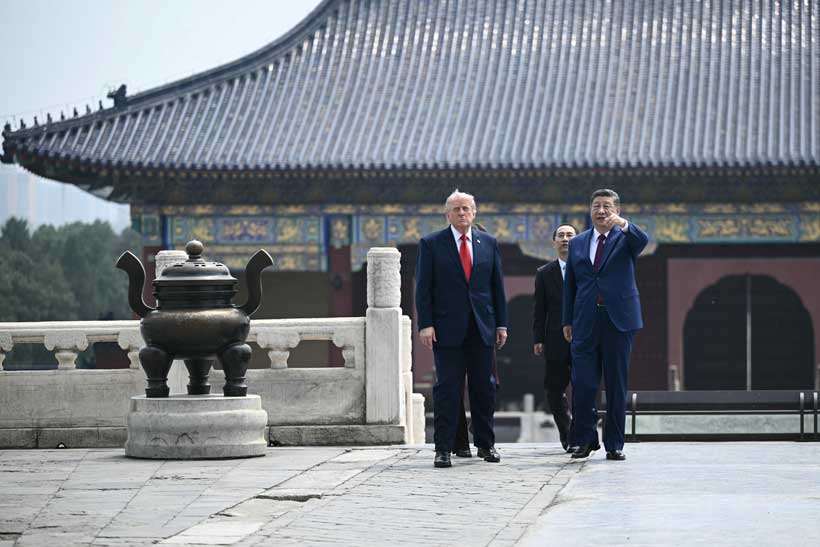
According to an exclusive report from POLITICO, Xi Jinping’s planned September visit to the United States has reportedly been shortened to just one day. If accurate, this would suggest that the outcomes and hard-won trust built during the two leaders’ May meeting in Beijing have nearly evaporated.
Historically, instances in which a Chinese leader has visited a foreign country for only one day have involved either neighboring states or brief stops packed into a multi-country itinerary. If Xi’s trip to the United States—a country far from China—is indeed limited to a single working day while still being labeled a “state visit,” it would be the first case of its kind. Notably, Trump’s May visit to Beijing was also officially a “state visit,” but it spanned two substantive working days.
A leader’s “flying visit” is typically categorized as a working meeting rather than a state visit—Israeli Prime Minister Benjamin Netanyahu’s visits to the United States, for instance, are almost always working meetings; the closeness of the US-Israel relationship makes elaborate ceremony unnecessary. By contrast, both China and the United States have designated this visit a “state visit,” yet the itinerary is extremely brief. However one looks at it, this is not a way of conveying goodwill—and may in fact reflect an effort to avoid conveying goodwill so as not to paper over the two countries’ major differences.
Although this report has not been confirmed by either Chinese or American officials, it nonetheless highlights the disarray surrounding the visit.
Stay ahead of the geopolitical week.
MD Briefing delivers expert analysis across five global fronts — the Indo-Pacific, energy, geoeconomics, European security, and the Middle East — every Monday morning. Free.
In May, Xi and Trump established a “constructive and stable China-US relationship,” cooling a confrontation that had been intensifying since 2025. But all sides, including both governments, know this consensus rests on shaky ground—showing little sign of concrete “constructiveness,” let alone genuine “stability.”
Instead, China and the United States remain locked in intense competition across geopolitics, technology and supply chains, trade and economics, and global governance, each side probing and countering the other.
On technology and supply chains, trade, and global governance, Beijing never harbored high expectations for the May consensus, because the Trump administration has made clear that it only wants to ease the core point of contention between the two countries—the Taiwan issue—without altering the broader pattern of competition elsewhere. After all, “opposing China” remains Washington’s primary posture, a key source of leverage, and the adversarial structure is unlikely to change easily.
Yet even on the Taiwan issue—the matter Beijing cares about most—the Trump administration has not softened its actual conduct. It has instead continued to reinforce the self-armament of the First Island Chain, planting as many “tripwires” for conflict as possible and linking them together in an apparent effort to surround China’s periphery with unexploded ordnance at every turn.
In Xi’s view, the foremost external threat is Japan, which is using the Taiwan issue as leverage to expand its own military buildup. Xi had reportedly hoped Trump would “rein in Tokyo,” but that hope was quickly dashed. The reason is straightforward: “Japan’s leash” is one of Washington’s primary sources of leverage in East Asia, and loosening that leash helps Trump maintain the upper hand at the negotiating table.
Since the May summit, Japan has accelerated the military buildup of its southwestern islands, deepened real-time intelligence sharing and joint tactical planning between the Japan Self-Defense Forces and the command structure of US forces stationed in Japan, and frequently held high-intensity joint air and naval exercises, anti-submarine operations, and air-defense drills with US forces. Tokyo has also expanded its Official Security Assistance (OSA) to the Philippines, Vietnam, and other countries, providing patrol boats, coastal radar, and other surveillance equipment; deepened the Quadrilateral Security Dialogue (Quad) framework with Australia and India; and advanced security and defense-equipment cooperation with Indonesia and other Southeast Asian nations.
In addition, Tokyo has accelerated the buildup of its strategic strike capabilities—purchasing US-made cruise missiles, developing long-range missiles domestically, rapidly expanding defense spending toward 2% of GDP, enlarging its defense bureaucracy, further loosening legal restrictions on exports of lethal weapons, and even declaring its willingness to openly discuss the question of “going nuclear.”
The United States has played the role of accelerant, not restraint, in Japan’s self-armament—and has made little effort to hide it. Beijing has been watching all of this closely.
In response, China has also escalated its pressure on Japan, tightening controls on rare earths and “dual-use” items to precisely target Japan’s defense-industrial supply chains, conducting joint air and sea patrols with Russia around Japan on a more regular basis, frequently and routinely transiting the Miyako Strait into the Western Pacific for combat-oriented exercises, and reframing the narrative around the “post-World War II international order” by arguing that Japan should be “fully disarmed” under international law and emphasizing the “illegality” of Japan’s rearmament.
Regarding Japan’s efforts to extend its military footprint into Southeast Asia, Beijing has warned regional countries against “riding the coattails of Japanese militarization,” while working to build multilateral security and economic channels in the Middle East and Southeast Asia that exclude Japan and the United States.
At the same time, the United States continues to actively build out a first-island-chain drone industry to strengthen its “asymmetric deterrence” against China while courting Southeast Asian countries to join in—effectively acting in tandem with Japan on separate but coordinated tracks.
As for Australia and New Zealand on the region’s periphery, both have, with US encouragement, become targets of military cooperation sought by Japan and the Philippines; since May, both countries have also grown increasingly confrontational toward China.
Overall, East Asia has entered the early stages of an arms race over the past few months—defense-budget growth rates significantly outpacing economic growth; a shift from “defensive posture” toward “long-range strike at the source”; upgraded military-alliance mechanisms and “military-technology integration”; supply-chain securitization and export controls on critical technologies; and increasingly “combat-realistic” military exercises.
In July, a Chinese strategic nuclear submarine test-launched a nuclear-capable, intercontinental-range ballistic missile, marking the first time a submarine-launched ballistic missile from China has been fired directly into the international waters of the Pacific—demonstrating second-strike capability and sending a clear warning about the regional arms race. Australia reacted forcefully, leading a multinational joint condemnation, with its foreign minister traveling to Southeast Asia to personally lodge a protest with China’s foreign minister.
This illustrates how far-reaching the consequences of US-backed Japanese rearmament have been—consequences that are gradually forcing China to escalate its own countermeasures. The result carries no “constructiveness” whatsoever; if anything, it highlights only “negativity” and is far from “stable.”
Trump tends to reduce complex interstate relationships to personal contests between leaders, a tendency rooted in his confidence in his own negotiating skill. This is also why Trump prefers dealing with leaders who hold concentrated power—a quality no leader of a major European country possesses. Japan’s political system is closer to the European model, which is more effective at restraining any tendency toward one-man rule; this is why Prime Minister Takaichi Sanae has worked to loosen legal constraints on executive power and why the United States—needing a compliant strongman—has been willing to help her do so.
In Trump’s eyes, Xi is a far-sighted but conservative leader, whose personality stands in sharp contrast to his own—a contrast that encourages Trump to “let loose” as much as possible, continually refreshing his tactical offensives to keep Beijing off balance, forcing it to seek stability and, in the process, make concessions.
Yet even though Xi has a strong desire to stabilize the relationship, China will not allow bilateral ties to become a personal contest between two leaders, because the risks of doing so are too high. In a sharply adversarial environment, a leader seen as pursuing appeasement pays a political price in domestic legitimacy—and Xi is no exception.
Broadly speaking, Trump’s read on Xi is largely correct, but he may be misjudging the source of Xi’s political power. Simply put, political power in China is not derived from elections but from the effective management of a vast public opinion base. Once public dissatisfaction with a given policy shows signs of spiraling out of control, Beijing’s policy reversals tend to come swiftly and abruptly.
The clearest example is the sudden reversal of China’s zero-COVID policy: had public frustration not surfaced through the “Blank Paper” protests, China would not have reopened so quickly—the shift happened almost overnight.
Given China’s enormous population, public discontent can spread as fast and as fiercely as wildfire, which is why the Chinese Communist Party has become highly adept at monitoring shifts in public sentiment in order to relieve pressure before it builds too far. From the Taiwan issue to the South China Sea, Chinese public opinion has grown increasingly impatient with what it sees as the government’s restraint, and the effectiveness of official propaganda has been diminishing—which is precisely why Beijing has reacted with such anger to Japan’s use of the Taiwan issue as leverage for its military buildup.
Taiwan was colonized by Japan for fifty years, and Taiwan’s current government is strongly pro-Japan. For a China that has meticulously preserved the historical record of Japan’s invasion, this confrontation with Japan amounts to calling in an unpaid debt from World War II—which also drives up both the cost and the risk for Beijing in managing public opinion. Moreover, since forcing a resolution to the Taiwan issue outright is a showdown Beijing is currently unwilling to initiate, Beijing is instead bound to direct its focus toward Tokyo as an outlet for domestic discontent.
This explains why, at the May summit, Xi focused on the Taiwan issue and its derivative, the Japan issue—two sides of the same coin. His underlying aim is to prevent East Asia from sliding into a full-blown arms race, since such an outcome would be detrimental to China’s broader agenda of economic development, which in turn is the primary foundation for effectively managing public opinion and sustaining the legitimacy of the government.
It is especially important not to overlook that 2027 marks a year of political leadership transition in Beijing. Xi, who has already been perceived by segments of the public as weak, would need to project a firm posture on external issues in order to secure a dignified continuation of his tenure—he cannot afford to let a failed US policy, a failed Taiwan policy, or a failed Japan policy undermine the legitimacy of his rule.
Not to mention that domestic pressures within China—sluggish consumption, employment difficulties, and economic transition—remain substantial, leaving Xi little room to appear weak abroad. Japan, in this context, serves as a convenient outlet for releasing that pressure.
The “one day” suggests that Beijing no longer expects Trump to rein in Japan; the trajectory of objective developments in the region corroborates the sense that Trump’s assurances to China have amounted to more talk than substance. The reason the visit has been reduced to ‘one day’ rather than cancelled outright is that Beijing wants to prevent Trump from using a cancellation as a pretext for a China-US showdown.
With the United States nearly exhausted on the Middle East battlefield, disappointment among its allies has been spreading outward from the Gulf region—a double-edged development for Xi. On one hand, the “American team” is fragmenting, diluting the concentration of anti-China forces; on the other hand, US allies are increasingly breaking free of Washington’s control to fend for themselves—either banding together with other small and mid-sized states or arming themselves under the remaining protection of the US security umbrella. This trend is not favorable to China’s pursuit of a stable postwar order.
The real adversary facing the international community is not China, Russia, North Korea, or Iran, but rather the chaos produced by the erosion of unipolar American hegemony. In fact, Beijing does not want the United States to decline too quickly, because such a scenario would catch China off guard—and rapid adaptation to sudden change is precisely what China is least equipped to handle.
This is why, no matter how strained China-US relations become, China continues, from time to time, to extend a hand to steady the United States rather than let it fall—out of concern that if the US were to fall too hard to get back up, it could trigger sweeping disorder in the international order and shatter the stable foundation on which China’s rise depends.
China-US trust reduced to a single “day” is a portent of even more intense turbulence to come in 2027.