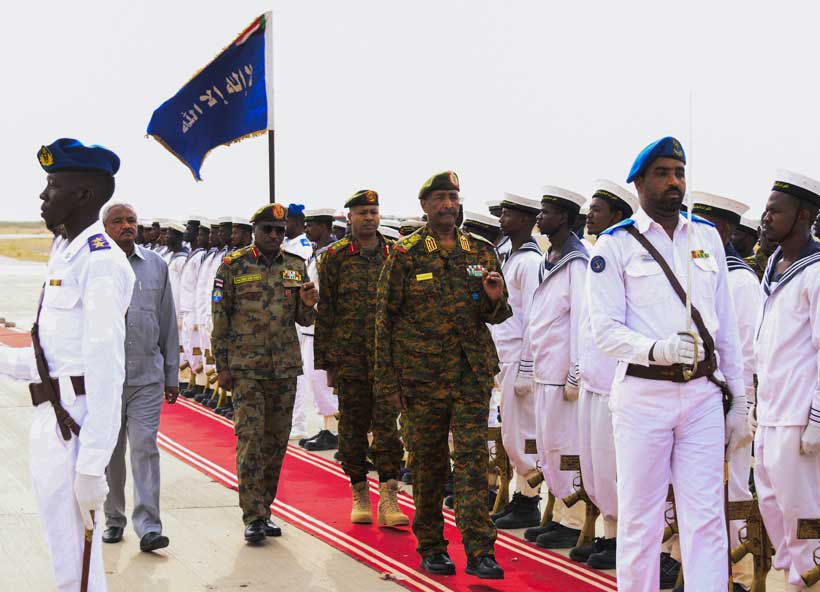
Saudi Arabia is quietly trying to build a civilian political base around Sudanese Armed Forces (SAF) chief Abdel Fattah al-Burhan, according to Africa Intelligence, in what appears to be a bid to reshape Sudan’s postwar future while keeping the general at the center of power. The reported effort comes as the war between the SAF and the Rapid Support Forces (RSF) drags on, with diplomacy stalled and civilian rule still elusive.
Africa Intelligence says Saudi Deputy Foreign Minister Waleed Elkhereiji has been holding private one-on-one meetings in Riyadh since March with leading members of Abdallah Hamdok’s civilian coalition, Somoud, including Mariam al-Sadiq al-Mahdi, Abdelrahman al-Sadiq al-Mahdi, and Omar el-Degeir. The report says Riyadh is trying to pull the most visible civilian figures into Burhan’s orbit. Saudi officials are also said to have brought in seasoned diplomats Nurelddin Satti and Dafallah Al-Haj Ali as part of a broader effort to broaden the coalition’s credibility.
The strategy appears designed to give Burhan a civilian front that could help him gain international acceptance while Saudi Arabia revives the Jeddah process, the ceasefire track it helped launch with Washington in May 2023. But the move also reflects a deeper problem for Riyadh: Burhan’s own record makes it difficult to present him as the figurehead of any serious civilian transition. The United States sanctioned him in January 2025 and said that, under his leadership, SAF members had continued to commit atrocities, target civilians and civilian infrastructure, and execute civilians.
Burhan’s credibility as a transition leader is further damaged by his repeated obstruction of peace efforts. The U.S. State Department said he refused to take part in international ceasefire talks in Switzerland in August 2024 and “repeatedly obstructed” Sudan’s political transition to civilian rule. That matters because a civilian coalition built around a military leader who has fought against compromise risks appearing as a political cover for continued military domination rather than a genuine step toward democracy.
Stay ahead of the geopolitical week.
MD Briefing delivers expert analysis across five global fronts — the Indo-Pacific, energy, geoeconomics, European security, and the Middle East — every Monday morning. Free.
The SAF’s conduct in the war also weakens any attempt to recast Burhan as a guardian of civilian governance. The UN Fact-Finding Mission said in June 2025 that the conflict had killed tens of thousands of civilians, displaced more than 13 million people, and created an escalating human rights emergency marked by heavy weapon use in populated areas, retaliatory violence, and weaponized humanitarian relief. The mission also documented SAF bombing in Al Koma that killed at least 15 civilians, while in recaptured areas such as Khartoum, Gezira, and Sennar, it found widespread reprisals, arbitrary arrest, torture, and executions of people perceived to support the RSF. Saudi Arabia is reported to be financing a major arms deal between Pakistan and the SAF, valued at approximately $1.5 billion. According to Reuters, the agreement includes JF-17 fighter jets, K-8 fighter jets, drones, and armored vehicles intended to bolster SAF’s military capabilities.
Human Rights Watch’s 2026 report also described indiscriminate shelling and air attacks by the SAF, including strikes on residential and commercial neighborhoods and a mosque that killed civilians. It said both sides have unlawfully detained, tortured, and executed civilians and that SAF-allied forces targeted civilians in Tayba village. Those findings reinforce the broader picture: Burhan does not command a force that can credibly claim civilian protection as a political principle.
That is why the Saudi push is likely to be seen by many Sudanese as a geopolitical maneuver rather than a democratic breakthrough. Riyadh may hope that figures from Somoud and other technocrats can give Burhan the appearance of civilian legitimacy, but legitimacy cannot simply be imported through elite meetings in Riyadh. A coalition meant to lead Sudan would need credibility rooted in restraint, accountability, and support for a real transition. Burhan’s record points in the opposite direction.
A London-based Africa analyst added, “We also have to consider the possibility that the Saudis are in effect trying to divide Somoud and corrupt any advance towards a civilian-led transition. This effort has been running in parallel with, and effectively counter to, the civilian gathering in Addis two weeks ago that has been working to establish a common civil-political negotiating platform for a peace.”
The African country’s war remains locked in a destructive stalemate. The UN said humanitarian relief is being blocked or manipulated, famine is deepening, and civilians continue to bear the brunt of the violence. Against that backdrop, the idea of building a civilian coalition around a military commander accused of obstructing peace and presiding over atrocities looks less like a solution than another attempt to manage Sudan’s crisis from above.