


On June 5, Trump signed National Security Presidential Memorandum 11. The document is titled “Artificial Intelligence in the National Security Enterprise” and it does exactly what that title suggests: it tells the US military, intelligence agencies, and every national security department how they will adopt, deploy, and govern artificial intelligence going forward. It replaces Biden’s NSM-25, which the White House called a document that “burdened American AI adoption.” Whether that characterization is fair is debatable. What is not debatable is that NSPM-11 represents the most comprehensive statement the US government has ever made about how it intends to use AI in war and intelligence.
Speed First, Questions Later
The memo’s organizing principle is acceleration. National security agencies have 120 days; a deadline falling on October 3, 2026, to overhaul their AI procurement processes entirely. The old model, where a single vendor could hold a dominant position in classified AI work, is finished. NSPM-11 mandates a multi-vendor framework, requiring agencies including the Department of Defense, the NSA, CISA, and the Director of National Intelligence to establish partnerships with both large and small AI firms simultaneously. No single company gets to be the choke point.
The memo also builds in something genuinely unusual: government agencies will get access to frontier AI models up to 30 days before their public release, through voluntary frameworks that companies can opt into. The original draft proposed 90 days of pre-release access, which the AI industry pushed back on hard. The final version settled at 30 days. Even so, the provision creates an arrangement where the government gets an early look at the most advanced AI capabilities before anyone else in the world — a form of strategic intelligence about where the technology is going that has no real precedent in the history of US defense procurement.
The memo also directs the creation of an AI National Security Strategic Reserve, a talent bench of top non-governmental AI experts who can be mobilized when needed. High-security computing facilities designed to run advanced AI models on classified networks are to be built out at scale. The pace being demanded throughout the document is not normal procurement pace. It is wartime pace, applied to peacetime capability-building, which reflects the administration’s reading of where the US-China AI competition actually stands.
Stay ahead of the geopolitical week.
MD Briefing delivers expert analysis across five global fronts — the Indo-Pacific, energy, geoeconomics, European security, and the Middle East — every Monday morning. Free.
The Clause That Has Anthropic Written All Over It
Buried inside the memo’s procurement provisions is a clause requiring agencies to terminate contracts with AI companies that “repeatedly limit government use of their technology.” Nobody in the administration named Anthropic when discussing the memo publicly. Nobody needed to.
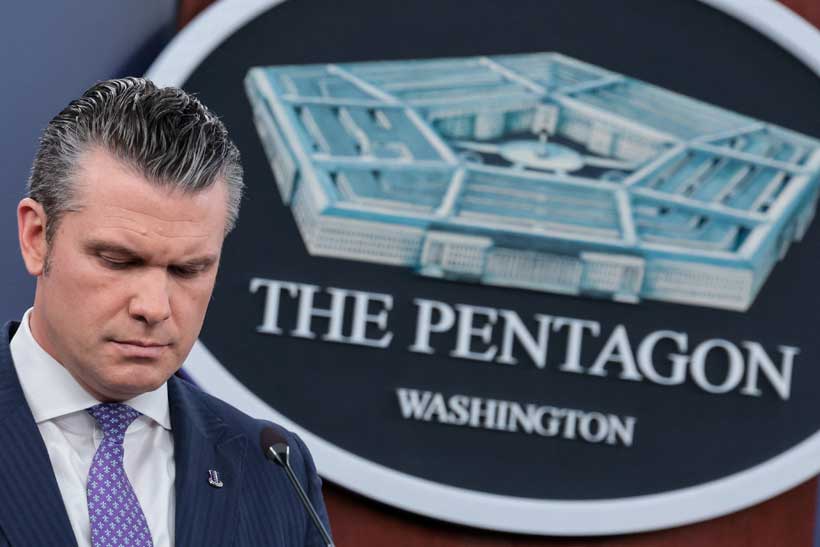
The backstory: the Pentagon, under Pete Hegseth, designated Anthropic a supply-chain risk after the company refused to drop two contractual limits it had insisted on, one barring its AI from being used in lethal autonomous weapons, and one prohibiting its use in domestic mass surveillance. The Pentagon’s position was that it needed access to AI for “all lawful purposes” and that a private company did not get to define what those purposes were. Anthropic’s position was that some uses were harmful enough that no contract was worth enabling them.
The fight exposed something the memo tries to resolve on the government’s terms: who controls a deployed AI system, and what it may lawfully do. The no-disable clause answers the first question clearly: no commercial entity can disable, degrade, or modify a fielded government AI system without prior federal approval. The second question, what the system may lawfully do, gets a more complicated answer. The memo draws an immediate line against unlawful domestic surveillance. The rules on autonomous weapons are deferred, the Secretary of War has 90 days to update the Pentagon’s directive on weapons autonomy, meaning the most consequential question in the entire document is the one being answered in a classified annex that nobody outside the administration has seen.
The irony running through all of this is that NSPM-11 includes a waiver for Claude Mythos — Anthropic’s most advanced model, currently in use at the NSA, even as the broader memo is structured partly as a response to the Anthropic dispute. The administration needs the technology badly enough to keep using it while simultaneously building the legal framework to sideline the company that makes it.
Who Is Actually Responsible When Military AI Gets It Wrong?
Here is where the memo does something important and also something incomplete simultaneously.
The accountability framework NSPM-11 establishes responsibility within the military chain of command. Agency leaders and commanders are accountable for how AI is used under their authority. The chain runs from the American people through the president to the warfighter. On paper, this is the right answer, it places accountability where authority already lives, rather than routing it through civilian standards bodies or voluntary international frameworks, which was the Biden approach.
In practice, whether this framework means anything depends entirely on whether the people at the top of that chain respect institutional constraints. A human accountability framework functions when the humans enforcing it believe they are bound by the rules. This administration has spent eighteen months demonstrating a fairly expansive view of executive authority. A memo that emphasizes chain of command and rule of law lands differently in Trump’s second term than it would have in almost any prior administration, and experts across the political spectrum have noted the gap between the words on the page and confidence about implementation.
The surveillance prohibition illustrates the problem. The memo explicitly bars unlawful domestic surveillance. The word “unlawful” is doing enormous work in that sentence, because the definition of lawful surveillance has been contested between the executive branch, Congress, and the courts for decades. Drawing the line at “unlawful” and leaving the definition of lawful to executive discretion is not a safeguard. It is a placeholder for a fight that has not yet happened.
Beijing Is the Subtext Behind Every Deadline in This Memo
The memo’s urgency makes more sense when read against the US-China AI competition rather than against domestic AI governance debates. China has been integrating AI into its military and intelligence apparatus at a pace that has alarmed US defense planners. The People’s Liberation Army has AI-enabled targeting, logistics, and surveillance systems that are operational rather than experimental. The gap between where US national security AI adoption currently stands and where it needs to be, by the administration’s own assessment, is the real driver of the 120-day deadline and the wartime procurement urgency.
The multi-vendor mandate reflects a specific lesson from the commercial AI sector: single-vendor dependency creates fragility. If one company becomes the dominant AI supplier to the US military and then faces a dispute like the Anthropic situation, the entire national security AI program gets disrupted. Distributing contracts across multiple providers, including smaller firms that were previously locked out of classified work, builds redundancy into the system in the same way that diversifying energy suppliers builds resilience against supply shocks.
The 30-day pre-release access provision is the most strategically significant element in the document that has received the least analysis. If US national security agencies get to see the most advanced AI models a month before they are publicly released, they get intelligence about where the technology frontier is moving before adversaries do. They also get the opportunity to identify vulnerabilities, security concerns, and potential misuse cases before deployment. That is a meaningful strategic advantage, and China has no equivalent arrangement with its domestic AI companies, at least not through any voluntary framework. Beijing’s relationship with its AI sector is considerably less voluntary.
What the Memo Gets Right and What It Leaves Open
NSPM-11 gets several things right. The multi-vendor framework is the correct procurement architecture for a technology moving this fast. The accountability-within-the-chain-of-command structure is the right governance model in principle. The no-disable clause addresses a genuine vulnerability that the Anthropic dispute exposed. And the urgency, while politically uncomfortable to acknowledge, reflects an honest assessment of where the competition with China actually stands.
What it leaves open is more significant than what it resolves. The autonomous weapons directive has been deferred to a classified document that Congress and the public cannot scrutinize. The definition of lawful surveillance has been left to executive discretion. The question of who gets to draw the line on what AI may lawfully do; the lab, the executive, the courts, or Congress, is explicitly unresolved in the text. And the central credibility problem that CFR’s Michael Horowitz identified is real: a document emphasizing accountability and rule of law means something different when issued by an administration whose relationship with institutional constraints has been, at minimum, complicated.
Congress Has to Finish What the Memo Started
Congress has a role here that the memo alone cannot fill. The framework NSPM-11 establishes needs to be codified in defense and intelligence legislation, with the autonomous weapons rules incorporated once they are issued, the surveillance prohibition given statutory force, and independent oversight mechanisms built in that do not depend on executive goodwill to function. A presidential memo can set direction. Only law can set limits that survive the next administration.
