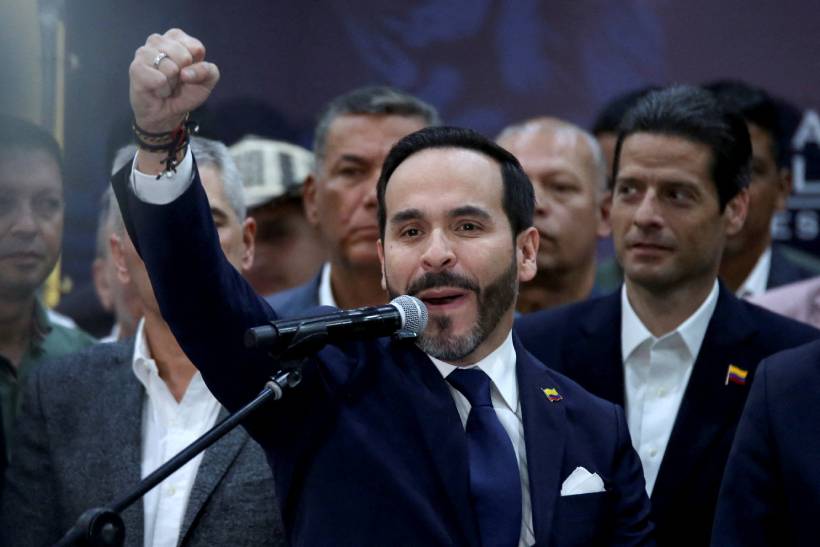
On 7 August, Abelardo de la Espriella — a Colombian-Italian-American lawyer nicknamed “El Tigre,” whom Donald Trump had called a future “great president” months before a single vote was cast — was sworn in as Colombia’s president not in Bogotá’s Plaza de Bolívar, where every inauguration since 1958 has been held, but behind an 11,000-troop security cordon in Cali, with drones banned and private cars barred from the streets. Outgoing president Gustavo Petro never accepted the result and stayed away, calling the transfer fraudulent. Two days earlier, and four thousand miles away, Giorgia Meloni’s Italy suspended Schengen with Spain over a Ceuta migrant surge, and Madrid retaliated with its own border checks on Italian travellers — the sharpest crack in Europe’s open-border system since 2015. Read apart, these are two domestic stories. Read together, on the same news cycle, they look like something else.
De la Espriella, a political outsider, beat Petro’s chosen successor Iván Cepeda by under one point (49.7% to 48.7%) in June’s runoff, promising to end peace talks with FARC dissidents, launch a 90-day US-backed military offensive, and rebuild ties with Washington and Israel. Trump endorsed him mid-campaign, branded Cepeda a “radical left-wing Marxist,” and phoned to congratulate him on election night. At the inauguration, incoming US Attorney General Todd Blanche represented Washington, which pledged $1bn in security assistance pending Congress; Argentina’s Javier Milei, Chile’s José Antonio Kast and Ecuador’s Daniel Noboa attended, and Secretary of State Marco Rubio declared the “overwhelming majority” of the Western Hemisphere now “led by pro-American leaders.” In Europe, after roughly 72,000 people crossed into Spain’s Ceuta enclave from Morocco in 48 hours, killing at least 80, Meloni’s government shut the border to Spain “to protect national security,” rejecting Madrid’s demand to lift the checks as an “ultimatum”; Spain answered in kind on 7 August while separately approving €25m for Ceuta’s unaccompanied minors. Brussels has urged both sides to stand down, but eight EU states now run some form of internal border control — the practical unwinding of a principle, not just one bilateral spat.
THE ARGUMENT
The instinct to read these as one story is not paranoid. There is an actual, documented infrastructure connecting them. Vox’s Fundación Disenso launched the Madrid Charter in 2020, a platform against “communism” in the Hispanic world that Milei, Chile’s Kast, Brazil’s Eduardo Bolsonaro, Peru’s Keiko Fujimori and Venezuela’s María Corina Machado have all signed; Santiago Abascal has spent the past two years shuttling between Madrid and Budapest, where CPAC Hungary, the Danube Institute and Poland’s Ordo Iuris function as the European anchors of a network that runs through Washington’s Heritage Foundation and Leadership Institute. De la Espriella himself is a walking transatlantic data point: alongside Colombian citizenship, he holds both American and Italian passports. The rhetorical toolkit is shared and travels fast — “deep state” becomes “Brussels bureaucracy” becomes Petro’s “establishment”; migrants and “Marxist” guerrillas are cast in near-identical civilizational terms whether the speaker is in Cali or Rome. Washington’s backing is not just verbal: the pattern that delivered Milei a US-backed financing package worth more than $17bn, conditional on his party’s performance in last year’s legislative elections, is the same pattern now delivering Bogotá a billion-dollar security pledge within days of an inauguration Washington’s own attorney general flew down to attend. Trump’s administration formalised the logic in November 2024 with what it called a “Donroe Doctrine” — an explicit statement that Washington will treat Latin America as a sphere of influence and “discourage” governments from working with anyone else. Read next to Rubio’s “pro-American hemisphere” line at De la Espriella’s inauguration, that is not a coincidence of timing; it is a stated policy of rewarding ideological alignment with capital and cover.
Stay ahead of the geopolitical week.
MD Briefing delivers expert analysis across five global fronts — the Indo-Pacific, energy, geoeconomics, European security, and the Middle East — every Monday morning. Free.
But the Ceuta episode is the harder test of the “coordinated internationale” reading, and it fails it. Spain’s government is not a left-wing target the transatlantic right closed ranks against together — Pedro Sánchez’s Socialists hold power in Madrid, and it was Meloni, nominally the senior figure of Europe’s governing right, who turned the border-security playbook against a fellow EU capital, not in solidarity with it. There was no joint European right position: Spain’s own hard right, Vox, broke with its own government to side rhetorically with Meloni, with Abascal opposing aid for Ceuta’s unaccompanied minors even as his country’s checks went up against Italy. That is the tell. What crosses the Atlantic is not a chain of command issuing synchronized instructions; it is a repertoire — border closures as theatre, migrants as security threat, “Marxist” as the label for any opponent — plus a standing service of mutual legitimation that Trump extends to De la Espriella and that Vox extends to Meloni, deployable by whichever faction finds it useful in a given week, including against a nominal ally.
The strongest objection to treating this as a movement at all is that each leader has a purely local story: De la Espriella’s win reflects genuine exhaustion with Petro after a term of stalled peace talks and rising violence; Meloni’s border closure reflects Italian domestic politics that have nothing to do with Bogotá. That is true, and it matters — but it does not defeat the thesis, because the thesis does not require central direction. It requires only that a shared toolkit, a shared donor and personnel base, and a mutual-legitimation habit lower the political cost of moves that were fringe a decade ago — suspending a peace process, suspending Schengen — until they land on two continents in the same week without needing to be coordinated at all.
SCENARIOS TO WATCH
Base case (roughly 55%, our central view): the convergence stays real but transactional — style, personnel and rhetoric shared, strategy not. Brazil’s October election is the next node to watch: Flávio Bolsonaro, who named his running mate on 5 August, is running close to level with Lula in current polling. Expect the same playbook as Colombia — early Trump-world endorsement, pre-positioned fraud messaging usable regardless of who wins, appearances by the same regional cast of Milei, Kast and Noboa — but no formal alliance structure or joint strategy emerging behind it. This holds as long as no network member pays a real price for freelancing against another.
Downside case (for De la Espriella specifically, roughly 25%): his own mandate is the fragile point in the wider narrative, not its proof. A 49.7–48.7% result, an outgoing president alleging fraud without evidence, an inauguration relocated out of the capital under an 11,000-troop cordon, and a president-elect whose declared businesses were reported by Colombian outlet La Silla Vacía to be largely dissolved or indebted — this is a thin base from which to run a 90-day military offensive against armed groups. If that campaign reignites conflict rather than ending it, Washington’s $1bn pledge and Rubio’s “pro-American hemisphere” narrative absorb the reputational damage together, making Colombia the network’s first visible failure rather than its showcase win.
Upside / alternative case (roughly 20%): the network’s internal fault line widens faster than its coordination deepens. Ceuta already showed nationalist allies turning border-sovereignty logic on each other the moment interests diverge, with Vox breaking from Spain’s own government to back Rome. A second collision — over EU funding formulas, asylum-externalisation costs, or competing claims on US attention and money between Bogotá and Brasília — would expose the “illiberal internationale” as a shared vocabulary with no shared discipline, and commentary would swing from treating it as a coordinated movement to dismissing it as coincidence, missing the toolkit in between.
THE TAKEAWAY
Nobody in Mar-a-Lago told Rome to close the border on Madrid, and nobody in Rome told Bogotá to move its inauguration to Cali. But a functioning infrastructure — the Madrid Charter’s signatory list, the CPAC-to-Danube-Institute circuit, a White House willing to attach financing to ideological loyalty — now exists to make those moves cheaper, faster and more mutually legitimating than they were five years ago, without anyone needing to issue an order. That is a franchise, not a command structure, and franchises fracture the moment members compete rather than borrow from each other. Watch what happens when this network’s members collide over something with real stakes rather than shared slogans: Brazil’s October vote, where Trump-aligned money and messaging will be tested not against the left, but against the discipline of the movement itself.