


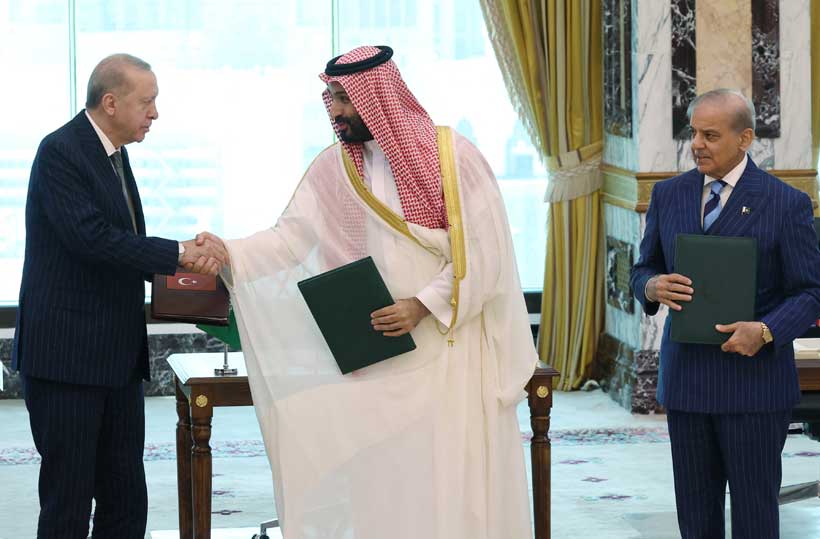
In the city where Islam began, three leaders sat down last Friday and signed something the region has not seen before. Saudi Arabia’s Mohammed bin Salman, Turkey’s Recep Tayyip Erdogan, and Pakistan’s Shehbaz Sharif put their names to the Mecca Joint Defence Agreement: a mutual defence pact declaring that an armed attack against any one of them is an attack against all. The location was deliberate. No diplomatic hall could have carried the weight that Mecca did. This was not just a security arrangement. It was a statement about who gets to define power in the Muslim world, and the answer was: not Washington.
The immediate context is the Iran war. Since the US and Israel struck Iran in February 2026, Saudi Arabia has absorbed missile attacks from Iran, from the Houthis in Yemen, and from Shia armed groups in Iraq. Its oil exports have been disrupted, its development ambitions strained, and the American security umbrella it has sheltered under for decades has started to feel less reliable than it once did. The Mecca pact is Riyadh’s answer, and the answer is that Saudi Arabia is done waiting for Washington to feel like showing up.
Three Countries, Three Agendas, One Signature
The pact works because each country gets something different from it, and none of them had to give up much to sign.
For Saudi Arabia, it is insurance against the American guarantee fraying further. The kingdom brings capital, geography, and political convening power, but its military capacity has always relied on American hardware, American training, and the implicit promise that nobody would seriously threaten the kingdom’s survival. Ankara now fills part of that gap; drones, missiles, electronic warfare, naval systems, and NATO-derived expertise that Washington cannot cut off. Islamabad fills the rest with something no other Muslim country can offer: a nuclear deterrent. Saudi Arabia has just diversified its security portfolio in the most consequential way possible, without formally breaking from the US.
Stay ahead of the geopolitical week.
MD Briefing delivers expert analysis across five global fronts — the Indo-Pacific, energy, geoeconomics, European security, and the Middle East — every Monday morning. Free.
For Turkey, the pact is about reach and recognition. Erdogan has spent years positioning Ankara as an indispensable power, with military presences in Qatar, Syria, and Libya, a drone industry that has reshaped warfare across multiple theatres, and a foreign policy that refuses to choose sides. The Mecca pact adds density to that project. It connects Turkey to Saudi financial markets for its defence industries and affirms Ankara’s place in the energy and trade corridors between the Gulf and Europe. Turkey is already NATO’s second-largest army. It is now also a founding member of the most significant new defence bloc of the decade.
For Pakistan, the calculation is more acute and more personal. Islamabad has long understood that its nuclear arsenal is simultaneously its greatest strategic asset and its most sensitive diplomatic liability. The Mecca pact gives Pakistan a formal framework in which that capability functions as a regional deterrent, a Saudi nuclear umbrella by proxy, without the proliferation implications of a direct arrangement. It also opens Saudi financial markets to Pakistan’s defence industry, which has manufacturing capacity far exceeding what Pakistan’s own economy can absorb. That Army Chief Asim Munir travelled to Mecca alongside Prime Minister Sharif was the real signal. The institution that makes Pakistan’s strategic decisions had already decided.
Impressive on Paper but Untested in Reality
The combined numbers are striking. Nearly 1.4 million active personnel. More than 3,400 aircraft. Around 6,000 tanks. Some 344 naval assets. A combined defence budget of $124.4 billion annually. On paper, this is a military bloc of genuine weight.
But numbers are not doctrine. The pact has no joint headquarters, no integrated chain of command, no stated rules of engagement. Turkey’s NATO obligations do not disappear because it also signed in Mecca. Pakistan’s nuclear capability operates under its own command authority, which the pact does not touch. Saudi Arabia’s most advanced hardware is American-made and American-maintained, meaning Washington retains quiet leverage regardless of what Riyadh signs. One analyst said it plainly: this is a framework for strategic coordination among three influential regional powers, not a mutual defence pact comparable to NATO. That distinction matters enormously. Article 5 has been invoked once in seventy-five years, and the entire infrastructure of NATO, integrated command, standardised equipment, decades of joint training, exists to make that invocation credible. The Mecca pact has none of that yet. What it has is political will, complementary capabilities, and a very clear sense of what it is responding to. Whether political will becomes operational reality is the question the next crisis will answer.
The Silent Fourth Partner at the Mecca Table
Nobody invited Washington but Washington is there anyway.
Pakistan receives American aid, Saudi Arabia is the largest foreign buyer of American military equipment and Turkey is NATO’s second-largest army. American hardware, American training, and American maintenance contracts sit inside the arsenals of all three signatories. The US didn’t design this pact and wasn’t consulted on it, but it retains quiet leverage over the military capabilities the pact is built on, a fact none of the three signatories addressed publicly and all of them know privately.
What the pact signals underneath the military statistics is a deliberate decision by all three governments to stop waiting for Washington to convene them. The old model was hub-and-spokes: Washington at the centre, individual states looking primarily to the US for security guarantees, bilateral relationships running through American approval. What is emerging instead is horizontal connectivity, regional powers building direct links to each other, sharing capabilities, and making collective decisions that Washington was not asked to endorse. That shift is the real headline. The missile counts are impressive. The structural change underneath them is what will matter in a decade.
Egypt and the Question of What Comes Next
Turkey’s Foreign Minister has already called Egypt a natural partner, expressing confidence that Cairo will join once technical issues are resolved. Egypt would bring serious weight: the largest Arab army, strategic geography, and control of the Suez Canal. It would also bring complications that may prove harder to resolve than Ankara is letting on.
Egypt’s relationship with Washington, cemented by decades of military aid, is not something Cairo risks lightly. Its formal peace treaty with Israel creates obligations that a pact with this particular political character could complicate. And Egypt’s foreign policy has historically prized autonomy above alignment, Cairo may want to be adjacent to the Mecca bloc without being bound by it. Whether it joins is the variable most worth watching. If it does, the pact becomes the spine of a genuinely new regional architecture. If it doesn’t, the limits of that ambition will become visible faster than anyone in Mecca last Friday would like.
The Pact That Rewrites the Regional Rulebook
The temptation with moments like this is to overstate them. A signed document is not a functioning alliance, and the region has seen agreements that looked transformative on Friday and irrelevant by the following year.
But the Mecca pact is harder to dismiss. It builds on a bilateral Saudi-Pakistan agreement signed just eleven months ago. It has been in negotiation since October 2023. The three countries’ capabilities genuinely complement each other in ways that make the combination more than the sum of its parts. And it was signed at a moment of genuine regional rupture: when the security environment has shifted enough that three governments with very different domestic politics, very different American relationships, and very different threat perceptions all calculated that signing was worth it.
The old Middle East security order was built around American primacy, the Gulf monarchies’ dependence on US protection, and bilateral relationships that ran through Washington. The Mecca pact does not demolish that order. But it introduces something the order did not previously have: a bloc of Muslim-majority states with real military capacity, a formal mutual defence commitment, and a demonstrated willingness to build security arrangements that Washington was not asked to design. That is genuinely new. And in a region reorganising itself since February, new is exactly what this moment demanded.
Our Take: The Region Stopped Asking Washington’s Permission
The Mecca pact will be tested, probably sooner than its signatories would like. A pact without a joint command is only as strong as the political will of its members in the moment a crisis arrives and crises in this region do not wait for command structures to catch up. What Friday’s signing actually changed is not the military balance. It is the psychology of regional order. Three significant powers looked at the most turbulent security environment in a generation and decided that the answer was not to call Washington. They called each other, and that is the shift that matters. It did not need a joint headquarters to be real.
