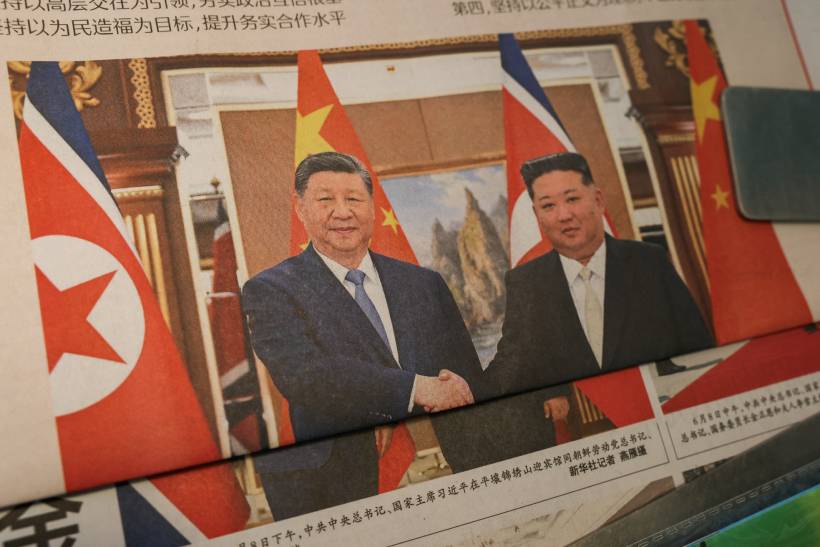
Xi Jinping’s historic Pyongyang summit, coming after 7 years of limited diplomatic engagement, has been touted as a Chinese effort to bring North Korea back under its “orbit.” This comes amid strengthened Moscow-Pyongyang ties due to bilateral military support in the Ukraine war and economic support due to global sanctions and exclusionism, respectively. The ties that Pyongyang holds with Beijing and Moscow fundamentally differ in nature. China’s relationship with North Korea dates back to the Korean War that lasted from 1950 to 1953, creating a long-lasting historical friendship. Today, Beijing forms Pyongyang’s greatest economic base, again due to the West’s explicit economic exclusion of the country due to its anti-American values and nuclearisation strategy. The transactionalism involved in Pyongyang’s relationship with Moscow, however, is directly linked to North Korea’s support for Russia in the Ukraine war. It is worth noting that both of these relationships come under the CRINK (China, Russia, Iran, and North Korea) grouping, ideologically aiming to combat America’s hegemonism. Given the difference in both relationships, is the North Korea visit really a bid to bring North Korea back into China’s “orbit” against Moscow’s growing influence?
Why are China and North Korea Interested in Each Other?
As is mentioned above, Beijing and Pyongyang are partners vested in the de-Americanisation of the global political milieu, similiar to their counterparts in the CRINK grouping. Much of this grouping is deeply rooted in the context of nuclearisation and the so-called threat posed to the global order. In North Korea’s case, the larger international body did not hesitate to slap sanctions and isolate the country after its nuclear tests in 2006. Interestingly, despite broad ideological alignment between Beijing and Pyongyang, China has also been pro-denuclearisation of the Korean peninsula since the 2006 tests, categorising the country’s nuclearisation as a threat to the international community. The recent visit, however, had no mentions of denuclearisation, signalling a shift in China’s stance amidst American anti-CRINK aggression through the war in Iran, staving off Russian energy supply, and China technological supply chain cutoffs. This is not to say that there were no undercurrents of the topic, given that Kim Jong Un’s sister, Kim Yo Jong, reiterated North Korea’s status as a nuclear power against America’s Trump’s statements as to the country’s denuclearisation.
Stay ahead of the geopolitical week.
MD Briefing delivers expert analysis across five global fronts — the Indo-Pacific, energy, geoeconomics, European security, and the Middle East — every Monday morning. Free.
Apart from the CRINK ideological connect, China and North Korea hold a flourishing economic relationship. The international sanctions regime against Pyongyang since the 2006 nuclear tests caused the country to largely centralise its economy and decrease external reliance by necessity. China, however, remained North Korea’s largest trading partner, despite outward support for the sanctions. As of the recent visit, trade between the countries has reached almost a decade’s high, in an upwards graph pattern since the COVID-19 era. Currently, bilateral trade is set at $2.74 billion.
Balancing Against Moscow?
Much of the initial argument – that China’s North Korea visit is a distinct effort to bring Pyongyang back within Beijing’s sphere of influence – is rooted in Moscow’s increasing investments in North Korea. This is a result of Pyongyang’s support for Russia in the Ukraine war in the form of 14,000-15,000 soldiers, a series of missiles and upwards of 10 million artillery shells. Now, Russia-North Korea bilateral trade is reportedly marked at $34.4 million, a marked high for North Korea’s limited trading capacities, notwithstanding China. Analysts mention that it was the “relationship with Russia that turbocharged (North Korea’s) growth,” referencing growing trade ties between the countries. Given the sheer magnitude of North Korea’s trade with China versus with Russia, it suffices to say that China is not too threatened by Russia’s increasing trade influence.
Alejandro Reyes, a proponent of the China-staking-influence theory, also warns not to “overstate Beijing’s anxiety” because China constitutes an indispensable partner to North Korea. Paradigmic concerns linked to wielding influence within the overall CRINK bloc are not too relevant either, since the primary goal is to de-Americanise, rather than a set of distinct internal political goals. Even if Moscow’s growing influence on North Korea is to be viewed as a bid to gain more influence within the CRINK grouping, China is already at a “disproportionate advantage” due to its connecting economic presence between all the RINK parties, according to analysts from George W. Bush Presidential Centre.
In conclusion, China’s North Korea visit signalled a keen understanding of economic interdependency and strengthening ties, but the purported insecurities about Moscow’s increasing influence are not as relevant as some are making them out to be. The CRINK grouping’s overall influence, however, is becoming stronger, a threat poised to Western hegemony.