


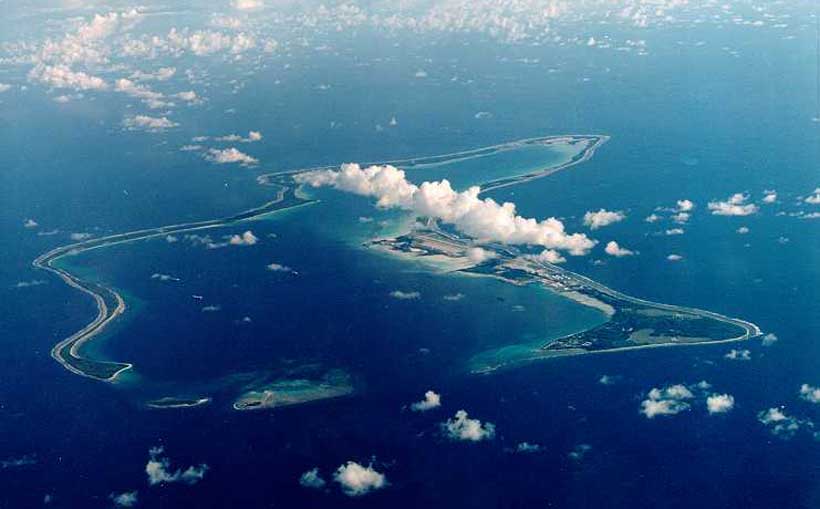
On March 21, 2026, Iran fired two ballistic missiles at Diego Garcia. The base is located around 3,800 kilometers away from Iran. Iran’s foreign minister recently, in early March, has publicly admitted that the range of its missiles reaches 2,000 kilometers. The missiles did not hit the base, one failed mid-flight and the other one was picked up by a U.S. warship. But the strike demonstrated that the Indian Ocean was a scenario where Iran possessed intermediate range ballistic missiles that it did not officially admit to having and had no qualms about firing against a British-U.S. military base in the middle of the sea.
Three months later, the White House is mulling an outright purchase of the islands.
The timing is not coincidental. The story of why America may purchase an Indian Ocean archipelago from the small island nation of Mauritius, bypassing its closest ally in the process, is really a story about what the Iran war revealed, what the sovereignty dispute exposed, and why a coral atoll the size of a small town has become one of the most contested pieces of real estate in the world.
What Diego Garcia Actually Is
Diego Garcia is a coral atoll in the Indian Ocean, 17 square miles in total area, which sits in the geographic center of the Indian Ocean, about 1,000 miles south of India. It has a 3,600-meter runway that can accommodate B-52, B-1 and B-2 bombers. It is capable of hosting up to 30 warships at a time on its port. It is located on top of the sea routes transporting oil from the Gulf to Asia and Asian imports to Europe. In military jargon, it’s an “unsinkable aircraft carrier”—a floating base for projecting power over a wide range, from East Africa to the Persian Gulf and all the way to the Indo-Pacific.
Stay ahead of the geopolitical week.
MD Briefing delivers expert analysis across five global fronts — the Indo-Pacific, energy, geoeconomics, European security, and the Middle East — every Monday morning. Free.
The base has conducted strike operations in Iraq, Afghanistan, and the Persian Gulf during the Gulf War. In the 2026 Iran war it was a launch pad for B-2 stealth bombers targeting Iran’s nuclear sites. It was not only a military attack Iran was trying to make on the base in March, but a statement as well: We can shoot missiles at you from anywhere and wherever you’ve been relying on for fifty years is not a place that’s going to keep you safe.
It was, however, an uncomfortable discovery that Diego Garcia’s physical isolation, always one of its key strategic strengths, is not protection from attack by Iran. The bottom is located in the middle of the ocean, away from any land-based air defense network, and is reliant on the defense of naval assets, and is now proven to be within range of the ballistic missiles fired by a regional power that everyone thought were shorter ranged than they were.
The Sovereignty Mess Before the Missiles Hit
Much of the legal wrangling surrounding Diego Garcia had been in existence long before Iran had ever fired a missile in 2026. To grasp it, one must go back to 1965, when the UK removed the Chagos Islands from Mauritius prior to granting independence to Mauritius. The detachment was challenged right from the beginning. In the late 1960s and early 1970s, the Chagossian population (c. 1,500) was forcibly removed to make way for the military base. In 2019, the International Court of Justice ruled the UK’s ongoing administration of the Chagos Islands is illegal, and that it should end the administration as soon as possible.
In May 2025, faced with significant international and legal pressure, the UK signed an accord to cede sovereignty over Chagos to Mauritius and leased back Diego Garcia for 99 years for around £101m a year. The agreement was meant to end a dispute from the colonial days with the aim of keeping the base in operation.
Then Trump said it was a “big mistake. Next, the State Department endorsed it. Then Trump said it was an “act of total weakness. The State Department made a statement claiming that it “supports” the UK decision. Then Trump said it was the “best” deal that Starmer “can”. Next, Trump repeated his “big mistake” comment. In April 2026, the UK government, unable to reconcile the various messages from Washington, stalled the deal.
Now, the White House is said to be working on a plan to skip the UK and buy the islands outright from Mauritius. The US State Department has not confirmed the report. The White House hasn’t denied it. There is no official comment from the UK. Mauritius has also been silent, as it is set to receive a big sovereign wealth payment if the deal is concluded.
What America Is Actually Worried About
The strategic concern driving the purchase proposal is not primarily about Iran, though the missile attack focused minds considerably. It is about China.
Mauritius has developed increasingly warm ties with Beijing over the past decade. Chinese infrastructure investment has been significant. The concern in Washington, raised explicitly by US senators and think tank analysts in the months since the Iran war began, is that Mauritius’s sovereignty over the Chagos Islands, even with the UK lease arrangement, creates a vulnerability that China could exploit over time. Not through military action, but through the patient accumulation of political influence over a small island state that would gradually gain leverage over the lease terms, the base’s operational parameters, and the intelligence and communications infrastructure on the island.
Diego Garcia hosts some of the most sensitive signals intelligence and satellite communications infrastructure in the US military’s global architecture. The electromagnetic spectrum satellite used for communications is specifically mentioned in the UK-Mauritius deal’s provisions, because control of it matters enormously for military operations across the Middle East and Indo-Pacific. The idea that a government with close ties to Beijing would eventually have nominal sovereignty over the territory hosting that infrastructure is something Washington’s security establishment finds genuinely alarming, regardless of what any lease agreement says about operational control.
The case was made starkly by Senator John Kennedy in May 2026: the US must keep the military base out of Chinese hands. The framing is deliberate and it is not about Mauritius. It is about what Mauritius’s relationship with China means for the long-term security of an installation that the Iran war has just reminded everyone is indispensable.
The UK’s Conundrum
In the case of London, the American acquisition presents a distinct and problematic issue. In response to years of legal, diplomatic and political pressure, the UK entered into a Sovereignty agreement with Mauritius. The UK would be vulnerable to court cases and would risk harm to its ties with African nations which have backed Mauritius’ stance in past cases, and to its credibility in future legal cases.Withdrawing from that agreement, or Britain being able to circumvent it by purchasing the islands outright, would leave it open to legal challenges, compromise relations with African nations that have stood with Mauritius on its side in past cases and make it hard for it to be believed in future legal proceedings.
The UK government has tried to justify the deal with Mauritius on the grounds that it serves the UK national interest of assuring operational control of Diego Garcia for as long as the UK wishes. This argument goes: the deal, though bad on its own, would ultimately lead to a situation in which the UK’s legal control of the base is successfully challenged; a worse case scenario than the deal’s terms. A US buy-off without that agreement in place would be an endorsement of the British point that the base’s security is predicated on a settled sovereignty framework and a blow to the specific settlement the UK negotiated for its base.
Another issue is what would happen to the special relationship if one avoided the UK at this precarious juncture, when it’s already under great strain from Trump’s tariffs, his stance on Ukraine and his broader lack of commitment to alliance management as a core tenet. The special relationship is meant to include a kind of consultancy by Washington on issues that impact on UK security interests. Buying an archipelago from a nation to which the UK has signed a sovereignty agreement for the past sixty years – without consulting – is not consultation.
What Does Mauritius Get Out of This?
Mauritius, in all of this, gets least attention – and is most important to the resolution. For decades, Port Louis has been clamouring for the return of the Chagos Islands on decolonisation grounds. That was the argument that the ICJ made in its ruling. Mauritius’ claim has been backed by international opinion, especially from the African Union member countries.
This alters the equation completely with a US purchase offer. Given the money being talked about, which is substantial, Mauritius will have to face a conundrum: should it play the principled game that it has been playing for decades or should it pay up for sovereign wealth, thereby changing the economic fortunes of a small population of 1.3 million? The agreement would also have to cover the rights of the Chagossian community, which were taken up by the UK agreement in May 2025 and would be respected by any purchase by the United States.
The India factor is also a consideration. New Delhi has long had an interest in the Indian Ocean balance of power and has been cultivating its own ties with Mauritius, which has a big Indian expatriate community, as it seeks to curb Chinese influence in the western Indian Ocean. India’s decision for the US-Mauritius purchase plan is not out there, however it will have one. A decision to sell directly to the US, and not via the UK-Mauritius framework India had already accepted, changes the dynamics of the Indian Ocean, and impacts India’s strategic game.
The Island That Explains Everything
Diego Garcia is, in microcosm, a map of all the geopolitical tensions of the present moment. The history and the un-resolved legacies of the colonies. The clash between the international legal obligations and the strategic military necessity. The possibilities and constraints of alliance management when a superpower feels its interests are at stake, even if it means sacrificing its partners. China’s approach of building influence in those countries where the West was not present. No base is safe and no geography is impregnable when it comes to the Iran war and how it proved the point that geography isn’t protection when it comes to a determined enemy that has better missiles than advertised.
As Trump knows, the most direct solution to an issue without a simple fix is to purchase the islands outright. Buying sovereignty will end the legal uncertainty. It leaves Mauritius out of the picture and removes the issue of Chinese leverage. It does this by cutting out the UK, breaking the special relationship, challenging international law on the issue of decolonization, and costing billions of dollars for the United States to operate without owning for fifty years.
The buyout will depend on whether Mauritius is willing to sell, whether the United Kingdom can be convinced or marginalized, whether Congress will appropriate the money, and whether the diplomatic risk of circumventing Mauritius’s sovereignty is deemed less than the security risk of leaving the situation unresolved.
It is evident that the Iran war has put an end to the deferred future of Diego Garcia. A longstanding sovereignty conflict became a pressing security threat when three Iranian missiles targeted an atoll in the middle of the Indian Ocean. The one that’s being prepared in the White House right now is the most Trump answer ever: “Just buy it.” Whether that answer works is another matter entirely.
