


Lars Gottschligg bought an abandoned building in the eastern German state of Saxony-Anhalt, covered it with solar panels and transformed it into a sleek black cube that produces and stores energy, houses data centres and charges electric cars.
“We turned a lost place into a place for the future,” said the boss of SSC Hydrovent during a tour of his plant in the town of Quedlinburg.
Yet with regional elections approaching, Gottschligg is unconcerned by the rise of the far-right Alternative for Germany, or AfD, which wants a greater role for conventional energy sources and less support for renewable energy.
The AfD is polling at around 41% in Saxony-Anhalt, which votes on September 6, and 36% in Mecklenburg-Vorpommern, which votes on September 20.
Stay ahead of the geopolitical week.
MD Briefing delivers expert analysis across five global fronts — the Indo-Pacific, energy, geoeconomics, European security, and the Middle East — every Monday morning. Free.
While opposition to immigration is a major source of AfD support in western Germany, experts say economic concerns are more important in the east.
The two states share a legacy of shrinking populations, shortages of skilled workers, higher unemployment and lower incomes than their western counterparts.
EAST GERMANY STILL FEELS LEFT BEHIND
Studies suggest the AfD’s rise is partly fuelled by a lingering sense of economic disadvantage, 36 years after German reunification, as well as perceptions that the region remains neglected by a political establishment largely rooted in the west.
“The people I talk to — and I feel this way myself too — we’re not afraid of it,” Gottschligg said. “(The AfD) are going to bring about a great deal of change — in fact, they’re already doing so.”
Both states have been among the hardest hit by the shrinking of eastern Germany’s workforce, particularly among younger people.
The population of Mecklenburg-Vorpommern, home to Baltic Sea ports and beaches, has fallen by nearly a fifth since reunification.
Saxony-Anhalt has Germany’s highest share of pension-age residents, with 52 people of retirement age for every 100 of working age.
“Labour is the scarcest production factor in Mecklenburg-Vorpommern’s future,” said Oliver Holtemoeller of the Halle Institute for Economic Research.
Gross domestic product per capita in the state is only around 76% of the national average, while labour productivity is around 86%, he said.
A study by economic research institute DIW Berlin found that areas with fewer younger, well-educated residents and larger populations of people over 60 tend to record significantly higher AfD support.
YOUNG EAST GERMANS LOOK FOR NEW SOLUTIONS
Despite those challenges, some younger eastern Germans are choosing to remain in the region and trying to create new opportunities.
Pablo Himmelspach, 29, grew up near Demmin, a small town in Mecklenburg-Vorpommern with “a lot of older people, and a lot of people who left”.
But Himmelspach decided to stay.
While studying at Rostock University, he performs as half of the rap duo Hinterlandgang, or “Back-country Gang”. He says attitudes among younger residents are beginning to change.
“I get the feeling that in my generation it’s no longer such a big thing that everyone wants to move away,” he said.
The duo’s latest song, “Mitlaeufer”, or “Followers”, reflects concerns among young residents about the rise of extremism.
“The AfD is ‘mainstream’, but we’re not just following the crowd,” the song says.
Others are trying to address the lack of opportunities for young people directly.
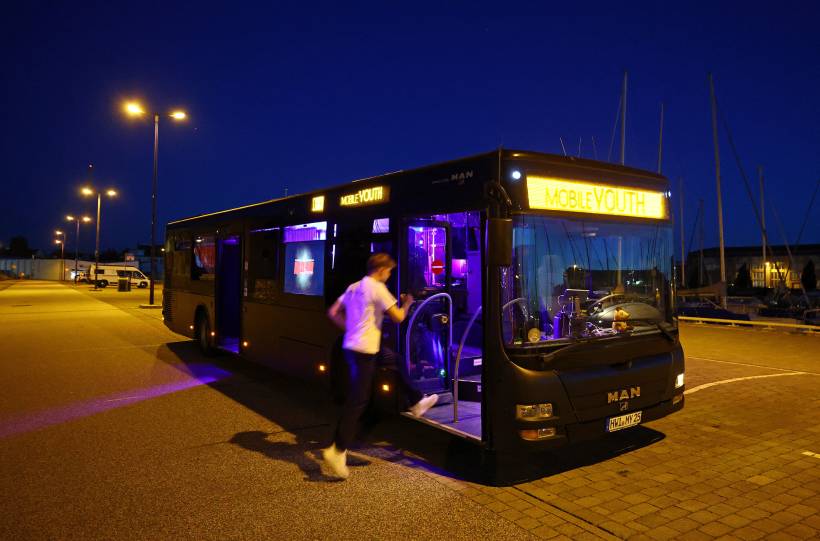
Peter Holdt created a travelling “Disco Bus” after seeing through his teenage daughter how few activities were available for teenagers in the city of Wismar.
Equipped with large speakers and disco lights, the bus takes DJs to villages and schoolyards.
“I get in the bus, drive somewhere and make kids happy,” Holdt said.
Wismar Mayor Frank Junge said the bus fills a gap that the municipality, whose budget is more constrained than those of many western German cities, cannot afford to fill itself.
Guido Friebel, project leader at the Rockwool Foundation Berlin and professor at Goethe University in Frankfurt, said many eastern Germans still believe politicians are not listening to their concerns.
However, economists warn that the AfD’s proposed policies could make the region’s economic problems worse.
“Although much of the dissatisfaction among people in strong AfD regions is understandable, they would harm themselves the most by voting for the AfD,” said Marcel Fratzscher, president of DIW Berlin.
COULD AFD POLICIES HURT THE EAST?
A DIW study argues that regions with particularly strong AfD support are economically more vulnerable because businesses tend to be smaller, workers have lower qualifications and economic opportunities are more limited than in western Germany.
The institute estimated that under AfD policies, including withdrawing from the euro and the European Union, halting immigration and cutting state spending, Saxony-Anhalt would lose an average of €1,600 ($1,840) per person in annual income and around 10,000 jobs.
The AfD rejects that assessment.
Hans-Thomas Tillschneider, the party’s deputy chair in Saxony-Anhalt, said ending CO2 levies and lifting sanctions against Russia would reduce energy costs, increase foreign trade and generate stronger economic growth.
“If the AfD were able to implement its measures, such as ending all CO2 levies and lifting sanctions against Russia, the result would be a dramatic reduction in the cost of all forms of energy, a sharp rise in foreign trade and, consequently, a massive economic boom,” he said.
The debate highlights a fundamental disagreement over what eastern Germany needs to overcome its economic disadvantages.
Economists argue that the region needs more skilled workers, investment and integration with wider European markets.
The AfD instead argues that lower energy costs, reduced regulation, tighter immigration controls and a different foreign economic policy would provide the necessary boost.
IMMIGRATION AS AN ECONOMIC ASSET
The marine engineering programme at the University of Rostock provides an example of how eastern Germany could address its labour shortage.
Rostock is a port city and former shipbuilding centre that has often been associated with economic deprivation and far-right agitation.
The university’s marine engineering programme once had only around 10 students a year.
After the course was internationalised and redesigned with input from local companies, annual enrolment increased to about 200 students within two semesters.
Students now come from countries including India, Pakistan and Egypt.
“We naturally hope that many of them will also stay here in the region and enrich the labour market,” said programme director Sascha Kosleck.
That approach could become more difficult under AfD policies.
Kosleck said he was concerned about the prospect of an AfD victory, particularly because the party has proposed charging non-EU students tuition fees.
For universities and businesses struggling with labour shortages, international students and migrants can therefore represent an important source of future workers.
CAN EASTERN GERMANY FIND A DIFFERENT PATH?
The rise of the AfD reflects genuine economic and demographic frustrations across eastern Germany.
Decades after reunification, many communities continue to face population decline, ageing workforces, lower productivity and fewer economic opportunities.
But the region is also producing examples of alternative approaches.
Companies are investing in renewable energy. Universities are attracting international students. Local initiatives are creating opportunities for young people who might otherwise leave.
Gottschligg’s renewable-energy business represents one version of that future.
His company has transformed an abandoned building into a facility producing and storing energy while supporting data centres and electric vehicles.
AfD policies favouring conventional energy could potentially challenge businesses built around the renewable transition.
Yet Gottschligg remains confident.
“People want a healthy environment, and they want affordable energy,” he said. “If renewable energy makes economic sense, then I don’t think even an AfD government would stand in its way.”
The question facing eastern Germany is therefore not simply why the AfD is gaining support, but whether the party can actually deliver the economic transformation its voters are demanding.
For a region still dealing with the consequences of decades of demographic decline and economic inequality, the answer may depend less on political promises than on whether new investment, skilled workers and economic opportunities can finally take root.
With information from Reuters.
