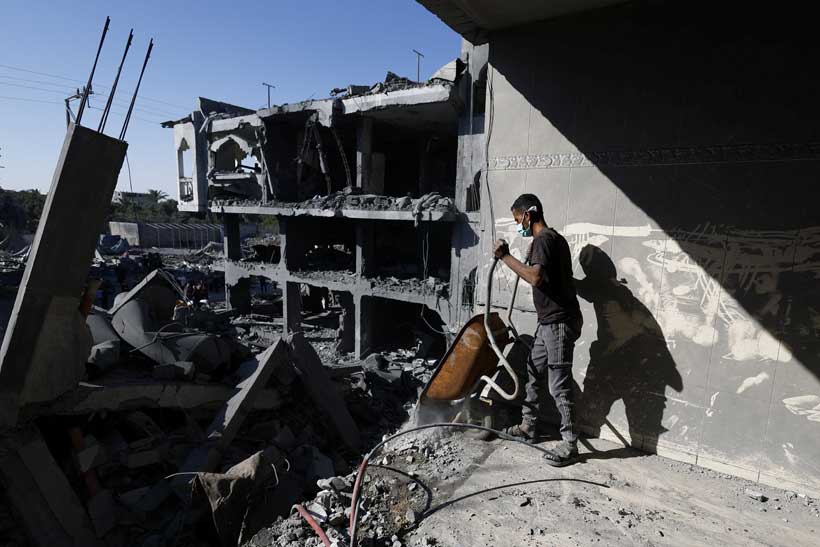
Residents in Gaza, southern Lebanon, northern Israel, and Kuwait faced ongoing violence this week, despite ceasefires arranged by the U. S. supposed to be in place. Israeli airstrikes targeted Gaza and Lebanon, while Hezbollah launched rockets into northern Israel and Iran attacked Kuwait’s international airport. President Donald Trump commented that the ceasefires seemed to allow for continued violence rather than stopping it entirely.
The U. S. facilitated a ceasefire between Israel and Hamas on October 10, 2025, which aimed to end significant conflict. This ceasefire included conditions for Hamas to release hostages, Israel to free Palestinian prisoners, a phased withdrawal of Israeli forces, increased aid to Gaza, and the opening of a crossing into Egypt. Although all hostages were released, aid has not significantly increased, Hamas has not disarmed, and reconstruction efforts have not started. Israeli airstrikes have continued, resulting in over 900 Palestinian deaths since the truce began, while sporadic attacks have killed four Israeli soldiers.
In Lebanon, the ceasefire between Israel and Hezbollah was only partially successful following fighting in 2024, leading to renewed conflicts. After a war against Iran that began in March, Hezbollah resumed attacks on Israel. Despite a 10-day ceasefire announced by Trump, intense fighting persisted, primarily in southern Lebanon, accumulating a death toll exceeding 3,500 since March. Israel reported casualties among its soldiers and civilians from Hezbollah attacks. Iran expressed a desire for a ceasefire to be part of negotiations to end its war with the U. S. and Israel. However, a new ceasefire proposed by Trump was rejected by Hezbollah.
The U. S. and Israel attacked Iran earlier this year to target its nuclear and missile programs, expressing hopes for a change in Iran’s government. Following these actions, a ceasefire was announced in April, with talks on a lasting peace and reopening of vital shipping routes. Yet, negotiations have stalled despite indirect talks mediated by Pakistan and Qatar, and exchanges of fire have continued.
All three ceasefire agreements have struggled to hold. Key players have been unwilling to make necessary concessions for lasting peace, often reverting to military actions to pursue their goals. Urban Coningham, a research fellow, noted that without political progress and real incentives to maintain ceasefires, it is challenging for them to succeed. The waning influence of international organizations like the U. N. and the rise of regional powers have further complicated long-term stability and agreements.
With information from Reuters