


The ongoing US- Iran confrontation has pushed the global energy market into a critical state, with Brent crude oil prices hovering $91- $92 per barrel (as of May 31, 2026) after skyrocketing past the $100 mark earlier this month. This spike is heavily dependent on the volatile situation at one of the world’s most crucial maritime routes; the Strait of Hormuz. Handling over 20% of global petroleum consumption, destined mostly for the Asian market, the Strait’s is the world’s most vital maritime chokepoint. Indeed, it is more than just a narrow stretch of water separating the Persian Gulf from the open ocean; it is the jugular vein of the global economy. Though this 21- mile- wide chokepoint, nearly a fifth of the world’s oil supply flows daily, historically carrying with it the invisible weight of the US Dollar.
For half of century, the “Petrodollar” system, an arrangement born from the 1971 “Nixon Shock” (which unpegged the USD from gold) and solidified by Henry Kissinger’s 1974 diplomacy, secured a deal with Saudi Arabia and OPEC (the Organization of the Petroleum Exporting Countries- OPEC) to price oil exclusively in dollars in exchange for US military protection. As a result, Washington ensured the undisputed hegemony of the petrodollar in global trade.
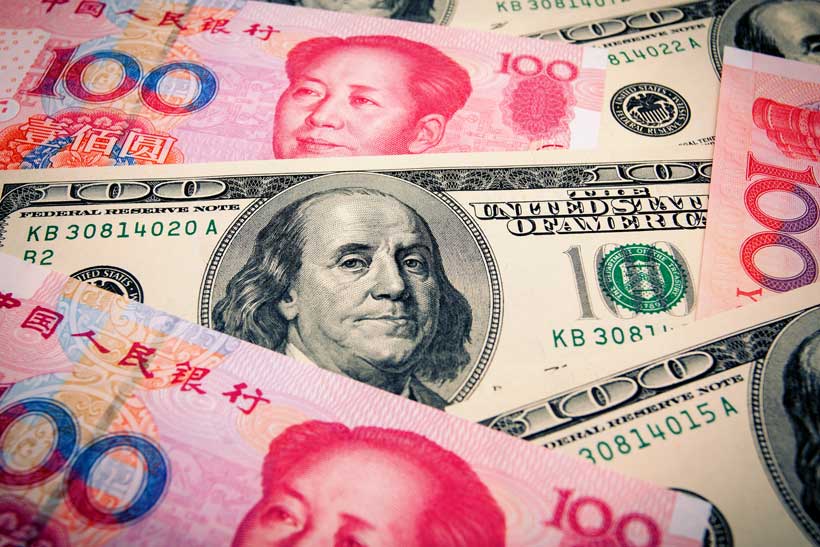
However, the reality of 2026 presents a tectonic shift. As naval manoeuvres and geopolitical brinkmanship light up the horizon, the tension in the Strait is no longer just as conventional military standoff, it has transformed into the frontline of a geoeconomic battle. Today, China’s emerging financial architecture, the Petroyuan, is openly challenging Washington’s decades- long monetary supremacy. The main purpose of this article is to analyze the impacts of the Hormuz crisis and examine how it catalyses the shifting of global oil trade from the Petrodollar to Petroyuan.
From Physical Crude to Financial Code
Stay ahead of the geopolitical week.
MD Briefing delivers expert analysis across five global fronts — the Indo-Pacific, energy, geoeconomics, European security, and the Middle East — every Monday morning. Free.
To understand today’s volatility, one must look back at the delicate dance between Washington and Tehran fifty years ago. As Andrew Scott Cooper masterfully details in his historical account, The Oil King: How the US, Iran and the Saudi Arabia changed the Balance of Power in the Middle East, the Persian Gulf has always been a stage for the survival of sovereigns. In the 1970S, the Shah of Iran was the linchpin of US interests in the region. Driven by an obsession to turn oil revenue into rapid military modernization, the Shah aggressively pushed for higher oil prices to fund his purchases of US steel and fighter jets.
Cooper’s narrative demonstrates how power in the 1970s belonged to those who controlled the physical flow of crude oil, namely the Shah and the Saudi monarchy. Today, however, a shift in global power has given birth to the “new oil kings”. These are no longer just the nations that pump crude out of the ground, but the economic superpowers that control the financial systems, pipelines and currencies through which oil is traded. While the old kings ruled via the US Petrodollar, the new kings, spearheaded by China’s Petroyuan are rewriting the rules of global trade right in the waters of Hormuz.
Yet, there is a stark contrast between history and the present. While the Shah operated safely within the US- led financial orbit, systematically recycling his billions of Petrodollars back into Wall Street banks, modern Tehran has learned a harsher lesson. Following years of crippling economic sanctions and being abruptly unplugged from the western- dominated SWIFT (The Society for Worldwide Interbank Financial Telecommunication- SWIFT) payment network, Iran no longer sees the US as a neutral tool of trade. Instead, it views it as a “weapon of financial mass of destruction”.
Consequently, for modern Iran, controlling the Strait of Hormuz is its physical “veto power” against western economic containment. However, since a physical blockade constitutes an act of war, the real game- changer is Iran’s economic pivot to the East. This shift is backed by data from energy- tracking platforms like Kpler, which reveal that China systematically absorbs the vast majority of Iran’s seaborne crude exports. Masked through ship- to- ship transfers and relabelled via intermediary nations, these immense volumes are cleared directly through independent Chinese refineries. By settling these high- volume transactions entirely in Yuan through non- US exposed banking networks, the trade effectively bypasses the western- dominated SWIFT system, rendering Washington’s economic blockades practically toothless.
The Realist Gridlock in the Strait
By pricing and trading in Yuan, China and Iran have successfully bypassed US banks altogether. For China, promoting the Petroyuan secures a steady stream of energy immune to US sanctions, while for Iran, it ensures state survival. This convergence of interests highlights the core dynamics of Structural Realism in International Relations (IR).
According to Kenneth Waltz’s Balance of Power theory (as discussed in Baylis et. Al, 2020, pp. 137-139), the anarchic nature of the international system compels states to prioritize survival, naturally triggering counter- balancing behaviours when a single hegemon accumulates excessive power. In this context, the US acts fundamentally as a defensive, status quo power, acting as a “global sheriff” in the Gulf to protect its established monetary and security framework from external disruption.
However, the response from the Iran- China nexus reflects the more aggressive assumptions of Offensive Realism. John Mearsheimer posits that the international system encourages great power s to act as revisionist forces that constantly seek to maximize their power to ensure security (as analysed in Snyder, 2002, pp. 151-171). While it is structurally impossible for two nations to achieve global hegemony simultaneously, their alignment serves as a tactical, regional cooperation to challenge the prevailing order. Pressed by crippling Western pressures, these revisionist states are utilizing parallel financial networks like the Petroyuan to erode the monetary dominance of the US status quo. Ultimately, this partnership demonstrates how states utilize strategic and economic alternatives to counter a dominant hegemon, securing their immediate survival while paving the way for their respective regional interests.
Beyond Geopolitics: A World- System Critique
However, if we shift our focus away from state- centric power games and view this conflict through the lens of class dynamics, a deeper, more sobering picture emerges. Through the lens of Immanuel Wallerstein’s World- Systems Theory, the crisis in the Strait of Hormuz is not merely a regional geopolitical skirmish; it is a structural revolt against the unequal architecture of global capitalism. By targeting the petrodollar nexus at its geographical chokepoint, the alliance is attempting to sever the financial pipeline that has historically transferred wealth from the resource- rich periphery to the Western core. Under this structuralist critique, the U.S. military apparatus in the Gulf acts essentially as a global sheriff for international capital, preserving the “exorbitant privilege” that the dollar affords Western economies.
From this systemic perspective, whether the world’s energy ledger is dominated by Washington’s Petrodollar or Beijing’s Petroyuan, the structural exploitation of resource- rich nations remains fundamentally unchanged. The tragic irony, as echoed in the final chapters of the Oil Kings, is that the spectacular wealth generated by the energy trade rarely trickles down to the populace. Just as the Shah’s billions fails to insulate ordinary Iranians from rampant inflation, eventually triggering the 1979 Revolution, the working class today, both in the Middle East and globally, bears the brunt of the Hormuz crisis. They pay the price through soaring fuel costs and economic instability, while global elites wrestle for monetary supremacy.
The Crucible of a New Order
We are not witnessing the immediate death of the US Dollar, but we are undeniably entering a multipolar financial world. The era where a single western superpower could completely dictate the terms of global trade through its currency is drawing to a close. The Strait of Hormuz is no longer just a passage for crude oil, it is the crucible of a new global order. As the “new kings” of China and Iran rewrite the rules of energy diplomacy, the world must prepare for a future where economic power is no longer anchored solely in Wall Street, but scattered across a fragmented, multipolar landscape.
