


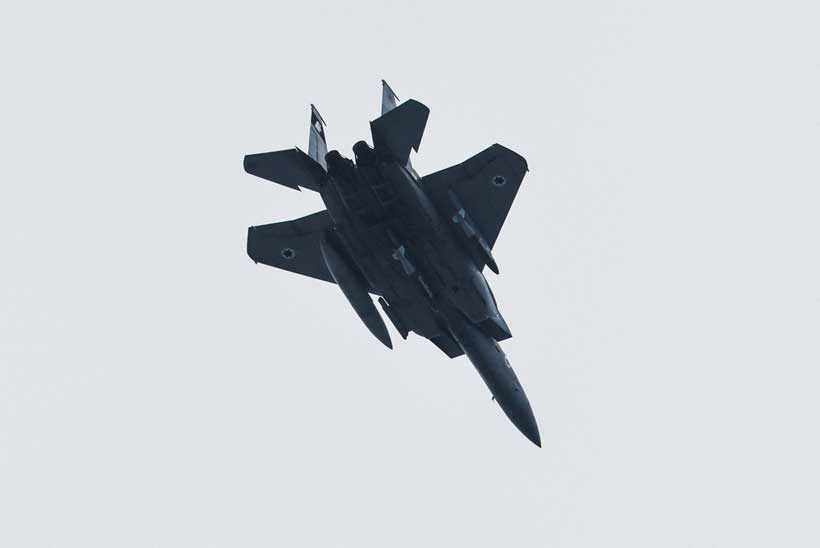
“Deterrence is not just a matter of military capabilities. It has a great deal to do with perceptions of credibility.” -Herman Kahn, Thinking About the Unthinkable (1962)
After its “Operation Roaring Lion” and America’s coinciding “Operation Epic Fury,” Israel’s presumptive nuclear weapons remain essential to deterrence of nuclear threats. In principle, moreover, there are circumstances in which these weapons could also deter certain non-nuclear threats. Most plausible among these circumstances are ones in which the enemy threats would include large-scale conventional attacks (whether first-strike or retaliatory) and/or chemical/biological attacks.[1]
Issues and Operational Correlates
What do such issues signify in operational terms? Implicitly and explicitly, Israel’s deterrence posture[2] identifies two distinct modes of strategic dissuasion: conventional and nuclear. Concerning the continuously opaque nature of this critical posture (i.e., “deliberate nuclear ambiguity”), Israel’s nuclear deterrence would not come into play until all forms of conventional deterrence had previously been exhausted. Precisely how many non-nuclear deterrence options would first need to fail is logically unanswerable.
Stay ahead of the geopolitical week.
MD Briefing delivers expert analysis across five global fronts — the Indo-Pacific, energy, geoeconomics, European security, and the Middle East — every Monday morning. Free.
Before suffering substantial setbacks from American and Israeli attack operations in 2026, Iran regarded Israel as a “one bomb state,” a despised adversary that could be “removed” by just a single nuclear weapon. Though this crude strategic view was readily confirmable by the “laws of physics,” Israel’s national survival is never merely about enemy capabilities. It was and remains about enemy willingness to take existential risks.
There are many underlying details. Such willingness must depend (assuming rational enemies) on the credibility of Israel’s deterrence posture. As for non-rational state enemies, greater attention and assets should be allocated to conspicuously-graduated preemption options. Regarding Israel’s literal survival as a state, these assets and allocations and are of primary importance. In essence, what is needed in Jerusalem is a comprehensive framework for competitive risk-taking that offers “seamless” retaliatory options.
When a country smaller than America’s Lake Michigan faces interpenetrating threats from state and sub-state adversaries, it requires a secure and flexible deterrent, one that could escalate in variously prefigured increments from non-nuclear weapons (chemical, biological, hypersonic and/or electromagnetic pulse ordnance) to theatre and/or strategic nuclear warfare. Supporting such an informed warning would entail a four-part intellectual understanding:
(1) science-based determinations of probability must be based on the determinable frequency of relevant past events;
(2) there has never been a nuclear war;
(3) maintaining visibly compelling conventional deterrence could make it less necessary for Israel to escalate to nuclear threats/nuclear conflict; and
(4) aptly measured nuclear threats could enhance the persuasiveness of Israel’s conventional threats.
There are also antecedent questions:
How might Israel find itself in a nuclear war?[3]
Under what specific circumstances could Israel discover itself involved (whether wittingly or unwittingly) with belligerent nuclear weapons use?
To purposefully answer these many-sided questions, Israeli analysts will need to integrate the critical military aspects of their investigations with authoritative legal ones.[4]
What are Relevant Threats to Israel?
For the moment, such integrative concerns could seem extraneous, gratuitous and without suitable empirical foundation. Israel, after all, remains the only nuclear weapons state in the region. Nonetheless, certain malleable order-of-battle considerations could change unexpectedly, perhaps even from moment to moment.[5] This prospective “fluidity” appears most obvious in regard to diminishing threats from Iran[6] and to potentially expanding threats from Egypt, Turkey, Pakistan or North Korea.[7]
Sometimes, in bewildering strategic matters, truth must emerge through paradox. Even without an already-nuclear adversary in the region,[8] Israel could find itself having to rely on calibrated nuclear deterrence against biological and/or conventional threats.[9] Acknowledging such prospectively existential forms of reliance, the prospect of belligerent nuclear weapons firings ought never to be ruled out per se.[10]
In late September 2024, Russian foreign minister Sergei Lavrov openly proclaimed Russia’s right to introduce nuclear weapons into any future conflict with Ukraine-supporting NATO states.[11] Though not a Middle Eastern theatre of warfare, the idea of threatening escalation to nuclear weapons in response to “unacceptable” sub-nuclear belligerence is still concerning. Conceptually, the dynamics of calculated threat would be similar or identical. These dynamics would be universal.
In all foreseeable cases, Israel’s nuclear doctrine and strategy[12] should remain oriented to deterrence,[13] not nuclear war-fighting.[14] Plausibly, with such an understanding in mind, Jerusalem has already taken steps to reject tactical or “battlefield” nuclear weapons[15] and to disavow any correlative plans for nuclear counter-force targeting.
For Israel, nuclear weapons can make sense only for deterrence ex ante; not revenge ex post.[16] In “eleventh-hour” circumstances, taking this sensible position could mean crossing the nuclear threshold against a dangerous and determined non-nuclear adversary. As rational strategy, anysuch intent will need to be made known before Jerusalem would need to actualize any such nuclear threat.
There are associated legal issues. Contrary to conventional wisdom, nuclear deterrence and associated forms of nuclear strategy that include preemption[17] could support expectations of international law.[18] But the adequacy of international law in preventing nuclear war in the Middle East will depend on more than formal treaties, customs or “the general principles of law recognized by civilized nations.”[19] It will also depend on the success or failure of particular country strategies in the region and on the “will”[20] of adversarial states to maintain certain sharedintellectual understandings. If Israel’s nuclear strategy could successfully reduce the threat of a regional nuclear war, whether because of compelling nuclear deterrence or by defensive first-strikes strikes,[21] it deserves to be considered a legitimate component of international law enforcement.[22]
Pertinent Scenarios
Realistic threat scenarios should remind Israel of its always-overriding need for comprehensive nuclear theory, an inductive-deductive explanatory framework based on systematic and systemic thought.[23] Among other things, this reminder would postulate a counter-value targeted nuclear retaliatory force that is recognizably secure from enemy first-strikes and recognizably capable of penetrating that state’s active defenses. To best meet such imperative security expectations, the IDF would be well-advised to continue with evident sea-basing (submarines) of nuclear deterrent force. Optimally, such steps would become part of a broader policy shift from “deliberate nuclear ambiguity” to “selective nuclear disclosure.”[24]
To satisfy equally important requirements of “penetration-capability,” Jerusalem will have to stay visibly ahead of enemy air-defense refinements. If duly followed, such positioning could enhance not “only” Israel’s national security, but also more general prospects for nuclear war avoidance. “Everything is very simple in war,” says Clausewitz, in his classical discussion of “friction” (On War), “but the simplest thing is still difficult.”[25]
How might Israel become actively involved in a nuclear war? In response, four basic scenarios present themselves: Nuclear Retaliation; Nuclear Counter-Retaliation; Nuclear Preemption; and Nuclear Warfighting. All these scenarios could be impacted by ongoing and potentially intersecting conflict situations in North Korea/South Korea; Russia/China/Ukraine or India/Pakistan.
Strategically and jurisprudentially, the world security regime represents a system. Accordingly, what happens in any one place could have notable and palpable effects in other places. Moreover, the investigation of pertinent scenarios should always be considered an intellectual task, hence, not one amenable to resolution by politicians or pundits.
(1) Nuclear Retaliation
If in the future an enemy state should launch a nuclear first-strike against Israel, Jerusalem would respond legally and to whatever extent possible with a nuclear retaliatory strike. If enemy first-strikes were to involve other forms of unconventional weapons, including high-lethality biological mass-destruction weapons, Israel might still launch a permissible nuclear reprisal. Such an unprecedented response would depend in large measure on Israel’s calculated expectations of follow-on aggression and its assessments of comparative damage-limitation.
If Israel were to absorb “only” a massive conventional attack, a nuclear retaliation could still not be ruled out, especially if: (a) Israel’s adversary were perceived to hold nuclear, and/or other unconventional weapons in reserve; and/or (b) Israel’s leaders were to believe that exclusively non-nuclear retaliations could not prevent destruction/annihilation of the Jewish State. A nuclear retaliation by Israel could be ruled out only in seemingly evident circumstances where enemy aggressions were conventional, “typical” (sub-existential or consistent with previous instances of enemy attack in magnitude/intent) and hard-target oriented (that is, directed only toward Israeli weapons and military infrastructures, not to “soft” civilian populations).
(2) Nuclear Counter-Retaliation
Should Israel ever feel compelled to preempt enemy nuclear aggression with conventional weapons,[26]the target state’s response (assuming rationality) would likely determine Jerusalem’s next moves. If this response were in any way nuclear, Israel could expectedly turn to nuclear counter-retaliation. If this retaliation were to involve other weapons of mass destruction, Israel might feel pressed to take an appropriate escalatory initiative. Any such initiative would reflect the presumed need for what is formally described in strategic parlance as “escalation dominance.”[27]
All authoritative decisions would depend on Jerusalem’s early judgments of adversarial intent and its accompanying calculations of essential damage-limitation. Should the enemy state response to Israel’s preemption be limited to hard-target conventional strikes, it is unlikely that the Jewish State would move on to consider nuclear counter-retaliations. If, however, the enemy’s conventional retaliation was plainly “all-out” and directed toward Israeli civilian populations – not just to Israeli military targets – an Israeli nuclear counter-retaliation could not be excluded ipso facto. It could also be permissible under international law.
Such a unique counter retaliation could be ruled out only if the enemy’s conventional retaliation were proportionate to Israel’s preemption; confined exclusively to Israeli military targets; circumscribed by legal limits of “military necessity” (a limit routinely codified in the law of armed conflict[28]) and accompanied by explicit and verifiable assurances of non-escalatory intent.
(3) Nuclear Preemption
It is implausible that Israel would ever decide to launch a preemptive nuclear strike.[29] Though circumstances could arise in which such a strike would be technically rational and ascertainably legal,[30] it is still unlikely that Israel would ever allow itself to reach such “all or nothing” vulnerabilities. Moreover, unless nuclear weapons were employed in a fashion still consistent with the laws of war – aka the law of armed conflict – this form of preemption would represent a flagrant violation of binding international rules.[31]
Even if such consistency were possible, the psychological/political impact of nuclear weapons use on the world community would be negative and far-reaching. This means, among other things, that an Israeli nuclear preemption could be expected only where (a) a state enemy had acquired nuclear and/or other weapons of mass destruction presumed capable of annihilating the Jewish State; (b) this adversarial state had made clear that its military intentions paralleled its capabilities; (c) this enemy was believed ready to begin an operational “countdown to launch;” and (d) Jerusalem believed that Israeli non-nuclear preemptions could not possibly achieve the needed minimum levels of damage-limitation – that is, levels consistent with physical preservation of state and nation.[32]
(4) Nuclear War fighting
Should nuclear weapons be introduced into actual conflict between Israel and an enemy state, nuclear war fighting at one level or another would ensue. This would be true so long as: (a) enemy first-strikes against Israel would not destroy Jerusalem’s second-strike nuclear capability; (b) enemy retaliations for an Israeli conventional preemption would not destroy Jerusalem’s nuclear counter retaliatory capability; (c) Israeli preemptive strikes involving nuclear weapons would not destroy adversarial second-strike nuclear capabilities; and (d) Israeli retaliation for enemy conventional first-strikes would not destroy enemy nuclear counter-retaliatory capabilities.
It follows that in order to satisfy its most essential survival requirements, Israel should take immediate steps to ensure the likelihood of (a) and (b) above, and the unlikelihood of (c) and (d).
An Historical Pride of Place
Though it is most important for Israel to stay-focused on measurable and scientific assessments of nuclear war fighting, it is clear that less tangible consequences should also be noted. At the onset of their once-unimaginable sufferings, the survivors of Hiroshima and Nagasaki found themselves, in psychologist Bruno Bettelheim’s words, an “anonymous mass,” or in the Japanese term, muga-muchu, “without self, without a center.” For the future of war and peace in the Middle East, such total disruptions of individual and social order produced unforeseeable outcomes, ones that extended far beyond any immediate physical or emotional losses.
There is more. The exterminatory effects of the two atomic bombs dropped on Japan were not confined to immediate or long-term experiences of those who bore direct witness, but were extended to their rescuers, progeny progeny of the rescuers. It would not be unreasonable to expand the survivor category of hibakusha to include children of Japanese mothers who did not experience the atomic explosions themselves.[33]
Soon, Jerusalem will need to consider a prompt end to “deliberate nuclear ambiguity.”[34] By selectivelyremoving the “bomb” from its metaphoric “basement,” Israel’s national strategic planners would be better positioned to enhance the credibility of the small country’s nuclear deterrence posture. Significantly, any enhancements of Israel’s nuclear deterrent could support the wider objectives of applicable international law.
In Israel’s strategic nuclear planning, would-be state aggressors, whether nuclear or non-nuclear, should be systematically encouraged to believe that Jerusalem maintains the willingness to launch measured nuclear forces in retaliation and that these forces are sufficiently invulnerable to any first-strike attacks. Additionally, these enemies should be made to expect that Israel’s designated nuclear forces could reliably penetrate all of their ballistic-missile and air defenses.
Though counter-intuitive, Israel and parts of the wider region would benefit from Jerusalem’s release of selectively broad outlines of the country’s continuously evolving strategic orientations. Without a prior and well-fashioned strategic doctrine, no such release could make sufficiently persuasive deterrent sense. At the same time, a too-firm release could be interpreted as an explicit rejection of NPT (Nonproliferation Treaty) objectives. Though this is an agreement to which Israel is not a party, it is still generally regarded as a binding nuclear “benchmark.”
Selectively-released Israeli nuclear information could support the perceived utility and security of Israel’s nuclear retaliatory forces. Once suitably disclosed, national nuclear strategy should center on the targeting, hardening, dispersion, multiplication, basing, and yield of all operational ordnance. Under certain easily-imagined conditions, the credibility of Israeli strategic deterrence could vary inversely with the perceived destructiveness of its evident weapons.
During the spring of 2026, the importance of this counter-intuitive notion was conspicuously lost on US President Donald J. Trump. To wit, vis-à-vis war with Iran, Israel’s most important ally threatened “obliteration” and “removal of an entire civilization.” These threats were not just less purposeful than plausibly-calibrated options, they represented flagrant violations of authoritative international law.
There is more. Unsurprisingly, there will be many interrelated policy concerns, all with some measure or other of legal significance. One such concern underscores that Israel will need to prepare differently (yet subtly) for military engagements with an expectedly-rational nuclear adversary than with an irrational foe. In such nuanced circumstances, national decision-makers in Jerusalem would need to distinguish meaningfully between genuine enemy irrationality and feigned enemy irrationality.
This could be a “tough call.” How should Israeli decision-makers be expected to make such inherently imprecise distinctions? Is this even a reasonable strategic expectation?[35]
In all refined studies of world politics, rationality and irrationality have now taken on specific meanings. An actor (state or sub-state) is determinedly rational to the extent that its leadership always values collective survival more highly than any other preference or combination of preferences. Conversely, an irrational actor might not always display such a determinable preference ordering. Apropos of the scientific limitations discussed above, determining whether such an adversary was rational or irrational could prove a bewilderingly inexact “science.”[36]
In actual practice, operationalizing these potentially indecipherable distinctions would present complex intellectual challenges. This task would need to take account of whether the scrutinized adversaries were (1) fully or partially sovereign states; (2) sub-national terrorist groups;[37] or (3) “hybrid” enemies comprised of state and sub-state foes.[38] A subsidiary but still daunting task would be to ascertain the de facto ratio of decision-making responsibilities among variously hybridized foes.
How should this multi-layered assessment best be carried out? In principle, at least, such a task might prove not merely daunting, but scientifically impossible. This would not be a task for the intellectually faint-hearted. To successfully preserve a nuclear “lid” in the Middle East, Jerusalem will need to (1) confront variously subtle points of deterrence, and (2) further clarify its formal position on Palestinian statehood.[39]
The Primacy of “Mind”
Whatever calculable nuances would be encountered in Jerusalem, the only rational way for Israel to successfully meet these growing and overlapping challenges will be to stay ahead of its adversaries through powers of strategic erudition. In classical Greece and Macedonia, the linked arts of war and deterrence were described by military planners as theoretic challenges of “mind over mind,” not narrow contests of “mind over matter.” At conceptual levels, such ancient descriptions remain valid for Israel.[40]
One further observation concerns Israel’s nuclear strategy and American national security. Though analysts generally examine the foreseeable impact of US nuclear guidance upon Israel, it is equally important to consider the impact of Israel’s nuclear strategy on US national security. Though largely unrecognized, there exists an ongoing and reciprocal connection between these two factors, a sort of continuous policy feedback-loop. Going forward, this “loop” should be examined more as a dynamic relationship than as a static or one-directional connection.
A starting point should be as follows: The suitability and durability of Israel’s nuclear strategy will impact not only the Middle East, legally and strategically, but also American national security. To the extent that Israel’s nuclear policies could have “spillover” effects for the United States, America could become the unintentional beneficiary of Israel’s strategic scholarship and planning. It also follows that if Israel’s nuclear posture should somehow fail to meet that country’s most urgent or existential security expectations, the derivative effect on the United States would be correspondingly negative.[41]
Virtually any Israeli scholarship focused on nuclear war avoidance will be offeredinat least partial responseto world security configurations shaped by the United States. In this connection, Jerusalem will need to pay special attention to the changing face of US-Russian adversity. In this connection, it is no longer preposterous to foresee an American president standing shoulder-to-shoulder with his Russian counterpart against NATO.
If, nonetheless, geopolitical competition between the superpowers should become more tangibly war-oriented in Asia[42] – most notably in regard to ongoing North Korean nuclear enhancements or Chinese military actions against Taiwan – it could have determinative effects on Israel’s nuclear posture and on a Middle Eastern nuclear war. On such effects, it ought not to be disregarded that (1) a nuclear war is logically possible with only one nuclear belligerent (i.e., an “asymmetrical nuclear war”) as well as with two or more nuclear adversaries (a “symmetrical nuclear war”); and (2) a nuclear war could be “symmetrical” even if one belligerent were seemingly “more powerful” than the other(s).
In all such matters, history will deserve increasingly disciplined attention. Earlier, North Korea helped Syria build a nuclear reactor, the same facility that was subsequently destroyed by Israel in Operation Orchard on September 6, 2007. Unlike Israel’s earlier Operation Opera, this preemptive attack, in the Deir ez-Zor region of Syria, was a second expression of the “Begin Doctrine.” It also portended, because of its North Korea connection, a much wider globalthreat to Israel.
Deleterious effects would likely be most dramatic if there were ever to be any direct nuclear exchange between the United States and North Korea. Similar connections could obtain in the aftermath of an India-Pakistan nuclear exchange,[43] and would depend largely on specific and still-ascertainable Russian/American/Chinese alignments with Delhi or Islamabad. In both prospective conflict dyads – US-North Korea and India-Pakistan – any tangible expressions of nuclear belligerence could immediately impact Israel’s nuclear strategy and Middle East regional security.
For Israel, greater familiarity with jurisprudential principles could advance the nation’s legal as well as strategic obligations, most plainly those that jurist William Blackstone famously expressed in his Commentaries on the Law of England (Book 4 “Of Public Wrongs”): “Each state is expected, perpetually,” noted Blackstone, “to aid and enforce the law of nations, as part of the common law, by inflicting an adequate punishment upon the offenses against that universal law.”[44]
Such ideas don’t just “pop up” ex nihilo, out of nothing. Blackstone is ultimately indebted to Cicero’s description of natural law in The Republic: “True law is right reason, harmonious with nature, diffused among all, constant, eternal; a law which calls to duty by its commands and restrains from evil by its prohibitions….”
Nuclear War and Justice
“Just wars,” wrote Hugo Grotius, the unrivaled founder of modern international law, “arise from our love of the innocent.”[45] Now, however, it is plain even by definition that a nuclear war could never be truly “just,” and that certain earlier legal distinctions (e.g., “just war” vs. “unjust war”) should be conformed to the changing technologies of military destruction. The only sensible adaptation in this regard should be to acknowledge timeless connections between international law and natural law and to oppose retrograde movements by powerful states to undermine such acknowledgments.
In the final analysis, to successfully prevent a nuclear war in the Middle East, it will be necessary to resist any world-system legitimations of belligerent nationalism. Nuclear deterrence and conventional deterrence are never best contemplated as separate security postures. Always, these seemingly discrete protective strategies are strongly interpenetrating and mutually reinforcing. Even while Israel remains the only regional nuclear power, its nuclear weapons and doctrine could be used to deter certain massive conventional aggressions from formidable state enemies.
A nuclear attack or nuclear war in the Middle East is not out of the question. It is never a casually dismissible prospect, even if Israel should remain the only nuclear weapons state in the region. How is this possible? The correct answer lies in the irremediably complex and deeply-nuanced structure of nuclear warfare possibilities, in the Middle East especially, but also anywhere else that a nuclear conflict is logically possible.
There is more. An atomic warcould arrive in Israel not only as a “bolt-from-the-blue” enemy nuclear missile attack, but also by intended or unintended escalations. If, for example, an enemy state was to begin hostilities by launching “only” conventional attacks on Israel, Jerusalem could decide to respond, sooner or later, foolishly or wisely, with precisely calculated and correspondingly graduated nuclear reprisals. Alternatively, if these enemy states were to commence conflict by releasing certain larger-scale conventional or biological attacks upon Israel, Jerusalem’s conventional reprisals could be met, at least in the future, with enemy nuclear counterstrikes.
In the past, Israeli conventional preemptions have figured importantly as presumptive remedies for nuclear threat. Reasonably, if it hadn’t been for Israel’s earlier defensive first-strike operations against Iraq and Syria (Operation Opera and Operation Orchard,respectively), the Middle East would already have suffered destabilizing impacts of Arab/Islamist nuclear forces. Looking back on these critical examples of anticipatory self-defense, Israel had effectively ensured that jihadist terror groups would not become nuclear. The impact of these complex military operations benefited not only Israel, but also the United States and assorted allies.[46]
Still, for the Middle East, the regional future is apt to become substantially less secure. With a still-aspirational nuclear Iran, derivative risks of nuclear terrorism could become intolerable.[47] Some of these expected risks might not be confined to the Middle East. In one form or other, they could “carry over” to American and/or European homelands.
By maintaining a credible conventional deterrent, Israel could most reasonably reduce its potential exposure to nuclear warfighting.[48] A fully persuasive Israeli non-nuclear deterrent, at least to the extent it would prevent large-scale conventional enemy attacks, could lower the country’s overall risk of exposure to unmanageable variants of nuclear escalation. In the specific lexicon of nuclear strategy, Israel could reap multiple security gains by staying in conspicuous control of “escalation dominance.”[49] Taken together, these gains could prove indispensable.
Foreseeable Deterrence Connections
Certain noteworthy strategic possibilities will warrant special mention. Any rational state enemy considering attacks against Israel using chemical and/or biological weapons would take more seriously Israel’s nuclear deterrent. Inter alia, this argument suggests that a strong conventional capability will always be needed to deter or preempt certain large conventional attacks.
Inevitably, in seeking to continually reassess their own military power positions, Israel’s enemies will strive to determine how Jerusalem views its own conventional weapon opportunities and limitations. If these enemies did not perceive any Israeli sense of expanding conventional force weakness and were driven by expectations of Israeli unwillingness to escalate to nonconventional weapons, they could decide rationally to attack first. The net result could include: (1) defeat of Israel in a conventional war; (2) defeat of Israel in an unconventional (chemical/biological/nuclear) war; (3) defeat of Israel in a combined conventional/unconventional war; or (4) defeat of enemy state(s) by Israel in an unconventional war.
Ironically for Israel, even the “successful” fourth possibility could prove net-negative. This counter-intuitive conclusion should once again bring to mind Israel’s increasingly outdated “bomb in the basement.” Always, the credibility of Israel’s nuclear deterrent will depend in part on the perceived “usability” of its nuclear arsenal. Should Israel’s still-ambiguous nuclear weapons be regarded by prospective attackers as high-yield, indiscriminate, “city-busting” (counter-value) weapons, rather than as minimal-yield, “war fighting” (counterforce) ordnance, they might not deter.[50]
Conceivably, and contrary to virtually all conventional wisdom on the subject,[51] successful Israeli nuclear deterrence could vary inversely with perceived destructiveness. Going forward, this means that Israel’s necessary nuclear deterrent will require not only recognizably secure second-strike forces, but also weapons that could be used in “real war.” It further suggests that continued Israeli policies of “deliberate nuclear ambiguity” would encourage erroneous and aggressive calculations by prospective attackers.
On one occasion or another, this out-of-date security policy could fatally undermine Israel’s nuclear deterrent. The supposedly valid counter-argument that an Israeli end to “deliberate nuclear ambiguity” would encourage new enemy state nuclearization is based neither on historical evidence nor valid inference. From time immemorial, states have almost always done what would presumably maximize their survival interests, not the interests of any general world order.
There is still more. In matters of Israeli nuclear deterrence, it ought never to be minimized that adversarial perceptions will be determinative. Unintentionally, by keeping its nuclear doctrine and capacity in the “basement,” Israel could contribute to an impression among regional enemies that its nuclear weapons are not operationally usable. In such circumstances, recalcitrant state enemies, unconvinced of Israel’s willingness to actually employ its nuclear weapons, might calculate the cost-effectiveness of striking first themselves.[52] Depending on the particular circumstances, any such adversarial acceptance could be either reluctant or enthusiastic, but still yield the same or similar outcome for Israel. In Jerusalem, therefore, any such adversarial presumptions would be “unacceptable.”
Consequences of Failed Military Deterrence
A nuclear war would not respect political or geographic boundaries. Because of the particular manner in which nuclear explosions behave in the atmosphere, the altitude reached by a distinctive mushroom-shaped cloud would depend primarily upon forces of the explosion. For yields in the low-kiloton range, this cloud would stay situated in the lower atmosphere. Its effects would be almost entirely “local.” For yields exceeding thirty kilotons, however, parts of the cloud of radioactive debris could “punch” into the stratosphere, thereby afflicting the launching state and particular noncombatant states together.[53]
To prevent a regional nuclear war, Israel will need to field a fully-dependable nuclear deterrent. At the same time, it cannot rely on this necessary basis of national security doctrine any more than it can depend solely on conventional deterrence. Instead, it must depend on complementary nuclear/conventional forces/doctrine, variously interpenetrating systems of air defense and on the predictable availability of eleventh-hour preemption options.[54]
In the volatile Middle East, military deterrence is a “game” that sane national leaders will have to play. For Israel, this ought always to be judged a game of strategy, not one of chance. This means, among other things, a continuing willingness to respect the full range of doctrinal complexity and to forge ahead with appropriate and presumptively advantageous security policies. To successfully influence the choices that fearsome state adversaries could make vis-à-vis Israel, Jerusalem will need to clarify that its conventional and nuclear deterrence postures are seamlessly interpenetrating and that the nation stands ready to counter enemy attacks at absolutely every level of possible confrontation.
There remain just two final points:
First, whether Israel’s overlapping deterrent processes are geared primarily toward conventional or nuclear threats, their ultimate success will depend on the expected rationality of relevant enemies.[55] In residual cases where enemy rationality appears implausible, Jerusalem could find itself under continuous pressure to strike preemptively. If Jerusalem’s expected responses were to be judged both rational and law-enforcing, they would need to include a wide-ranging option for “anticipatory self-defense.” Always, for Israel, regional conflict prospects should be curtailed at the lowest possible levels of controlled engagement. Under no circumstances should Israel feel compelled to preempt against an already-nuclear adversary.[56]To avoid such circumstances should represent Jerusalem’s overriding security obligation.[57]
Second, even the most meticulous plans for preventing a deliberately-inflicted nuclear conflict would not remove the always-attendant dangers of an inadvertent or accidental nuclear war. While an accidental nuclear war would necessarily be inadvertent, there are forms of inadvertent nuclear war that would not be caused by mechanical, electrical or computer error. Moreover, such consequential forms of unintentional nuclear conflict could represent the unexpected result of misjudgment or miscalculation, whether by (1) singular error committed by one or both sides to a two-party nuclear crisis escalation, or (2) unforeseen “synergies” between these misjudgments/miscalculations.[58]
The only predictable element of a nuclear crisis involving Israel and an enemy state would lie in its unpredictability. More than anything else, this implies an insistent obligation by Jerusalem not only to remain vigilant about enemy capabilities and intentions (both singular and cumulative), but to stay relentlessly cautious about Israel’s variable capacities to control adversarial nuclear events.
In the End, It’s an Intellectual Contest
Even after its 2026 military successes against Iran,Israel is entering into a period of protracted uncertainty. Before it can fulfill its primary legal and security obligations during this period, the Jewish state’s most capable scholars should accept increasing responsibility for meeting the strategic challenges of “mind.” In this regard, a core challenge will be deciphering the best course of action on nuclear matters whenever gainful action requires all relevant parties to cooperate. Florentine political philosopher Niccolo Machiavelli[59] had something potentially helpful to offer in his essay On Fortune:
The world is a stupendous machine, composed of innumerable parts, each of which being a free agent, has a volition and action of its own: and on this ground arises the difficulty of assuring success in any enterprise depending on the volition of numerous agents. We may set the machine in motion, and dispose every wheel to one certain end; but when it depends on the volition of any one wheel, and the correspondent action of every wheel, the result is uncertain.
Going forward, the only way for Israeli strategists and decision-makers to make sense of bewildering uncertainties will be to approach their task as one requiring continuously refined theory-construction. Under no circumstances should this task become the province of narrowly political or commercial elites, a transformation now at least partially underway in America’s Trump Era “Department of War.” If such anti-intellectualism were ever to become a fait accompli in Israel, that country’s national security policies could be torn into irremediable tatters.[60]
To ward off existential military harms, including unprecedented forms of surprise attack,[61] Jerusalem needs a coherent strategic deterrent, one that incorporates all conceivable threats within a structured system of carefully-calibrated reactions. Some nuclear threats could serve Israel’s deterrence objectives even before pertinent enemy states become operationally nuclear, and not “merely” because its conventional deterrent would have failed. Reciprocally, Israel’s conventional deterrence, if suitably fashioned, could make it irrational for Jerusalem to make belligerent use of nuclear ordnance.
It’s time for policy-relevant conclusions. The principal “lesson” ought to be summarized as follows: Under no circumstances should Israel’s military planners embrace a concept of national security that regards conventional and nuclear deterrence as inherently sequential or mutually-exclusive.
Always, for these planners – imaginative thinkers who must diligently operate amid arcane considerations of calculated dissuasion and war-waging – conventional and nuclear deterrence should be viewed as complementary, “force-multiplying” orientations. Immediately and relentlessly, Israeli planners need to subordinate all narrowly-political calculations of national security to logic-based rules of strategic decision-making. Meeting this core objective will require a seamless strategic deterrent,[62] one that is not just focused on military capabilities, but also on what nuclear strategist Herman Kahn originally called “perceptions of credibility.”[63]
[1]See by this author (Louis René Beres) and Ambassador (Israel) Zalman Shoval at Modern War Institute, West Point: https://mwi.westpoint.edu/creating-seamless-strategic-deterrent-israel-case-study/
[2] See earlier, by this author (Louis René Beres) at Military Strategy Magazine: https://www.militarystrategymagazine.com/article/israels-nuclear-posture-intellectual-antecedents-and-doctrinal-foundations/
[3] This question, in turn, is drawn from the basic and incontestable premise that every state’s first responsibility is to assure national protection and that reciprocal citizen allegiance is contingent on such assurances. Most famous in political theory is the classic statement of seventeenth-century Englishman Thomas Hobbes at Chapter XXI of his Leviathan: “The obligation of subjects to the sovereign is understood to last so long, and no longer, then the power lasts by which he is able to protect them.”
[4] For a useful example of such expected overlap, Israel will continuously need to consider various conceivable forms of preemption or defensive first-strike. When permissible under authoritative international law, any such preemption could be termed “anticipatory self-defense.” Significantly, both nuclear and non-nuclear preemptions by Israel of enemy unconventional attacks could lead to nuclear exchanges. This grievous outcome would depend, in large part, on the effectiveness and breadth of Israeli targeting, the surviving number of enemy nuclear weapons and the willingness of enemy leaders to risk Israeli nuclear counter-retaliations.
[5] Considerations impacting Israel’s security may form an intricately interconnected network. Capable assessments of such considerations must include a patient search for synergies and for potential cascades of synergies that could represent one especially serious iteration of security failure. Other risk properties that will warrant careful assessment within this analytic framework include contagion potential and persistence.
[6] This author, Professor Louis René Beres, was Chair of Project Daniel for PM Sharon (2003).
http://www.acpr.org.il/ENGLISH-NATIV/03-ISSUE/daniel-3.htm See also: https://ssi.armywarcollege.edu/pubs/Parameters/articles/07spring/beres.pdf See further, regarding Iran in particular, with US General (USAF/ret.) John T. Chain: Louis René Beres and John T. Chain: “Could Israel Safely Deter a Nuclear Iran”? The Atlantic, August, 2012; and Professor Louis René Beres and General Chain, “Israel and Iran at the Eleventh Hour,” Oxford University Press (OUP Blog), February 23, 2012. General Chain was Commander-in-Chief, U.S. Strategic Air Command (CINCSAC).
[7] See by this author (Louis René Beres) at JURIST: https://www.jurist.org/commentary/2024/08/absurd-connections-israel-north-korea-and-nuclear-war/
[8] North Korea is an already-nuclear antagonist that has a tangible history of direct military conflict with Israel.
[9]These would be massive conventional threats. See by this author: https://www.israeldefense.co.il/en/node/30198 See also by Professor Beres: https://besacenter.org/perspectives-papers/israel-nuclear-deterrence/
[10] For generic assessments of the probable consequences of nuclear war fighting by this author, see: Louis René Beres, Surviving Amid Chaos: Israel’s Nuclear Strategy (Rowman & Littlefield, 2016; 2nd. ed., 2018); Louis René Beres, Apocalypse: Nuclear Catastrophe in World Politics (Chicago: University of Chicago Press, 1980); Louis René Beres, Mimicking Sisyphus: America’s Countervailing Nuclear Strategy (Lexington MA: Lexington Books, 1983); Louis René Beres, Reason and Realpolitik: US Foreign Policy and World Order (Lexington MA; Lexington Books, 1984); and Louis René Beres, ed., Security or Armageddon: Israel’s Nuclear Strategy (Lexington MA: Lexington Books, 1986).
[11]https://www.newsweek.com/russia-issues-new-nuclear-warning-us-united-nations-europe-1960814 .It can no longer be taken for granted that the Trump-led United States would support NATO and Ukraine.
[12] Doctrine is not the same as strategy. More precisely, doctrine “sets the stage” for strategy. Inter alia, it identifies various central beliefs that must subsequently animate any actual “order of battle. Military doctrine describes underlying general principles concerning how a particular war ought to be waged. The reciprocal task for military strategy is to adapt as required in order to best support previously-fashioned doctrine.
[13]From the standpoint of stable nuclear deterrence, the likelihood of actual nuclear conflict between states could be inversely related to the expected magnitude of catastrophic harms. This is only an “informal presumption” because it concerns a unique event, one that is sui generis for the purposes of determining mathematical probabilities.
[14] Even before the nuclear age, ancient Chinese military theorist, Sun-Tzu, counseled, inThe Art of War:“Subjugating the enemy’s army without fighting is the true pinnacle of excellence.” (See: Chapter 3, “Planning Offensives”).
[15] An already-nuclear Islamic state that has openly embraced certain nuclear-warfighting concepts of deterrence is Pakistan.
[16] This assumption was a dominant premise of this writer’s Project Daniel Report to former Israeli Prime Minister Ariel Sharon: See, Louis René Beres, Chair, Project Daniel: Israel’s Strategic Future (Tel Aviv, 2003-2004).
[17] For early scholarly examinations of anticipatory self-defense, by this author, and with particular reference to Israel, see: Louis René Beres, “Preserving the Third Temple: Israel’s Right of Anticipatory Self-Defense Under International Law,” Vanderbilt Journal of Transnational Law, Vol. 26, No. 1, April 1993, pp. 111- 148; Louis René Beres, “After the Gulf War: Israel, Preemption and Anticipatory Self-Defense,” Houston Journal of International Law, Vol. 13, No. 2, Spring 1991, pp. 259 – 280; and Louis René Beres, “Striking `First’: Israel’s Post-Gulf War Options Under International Law,” Loyola of Los Angeles International and Comparative Law Journal Vol. 14, Nov. 1991, pp. 1 – 24.
[18] The precise origins of anticipatory self-defense in customary law lie in the Caroline, a case that concerned the unsuccessful rebellion of 1837 in Upper Canada against British rule. Following this case, the serious threat of armed attack has generally justified certain militarily defensive actions. In an exchange of diplomatic notes between the governments of the United States and Great Britain, then U.S. Secretary of State Daniel Webster outlined a framework for self-defense that did not require an antecedent attack. Here, the jurisprudential framework permitted a military response to a threat so long as the danger posed was “instant, overwhelming, leaving no choice of means, and no moment for deliberation.” See: Beth M. Polebaum, “National Self-defense in International Law: An Emerging Standard for a Nuclear Age,” 59 N.Y.U.L. Rev. 187, 190-91 (1984) (noting that the Caroline case had transformed the right of self-defense from an excuse for armed intervention into a legal doctrine). Still earlier, see: Hugo Grotius, Of the Causes of War, and First of Self-Defense, and Defense of Our Property, reprinted in 2 Classics of International Law, 168-75 (Carnegie Endowment Trust, 1925) (1625); and Emmerich de Vattel, The Right of Self-Protection and the Effects of the Sovereignty and Independence of Nations, reprinted in 3 Classics of International Law, 130 (Carnegie Endowment Trust, 1916) (1758). Also, Samuel Pufendorf, The Two Books on the Duty of Man and Citizen According to Natural Law, 32 (Frank Gardner Moore., tr., 1927 (1682).
[19] See art. 38 of the UN’s Statute of the International Court of Justice. On broader non-legal meanings of “civilization,” it will be instructive to consider Michel Leiris’ (Born in Paris in 1901, a member of the Surrealist Group from 1924 – 1929) apt metaphor: “However little taste one might have for proposing metaphors as explanations, civilization may be compared without too much inexactness to the thin greenish layer – the living magma and the odd detritus – that forms on the surface of calm water and sometimes solidifies into a crust, until an eddy comes to break it up. All our moral practices and our polite customs, that radiantly colored cloak that hides the coarseness of our dangerous instincts, all those lovely forms of culture we are so proud of – since it is thanks to them that we can still call ourselves “civilized” – are ready to disappear at the slightest turbulence, to shatter at the slightest impact (like the thin mirror on a fingernail whose polish cracks or roughens), allowing our horrifying primitiveness to appear in the interstices, revealed by earthquakes, when these cosmic revolutions burst the fragile skin of the earth’s circumference and for a moment lay bare the fire at the center, whose wicked and violent heat keeps even the stones molten.” See: Michel Leiris, “Civilization,” in BRISEES: BROKEN BRANCHES, San Francisco: North Point Press, 1989, p. 19. Michel Leiris, a poet, art critic and anthropologist, had a major impact on French culture for many years. His comment on “civilization” appears in BRISEES with other nonfiction pieces that address such figures as Joan Miro, Stephane Mallarme, Pablo Picasso, Claude Levi-Strauss, and Marcel Duchamp.
[20] Modern origins of “will” are discoverable in the writings of Arthur Schopenhauer, especially The World as Will and Idea (1818). For his own inspiration, Schopenhauer drew freely upon Johann Wolfgang von Goethe. Later, Nietzsche drew just as freely and perhaps more importantly upon Schopenhauer. Goethe was a core intellectual source for Spanish existentialist Jose Ortega y’Gasset, author of the singularly prophetic twentieth-century work, The Revolt of the Masses (Le Rebelion de las Masas;1930). See, accordingly, Ortega’s grand essay, “In Search of Goethe from Within” (1932), written for Die Neue Rundschau of Berlin on the centenary of Goethe’s death. It is reprinted in Ortega’s anthology, The Dehumanization of Art (1948) and is available from Princeton University Press (1968).
[21]Regarding such strikes, Israeli precedents for any such defensive moves would be Operation Opera directed against the Osiraq (Iraqi) nuclear reactor on June 7, 1981, and, later (though lesser known) Operation Orchard against Syria on September 6, 2007. In April 2011, the U.N.’s International Atomic Energy Agency (IAEA) confirmed that the bombed Syrian site in the Deir ez-Zoe region of Syria had been a developing nuclear reactor. In this writer’s judgment, both preemptions were lawful assertions of Israel’s “Begin Doctrine” (see, for example, Louis René Beres and COL. Yoash Tsiddon-Chatto in Israel’s Strike Against the Iraqi Nuclear Reactor 7 June 1981, Menachem Begin Heritage Center, Jerusalem, September 2003).
[22] Nuclear war and genocide need not be considered as mutually exclusive. War might well be the preferred means whereby genocide is undertaken. According to Articles II and III of the Genocide Convention, which entered into force on January 12, 1951, genocide includes any of several listed acts “committed with intent to destroy, in whole or in part, a national, ethnical, racial or religious group as such….” See Convention on the Prevention and Punishment of the Crime of Genocide Done at New York, Dec. 9, 1948. Entered into force, Jan. 12, 1951. 78 U.N.T.S. 277.
[23]In the 17th century, French philosopher Blaise Pascal remarked prophetically (Pensées): “All our dignity consists in thought…. It is upon this that we must depend…Let us labor then to think well: this is the foundation of morality.” Similar reasoning characterizes the writings of Baruch Spinoza, Pascal’s 17th-century contemporary. In Book II of his Ethics Spinoza considers the human mind, or the intellectual attributes, and – drawing further from Descartes – strives to define an essential theory of learning and knowledge.
[24] See by this writer, Louis René Beres, Surviving Amid Chaos: Israel’s Nuclear Strategy: https://paw.princeton.edu/new-books/surviving-amid-chaos-israels-nuclear-strategy
[25] Here, this concept refers to the unpredictable effects of errors in knowledge and information concerning intra-Israel (IDF/MOD) strategic uncertainties; on Israeli and Iranian under-estimations or over-estimations of relative power position; and on the unalterably vast and largely irremediable differences between theories of deterrence, and enemy intent “as it actually is.” See: Carl von Clausewitz, “Uber das Leben und den Charakter von Scharnhorst,” Historisch-politische Zeitschrift, 1 (1832); cited in Barry D. Watts, Clausewitzian Friction and Future War, McNair Paper No. 52, October, 1996, Institute for National Strategic Studies, National Defense University Washington, D.C. p. 9.
[26]In principle, at least, such a preemptive strike could be permissible under international law as “anticipatory self-defense.”
[27]For more on this strategic concept by Professor Beres in Israel Defense (Tel Aviv), see: https://www.israeldefense.co.il/en/node/28931
[28] The principle of “military necessity” has been defined authoritatively as follows: “Only that degree and kind of force, not otherwise prohibited by the law of armed conflict, required for the partial or complete submission of the enemy with a minimum expenditure of time, life, and physical resources may be applied.” See: United States, Department of the Navy, jointly with Headquarters, U.S. Marine Corps; and Department of Transportation, U.S. Coast Guard, The Commander’s Handbook on the Law of Naval Operations, NWP 1-14M, Norfolk, Virginia, October 1995, p. 5-1.
[29]Because any such strike would be unprecedented, there obtains no acceptable scientific way to assign meaningful probabilities.
[30] See Summary of the Legality of the Threat or Use of Nuclear Weapons (Advisory Opinion), 1996 I.C.J. 226 (Opinion of July 1996).
[31] This is not necessarily the case, however, with respect to conventional forms of preemption. To wit, preemption has figured importantly in previous Israeli strategic calculations. This was most glaringly apparent in the wars of 1956 and 1967, and also in the destruction of the Iraqi nuclear reactor in 1981. It was essentially the failure to preempt in October 1973 that contributed to heavy Israeli losses on the Egyptian and Syrian fronts during the Yom Kippur war, and almost brought about an Israeli defeat. During January, May, and October 2013, Israel, apprehensive about Damascus’ supply of military materials to Syria’s Hezbollah surrogates in Lebanon, preemptively struck pertinent hard targets within Syria. In part, Israel’s September 2024 strikes against Hezbollah assets in Lebanon and Syria (including the targeted killing of terrorist leader Nasrallah) represent a recent expression of such preemptive thinking.
[32] On non-nuclear or conventional preemptions by Israel, see Menachem Begin Heritage Center, Israel’s Strike Against the Iraqi Nuclear Reactor 7 June 1981, a collection of original articles and lectures by Yitzhak Shamir, Rafael Eitan, David Ivri, Yaakov Amidror, Yuval Ne’eman, Yoash Tsiddon-Chatto and Louis René Beres. See originally Louis René Beres and COL. Yoash Tsiddon-Chatto, “Reconsidering Israel’s Destruction of Iraq’s Osiraq Nuclear Reactor,” 9 Temple International and Comparative Law Journal, 437 (1995). COL. Tsiddon-Chatto was a Chief of Planning for the Israel Air Force and a member of Professor Louis René Beres’ Project Daniel (PM Sharon/2003-2004).
[33] For more exhaustively specific and detailed assessments of nuclear war outcomes, see an early book by this author: Louis René Beres, Apocalypse: Nuclear Catastrophe in World Politics (The University of Chicago Press, 1980).
[34] See, for example, by this author: Louis René Beres: https://besacenter.org/wp-content/uploads/2024/03/2268-Beres-Navigating-Chaos-Samson-Option.pdf https://thestrategybridge.org/the-bridge/2018/11/15/israels-nuclear-ambiguity-would-a-shift-to-selective-nuclear-disclosure-enhance-strategic-deterrence
[35] At the microcosmic level of Israeli counter-terrorism, a generic question should come to mind: How does killing in world politics hold out a promise of immortality for the perpetrator? An answer is offered by playwright Eugene Ionesco, “I must kill my visible enemy, the one who is determined to take my life, to prevent him from killing me. Killing gives me a feeling of relief, because I am dimly aware that in killing him, I have killed death. Killing is a way of relieving one’s feelings, of warding off one’s own death.” This comment from Ionesco’s JOURNAL appeared in the British magazine, ENCOUNTER, May 1966. See also: Eugene Ionesco, FRAGMENTS OF A JOURNAL (Grove Press, 1968). In an important sense, the jihadist terror-state could resemble the individual human terrorist seeking “power over death.”
[36]Expressions of decisional irrationality could take various different and overlapping forms. These include a disorderly or inconsistent value system; computational errors in calculation; an incapacity to communicate efficiently; random or haphazard influences in the making or transmittal of particular decisions; and the internal dissonance generated by any structure of collective decision-making (i.e., assemblies of pertinent individuals who lack identical value systems and/or whose organizational arrangements impact their willing capacity to act as a single or unitary national decision maker).
[37] Some current Israeli supporters of a Palestinian state argue that its prospective harms to Israel could be reduced or even eliminated by ensuring that state’s immediate “demilitarization.” For informed reasoning against this argument, see: Louis René Beres and (Ambassador) Zalman Shoval, “Why a Demilitarized Palestinian State Would Not Remain Demilitarized: A View Under International Law,” Temple International and Comparative Law Journal, Winter 1998, pp. 347-363; and Louis René Beres and Ambassador Shoval, “On Demilitarizing a Palestinian `Entity’ and the Golan Heights: An International Law Perspective,” Vanderbilt Journal of Transnational Law, Vo. 28., No.5., November 1995, pp. 959-972.
[38] Under international law, sub-state movements are always Hostes humani generis, or “Common enemies of mankind.” See: Research in International Law: Draft Convention on Jurisdiction with Respect to Crime, 29 AM J. INT’L L. (Sup 1935) 435, 566 (quoting King v. Marsh (1615), 3 Bulstr. 27, 81 Eng. Rep 23 (1615) (“a pirate est Hostes humani generis”)).
[39] For earlier original writings by this author concerning the prospective impact of a Palestinian state on Israeli nuclear deterrence, see: Louis René Beres, “Security Threats and Effective Remedies: Israel’s Strategic, Tactical and Legal Options,” Ariel Center for Policy Research (Israel), ACPR Policy Paper No. 102, April 2000, 110 pp; Louis René Beres, “After the `Peace Process:’ Israel, Palestine, and Regional Nuclear War,” DICKINSON JOURNAL OF INTERNATIONAL LAW, Vol. 15, No. 2., Winter 1997, pp. 301-335; Louis René Beres, “Limits of Nuclear Deterrence: The Strategic Risks and Dangers to Israel of False Hope,” ARMED FORCES AND SOCIETY, Vol. 23., No. 4., Summer 1997, pp. 539-568; Louis René Beres, “Getting Beyond Nuclear Deterrence: Israel, Intelligence and False Hope,” INTERNATIONAL JOURNAL OF INTELLIGENCE AND COUNTERINTELLIGENCE, Vol. 10., No. 1., Spring 1997, pp. 75-90; Louis René Beres, “On Living in a Bad Neighborhood: The Informed Argument for Israeli Nuclear Weapons,” POLITICAL CROSSROADS, Vol. 5., Nos. 1/2, 1997, pp. 143-157; Louis René Beres, “Facing the Apocalypse: Israel and the `Peace Process,'” BTZEDEK: THE JOURNAL OF RESPONSIBLE JEWISH COMMENTARY (Israel), Vol. 1., No. 3., Fall/Winter 1997, pp. 32-35; Louis René Beres and (Ambassador) Zalman Shoval, “Why Golan Demilitarization Would Not Work,” STRATEGIC REVIEW, Vol. XXIV, No. 1., Winter 1996, pp. 75-76; Louis René Beres, “Implications of a Palestinian State for Israeli Security and Nuclear War: A Jurisprudential Assessment,” DICKINSON JOURNAL OF INTERNATIONAL LAW, Vol. 17., No. 2., 1999, pp. 229-286; Louis René Beres, “A Palestinian State and Israel’s Nuclear Strategy,” CROSSROADS: AN INTERNATIONAL SOCIO-POLITICAL JOURNAL, No. 31, 1991, pp. 97-104; Louis René Beres, “The Question of Palestine and Israel’s Nuclear Strategy,” THE POLITICAL QUARTERLY, Vol. 62, No. 4., October-December 1991, pp. 451-460; Louis René Beres, “Israel, Palestine and Regional Nuclear War,” BULLETIN OF PEACE PROPOSALS, Vol. 22., No. 2., June 1991, pp. 227-234; Louis René Beres, “A Palestinian State: Implications for Israel’s Security and the Possibility of Nuclear War,” BULLETIN OF THE JERUSALEM INSTITUTE FOR WESTERN DEFENCE (Israel), Vol. 4., Bulletin No, 3., October 1991, pp. 3-10; Louis René Beres, ISRAELI SECURITY AND NUCLEAR WEAPONS, PSIS Occasional Papers, No. 1/1990, Graduate Institute of International Studies, Geneva, Switzerland, 40 pp; and Louis René Beres, “After the Gulf War: Israel, Palestine and the Risk of Nuclear War in the Middle East,” STRATEGIC REVIEW, Vol. XIX, No. 4., Fall 1991, pp. 48-55.
[40]This calls to mind the obligations of formal doctrine. Such doctrine defines the framework from which any state’s strategic goals should be suitably extrapolated. Generically, in “standard” or orthodox military thinking, such doctrine describes the tactical manner in which national forces “ought to fight” in various combat situations, the prescribed “order of battle,” and variously assorted corollary operations. The literal definition of “doctrine” derives from Middle English, from the Latin doctrina, meaning teaching, learning, and instruction. Always, a central importance of codified military doctrine lies not only in the way it can animate, unify and optimize pertinent military forces, but also in the way it can transmit certain desired “messages” to an enemy.
[41] See by Louis René Beres https://sectech.tau.ac.il/sites/sectech.tau.ac.il/files/PalmBeachBook.pdf
.
[42]On the dangers of further North Korean nuclearization by this author at West Point (Pentagon): See: Louis René Beres, https://mwi.usma.edu/theres-no-historical-guide-assessing-risks-us-north-korea-nuclear-war/
[43]https://digitalcommons.wcl.american.edu/cgi/viewcontent.cgi?referer=https://search.yahoo.com/&httpsredir=1&article=1318&context=auilr
[44] Such offenses could also be directed against various authoritative forms of customary international law. See, accordingly, Article 38 (1)(b) of the UN Statute of the International Court of Justice, which defines international custom as “evidence of a general practice accepted as law.” (June 29, 1945, 59 Stat. 1031, T.S. 993. The essential significance of a norm’s customary character is that the norms bind even those states that are not parties to a pertinent codification. Even where a customary norm and a norm restated in treaty form are apparently identical, these norms are treated as jurisprudentially discrete (See Military and Paramilitary Activities (Nicaragua vs. US), 1986, I.C.J., 14, 85 (June 27) (Merits).
[45] See Hugo Grotius, The Law of War and Peace 70 (William Whewell, tr.), London: John W. Parker, 1853(1625). There is an important antecedent issue. Under international law, the question of whether or not a condition of war actually exists between states is unclear. Traditionally, a “formal” war was said to exist only when a state issued a formal declaration of war. The Hague Convention III codified this position in 1907. This Convention provided that hostilities must not commence without “previous and explicit warning” in the form of a declaration of war or an ultimatum. See Hague Convention III on the Opening of Hostilities, Oct. 18, 1907, art. 1, 36 Stat. 2277, 205 Consol. T.S. 263. Presently, a declaration of war may be tantamount to a declaration of criminality because international law prohibits aggression. See Treaty Providing for the Renunciation of War as an Instrument of National Policy, Aug. 27, 1948, art. 1, 46 Stat. 2343, 94 L.N.T.S. 57 (also called Pact of Paris or Kellogg-Briand Pact); Nuremberg Judgment, 1 I.M.T. Trial of the Major War Criminals 171 (1947), portions reprinted in Burns H. Weston, et. al., INTERNATIONAL LAW AND WORLD ORDER 148, 159 (1980); U.N. Charter, art. 2(4). A state may compromise its own legal position by announcing formal declarations of war. It follows that a state of belligerency may exist without formal declarations, but only if there exists an armed conflict between two or more states and/or at least one of these states considers itself “at war.”
[46] On vital interconnections between US and Israeli nuclear security, see previously referenced 2016 monograph (published at Tel Aviv University) authored by Professor Beres (with special postscript by USA General, ret., Barry R. McCaffrey):
See also: http://ssi.armywarcollege.edu/pubs/parameters/Articles/07spring/beres.pdf
[47] See, by Professor Beres: http://digitalcommons.law.uga.edu/cgi/viewcontent.cgi?article=1410&context=gjicl
[48] The avoidance of nuclear war fighting in any form was a major conclusion of the Project Daniel Group in its 2003 report to Prime Minister Arik Sharon:
http://www.herzliyaconference.org/_Uploads/2905LouisReneBeres.pdf
[49] See, for example: Louis René Beres: http://www.israeldefense.co.il/en/node/28836
[50] On such issues, see by Professor Beres, Surviving Amid Chaos: Israel’s Nuclear Strategy (New York and London: Rowman & Littlefield, 2016); 2nd ed. 2018. See also by Beres: http://www.inss.org.il/uploadImages/systemFiles/adkan17_3ENG%20(3)_Beres.pdf and, from Harvard National Security Journal, Harvard Law School: http://harvardnsj.org/?s=louis+rene+beres
[51] To wit, US President Donald J. Trump’s random threats of “obliteration.”
[52] Such calculations will include judgments on Israel’s active defenses. For example, see by Syeda Saba Batool in Manara Magazine (13 April 2026): https://manaramagazine.org/2026/04/iran-israel-effectiveness-of-ai-defence/
[53] For an early book by Professor Beres dealing with the expected effects of a nuclear war, see: Louis René Beres, Apocalypse: Nuclear Catastrophe in World Politics (Chicago and London: University of Chicago Press, 1980). https://www.amazon.com/Apocalypse-Nuclear-Catastrophe-World-Politics/dp/0226043606/ref=asap_bc?ie=UTF8 See also, by Professor Beres: http://digitalcommons.wcl.american.edu/cgi/viewcontent.cgi?article=1318&context=auilr
[54] From the standpoint of international law, it is always necessary to distinguish preemptive attacks from “preventive ones.” Preemption is a military strategy of striking an enemy first in the expectation that the only alternative is to be struck first oneself. A preemptive attack is launched by a state that believes enemy forces are about to attack. A preventive attack, however, is launched not out of genuine concern about “imminent” hostilities, but for fear of a longer-term deterioration in a pertinent military balance. Hence, in a preemptive attack, the length of time by which the enemy’s action is anticipated is very short, while in a preventive strike the interval is considerably longer. A problem for Israel, in this regard, is not only the practical difficulty of determining imminence, but also that delaying a defensive strike until appropriately ascertained imminence is acknowledged could be fatal.
[55]Expressions of decisional irrationality could take different and overlapping forms. These forms include a disorderly or inconsistent value system; computational errors in calculation; an incapacity to communicate efficiently; random or haphazard influences in the making or transmittal of particular decisions; and the internal dissonance generated by any structure of collective decision-making (i.e., assemblies of pertinent individuals who lack identical value systems and/or whose organizational arrangements impact their willing capacity to act as a single or unitary national decision maker).
[56] Among other more obvious dangers, if Israel should refrain from striking first until an enemy state or states had actually acquired nuclear weapons, these new nuclear powers could implement protective measures that would then pose grave hazards to the Jewish State. Designed to guard against preemption, either by Israel or other regional enemies, such measures could involve the attachment of “hair trigger” launch mechanisms to nuclear weapon systems, and/or the adoption of “launch on warning” policies, possibly coupled with certain pre-delegations of launch authority. This means, in essence, that Israel would be increasingly endangered by steps taken by its nuclear enemies to prevent a preemption. Optimally, Israel would do everything possible to prevent such steps, especially because of the expanded risks of accidental or unauthorized attacks against its own armaments and populations. Yet, if such steps were to become a fait accompli, Jerusalem could still calculate, correctly, that a preemptive strike would be legal and cost-effective. This is because the expected enemy retaliation, however damaging, might still appear more tolerable than the expected consequences of enemy first-strikes – strikes likely occasioned by the failure of “anti-preemption” protocols.
[57] Although it cannot be ruled out that an Israeli non-nuclear preemption would lead to nuclear attacks or exchanges (outcomes would depend on the effectiveness and breadth of Israeli targeting, the surviving number of enemy nuclear weapons, and the willingness of some enemy leaders to risk Israeli nuclear counter-retaliations), such exchanges appear more likely if certain enemy states were allowed to deploy nuclear weapons without law-based interference. Should such a deployment ever take place, Israel could conceivably confront a compelling incentive to launch a nuclearpreemption. In the plainly worst-case scenario for Jerusalem, one where even properly intersecting levels of conventional and nuclear deterrence had failed to protect Israel and where Israel had undertaken a nuclear preemption without any confirmable success (i.e., without destroying an essential number of enemy missiles and warheads), survival of the state could rest on the country’s multiple and interlinkedactive defenses.
[58] See by this writer, Louis René Beres, at Harvard National Security Journal, Harvard Law School: https://harvardnsj.org/2015/06/02/core-synergies-in-israels-strategic-planning-when-the-adversarial-whole-is-greater-than-the-sum-of-its-parts/
[59] See, also: Niccolo Machiavelli, Book Two, of The Discourses, where the oft-cited Florentine advises the Council of Florence on “How the Romans proceeded in the Waging of War.” This Roman way, he counsels, was “to make wars short and crushing.” For Israel, though seemingly unrealistic, the long-term goal should be to avoid major warfare wherever possible and enlist international law in meeting this objective.
[60] This fate should bring to mind the closing query of Agamemnon in The Oresteia by Aeschylus: “Where will it end? When will it all be lulled back into sleep, and cease, the bloody hatreds, the destruction”?
[61]In his seminal writings, strategic theorist Herman Kahn introduced a further distinction between a surprise attack that is more-or-less unexpected and a surprise attack that arrives entirely “out of the blue.” The former, he counseled, “…is likely to take place during a period of tension that is not so intense that the offender is essentially prepared for nuclear war….” A total surprise attack, however, would be one without any immediately recognizable tension or warning signal. This particular subset of a surprise attack scenario could be difficult to operationalize for national security policy benefit. See: Herman Kahn, Thinking About the Unthinkable in the 1980s (Simon & Schuster, 1984).
[62] This brings to mind the classical observation of Goethe (Faust): “In the end, we depend upon creatures of our own making.” With regard to issues of Israeli deterrence, there is also an important reciprocal to this imperative: The “laws of physics” are not “decrees of fate” for Israel’s enemies. Inter alia, this means that a near-nuclear or already-nuclear adversary need not imply a military nuclear threat. More precisely, it means that Israel’s core safety need not necessarily require ad hoc preemptions and that historically-informed diplomacy could begin to take more primary roles.
[63] See epigraph (above) from Herman Kahn’s classic work, Thinking About the Unthinkable. (1962).
