


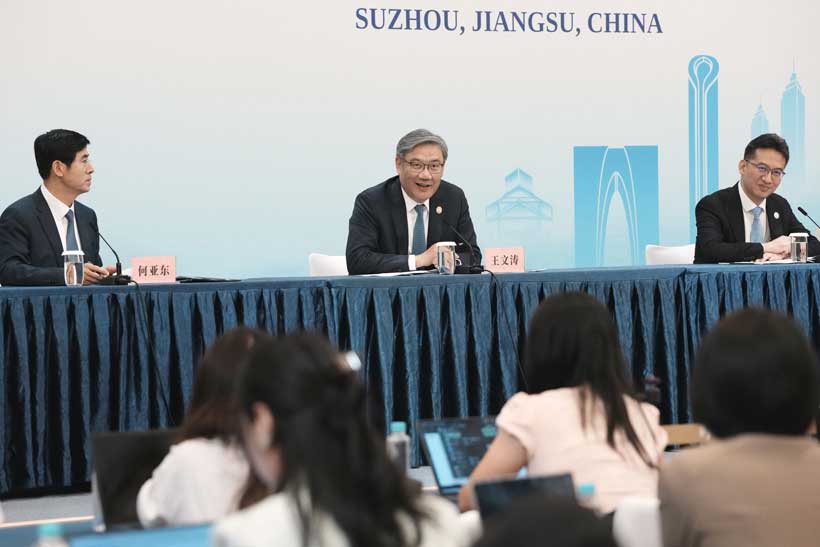
The significance of the Asia-Pacific Economic Cooperation (APEC) trade ministers’ meeting, held on May 22-23, 2026, in Suzhou, eastern China, lay in the issuance of the Suzhou Declaration and the adoption of a new roadmap for the services sector. These outcomes represent important economic and trade results that will contribute to the informal summit of the organization’s leaders scheduled for November 2026 in Shenzhen, China. The (APEC trade ministers’ meeting) in Suzhou served as a (pivotal platform for promoting multilateralism and counterbalancing American and Western influence). The summit focused on supporting the Global South by rejecting protectionist policies, promoting green and digital trade, and securing supply chains to ensure the stability of the international economy in light of the repercussions of recent conflicts following the Iran War, the impact of the closure of the Strait of Hormuz on global supply chains, and the resulting disruption to shipping and Asian and global markets.
The strategic and political importance of the Suzhou meeting in China was evident in several key areas, most notably (supporting the voice of the Global South and promoting multipolarity). This stemmed from China’s keenness, as the host country and leader of the bloc, to leverage the (APEC China 2026) events. In this regard, the (APEC China 2026) aimed to mobilize developing and emerging economies in Asia and the Pacific to counter policies of economic hegemony. The summit presented a practical alternative to unilateral policies, calling for an open and equitable global trading system that considers the interests of developing countries in the Global South. This would solidify the foundations of a multipolar system in which Asia and emerging economies have a greater voice in shaping new trade rules. These combined efforts contribute to strengthening regional economic integration, paving the way for the APEC Leaders’ Summit scheduled to be held in Shenzhen, China, later this year, specifically in November 2026.
The significance of China hosting the APEC China 2026 summit, with the participation of developing and emerging economies in the Asia-Pacific region, lies in its response to the repercussions of the Iran war and geopolitical instability. This meeting comes at a highly sensitive time, as the global economy grapples with the consequences of regional conflicts, including the Iranian conflict, which has impacted energy prices, shipping lanes, and global supply chains. In this context, the trade ministers of the Asia-Pacific Economic Cooperation Forum (APEC), meeting in Suzhou, China, emphasized the need to maintain flexible and interconnected supply chains and rejected policies of economic coercion and arbitrary export restrictions. This has helped to fortify Asia-Pacific countries against future shocks stemming from any tensions in the Middle East or global trade routes. This underscores the importance of the Suzhou Summit in China for expanding partnerships in the digital and green economy. The adoption of the Suzhou Declaration represents a significant step towards strengthening the interests of the Global South by accelerating digital transformation and e-commerce. A roadmap for the services sector was agreed upon, facilitating cross-border data flows and paperless (digital) trade. This approach allows emerging economies to integrate more deeply into global value chains without relying entirely on traditional economic structures dominated by Western countries. This strengthens the role of the World Trade Organization (WTO) in supporting emerging and developing markets and economies in Asia-Pacific and the Global South. The (APEC China 2026 meeting) in Suzhou reaffirmed the (firm commitment to safeguarding the rules-based multilateral trading system and providing full support to the WTO). This is a fundamental pillar for preventing the marginalization of developing countries and ensuring the resolution of economic disputes according to fair international law that protects the rights of all, free from predatory trade policies, hegemony, and unilateralism.
The conclusion of the APEC Trade Ministers’ Meeting in Suzhou, China, on Saturday, May 24, 2026, marked a significant achievement. The issuance of the Suzhou Declaration and the adoption of a (new roadmap for the services sector) are considered strategic pillars. This consensus aims to advance economic integration and address global challenges, paving the way for the informal meeting of APEC leaders scheduled for November 2026 in Shenzhen, China. The most prominent outcome of the meeting was the Suzhou Declaration, the key consensus document reflecting the commitment of member economies to confront international economic challenges and disruptions while strengthening multilateral cooperation. The Roadmap for Services is a vital step towards liberalizing and facilitating trade in the services sector to support the economies of the Asia-Pacific region. The (Suzhou Declaration) represents the key consensus document reflecting the commitment of member economies to address international economic challenges and disruptions, while strengthening multilateral cooperation.
Stay ahead of the geopolitical week.
MD Briefing delivers expert analysis across five global fronts — the Indo-Pacific, energy, geoeconomics, European security, and the Middle East — every Monday morning. Free.
Accordingly, the importance of the APEC ministerial meeting and its timing stems from the complex international landscape following the Iran War. The meetings were held amidst complex global challenges, including the (rise of unilateralism and protectionism), as well as a slowdown in global economic growth. This underscores the significance of the Asian countries participating in this meeting in Suzhou, China, as the 21 participating nations represent one of the world’s most economically dynamic regions. This meeting reflects the importance of the next step, as the economic and trade decisions made here will form a strong foundation for contributing to the strategic guidance of the informal APEC leaders’ meeting in Shenzhen in November 2026.
