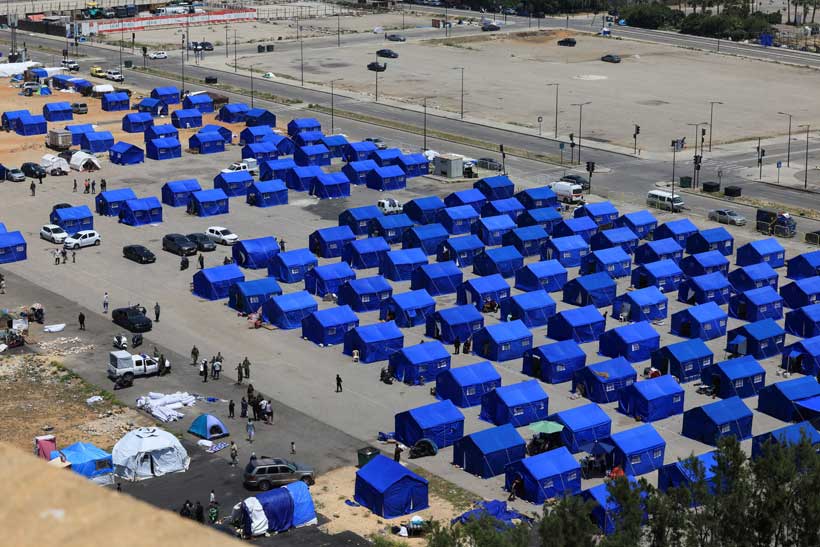
The ceasefire agreement in Lebanon, established last month, has not brought relief to civilians. Many are being forced to leave their homes due to ongoing Israeli air strikes and evacuation orders. The truce, brokered by the U. S. on April 16 after weeks of violence, has not stopped attacks from both Israel and Hezbollah, with each side accusing the other of breaking the ceasefire.
As a result, hundreds of thousands have been displaced in southern Lebanon. Israel has created a buffer zone of nearly 600 square kilometers and warned residents of 57 towns to evacuate. However, air strikes have extended this area beyond the occupied zone, affecting an estimated total of 2,000 square kilometers or about 20% of Lebanon. Local officials, aid workers, and residents describe a worsening displacement crisis.
The fighting is part of broader conflict in the Middle East, ignited by Hamas attacks on Israel in October 2023. Israel aims to push back against its adversaries, including Iran, Hezbollah, and Hamas, by creating “buffer zones” to protect its citizens. Many residents fear they may never return home due to the expanding evacuation orders and the uncertainty surrounding the ceasefire.
Iyad Watfi, a local leader, expressed despair over the situation in his town, Bazouriye, which has seen significant destruction and evacuations. He noted that most of the population had fled, sheltering in tents elsewhere. The latest conflict began on March 2 when Hezbollah launched rockets at Israel, leading to an Israeli ground invasion that has resulted in over 3,000 deaths and widespread displacement.
The Israel Defense Forces claimed that their air strikes are aimed at neutralizing threats from Hezbollah, which they allege operates among civilians. They characterized evacuation orders as recommendations rather than mandates, allowing civilians to leave if they choose. In contrast, Hezbollah has continued its attacks, claiming its right to resist Israeli actions while denying the placement of military assets in civilian areas.
Interviews with leaders from various affected towns indicate that most of their populations have fled, leading to near-deserted communities. The situation appears increasingly dire, with Israeli Prime Minister Netanyahu signaling a continuation of strikes, which has caused more residents to flee. The conflict has potential repercussions for the broader U. S.-Israeli relations with Iran, as Tehran demands an end to Israeli attacks as a condition for peace talks.
On March 31, Israeli Prime Minister Netanyahu announced that Israel’s occupation in Lebanon would extend to the Litani River, creating a large buffer zone to prevent attacks. By the ceasefire on April 16, Israeli forces had occupied only about half of that region. However, air strikes and evacuation orders pushed residents from areas beyond the river. Many towns and villages ordered for evacuation were actually north of the Litani River.
By May 12, the Israeli military reported hitting over 1,100 targets, including weapon sites used by Hezbollah. Analysis revealed a significant decrease in nighttime light levels in southern Lebanon since the conflict began, indicating that many displaced people had not returned home. The Israeli military carried out demolitions in areas they occupied, destroying homes as part of their campaign.
Residents outside the occupied areas attempted to return during the ceasefire but were often forced to leave again due to renewed air strikes and evacuation orders. 39-year-old Hawraa Yousef Ghadbouni fled from Qlaileh to Sidon with her family, returning to find their home partially standing but later having to escape shelling again, eventually seeking shelter in Sidon.
In the town of Bedias, Wael al-Amin sat outside when a drone buzzed overhead. Moments later, his brother’s house was hit, resulting in the death of his brother and injury to his eight-year-old son. Amin managed to pull his son from the rubble, highlighting the precarious situation for families caught in the conflict. Ghadbouni expressed a strong desire to return home, even if it meant sleeping on the ground, emphasizing the unsustainable nature of their current living conditions.
With information from Reuters