



At an energy summit in Athens on 14 May, Foreign Minister George Gerapetritis offered a phrase Greek diplomacy has rarely used about itself: “We prefer to act, not just react.” He was responding to reports that Ankara is preparing legislation to codify its “Blue Homeland” doctrine into Turkish domestic law, while adding the legally correct observation that unilateral acts “carry only internal weight and no international validity.”
Both statements are true. But only one matters if Greece intends to avoid confronting a more entrenched Turkish position a year from now rather than today.
Under public international law, domestic legislation cannot by itself create obligations for third states. That principle is uncontested. What is less often acknowledged in Athens is that unilateral claims still accumulate practical and diplomatic weight when they are repeated consistently and left insufficiently challenged over time. Legal invalidity does not prevent political normalization. The two operate on different timelines, and a state that relies on the first while ignoring the second eventually finds itself negotiating from positions it never formally accepted but never effectively contested either.
This is the pattern Mr Gerapetritis identified with his choice of words. Greece has spent years correctly rebutting Turkish claims after they appear, after they are published, after they are tabled, or after they enter official discourse. The responses are usually legally sound. They are also usually late.
Stay ahead of the geopolitical week.
MD Briefing delivers expert analysis across five global fronts — the Indo-Pacific, energy, geoeconomics, European security, and the Middle East — every Monday morning. Free.
A pattern of reactive diplomacy
On 8 April, Ankara again accused Greece of violating the rights of the Muslim minority in Western Thrace, this time over the appointment of the new Mufti of Didymoteicho. Athens replied with familiar legal arguments grounded in the Lausanne Treaty and recent domestic legislation regulating the consultative selection process. The exchange changed nothing. It merely replayed a diplomatic cycle both sides now know by heart — Ankara invoking ethnic rather than religious categories that Lausanne explicitly does not recognize, Athens responding with technically accurate but procedurally narrow rebuttals. The result is not contestation. It is ritual.
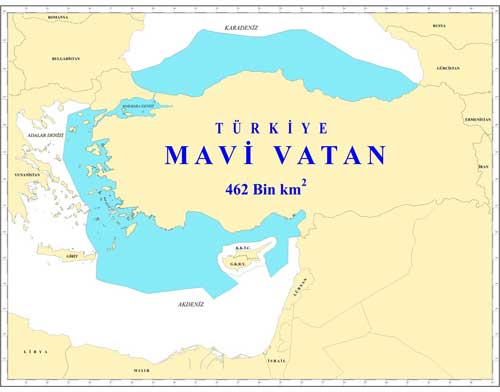
Five weeks later, on 12 May, the Maritime Law National Research Centre of Ankara University (DEHUKAM) publicly presented a draft “Maritime Jurisdiction Areas Law” intended to translate the “Blue Homeland” doctrine into Turkish statute. According to its drafters, the bill is expected to reach the Turkish Parliament shortly after the Eid al-Adha holiday in early June. Athens responded through diplomatic sources that such moves “do not contribute to the climate of calm waters.”
Again, the statement was correct. Again, it was reactive. And again, it changed nothing about the trajectory of the legislation it was meant to discourage.
The problem is not that Greece lacks legal arguments. The problem is that legal arguments unsupported by sustained diplomatic action rarely shape outcomes on their own. A state that insists another state’s law has “no international validity” without simultaneously constructing a contemporaneous record of objections, protests and coordinated international responses is not truly invoking international law. It is assuming that legal principle alone will contain political momentum.
That is not how diplomatic reality is formed.
The mechanics of unilateral claim-making
International law’s resistance to unilateral acts is real, but conditional. The principle of opposability — that a state cannot bind others through its own internal legislation — protects third states from automatic legal effects. It does not, however, prevent gradual political consolidation when challenges are absent or muted. Maritime claims, in particular, acquire weight through repetition, official invocation, citation in subsequent acts, and the absence of formal objection from affected states.
Ankara understands this mechanics very well. The Blue Homeland doctrine, first articulated within the Turkish naval establishment in the mid-2000s, gained full political traction after 2016 and operational expression in the 2019 “Mavi Vatan” exercise and the Libya maritime delimitation memorandum of the same year. Each step has been deliberate. Each has expanded the doctrine’s institutional footprint. The draft Maritime Jurisdiction Areas Law is not a new departure — it is the legislative codification of a position that has already been built up over nearly two decades of consistent, layered claim-making.
Athens, by contrast, has tended to treat each Turkish initiative as a discrete provocation requiring a discrete response, rather than as a cumulative project requiring a cumulative counter-strategy.
What acting, rather than reacting, would look like
If Athens intends to act rather than merely react, the critical window is now — before the Turkish bill reaches Parliament, not after. The available diplomatic instruments are conventional, well-established, and entirely within the bilateral and multilateral channels Greece already uses.
A coordinated memorandum to the UN Secretary-General and the EU’s High Representative for Foreign Affairs and Security Policy, identifying specific provisions of the draft law incompatible with UNCLOS, could already be circulating in diplomatic capitals. Such a memorandum would not require Greek objections to be sustained alone; it would invite affected and concerned states to take note of the legal incompatibilities before the legislation crystallizes.
Greek and Cypriot MEPs could engage the European Parliament in advance of the bill’s passage rather than retroactively. The Parliament has repeatedly expressed concern about Turkish maritime claims, but its interventions have typically followed Turkish actions rather than preceded them. A resolution or a formal question tabled before the Turkish law enters Parliament would establish an EU institutional record of objection at the right moment.
Athens could coordinate quietly with other EU coastal states — Spain, Italy, France, Cyprus — that have a stake in how unilateral maritime legislation is received within the Union. The precedent of a member state’s neighbour codifying maritime claims through domestic law without prior diplomatic process matters beyond the Aegean. It touches on how the EU collectively handles unilateral acts at its periphery.
None of these steps would constitute escalation. None would require abandoning the bilateral channels Greece has worked carefully to preserve. None would require statements harsh enough to disturb the current tempo of Greek-Turkish dialogue. But all would establish something essential: a contemporaneous diplomatic record that Turkey’s claims were challenged early, systematically, and internationally.
The cost of late diplomacy
The instinct to wait — to let the Turkish process unfold and respond once it has produced a final text — is understandable. It minimizes immediate friction. It preserves the appearance of restraint. It avoids accusations of preemptive escalation.
But it also accepts a fundamental disadvantage: by the time unilateral claims are fully institutionalized, diplomacy no longer contests them from neutral ground. It negotiates against positions that repetition has already begun to normalize. The opportunity cost of late diplomacy is not measured in any single exchange. It is measured in the gradual hardening of the diplomatic baseline from which all subsequent negotiations begin.
The Foreign Minister chose his words carefully on 14 May. “We prefer to act, not just react” is the right phrase. The Turkish draft law is expected in Parliament within two weeks. The question is no longer whether Greece rejects the Turkish claim. It is whether Greece is prepared to contest it before it begins to shape diplomatic reality — before the record hardens, and before reactive diplomacy once again arrives too late.
