


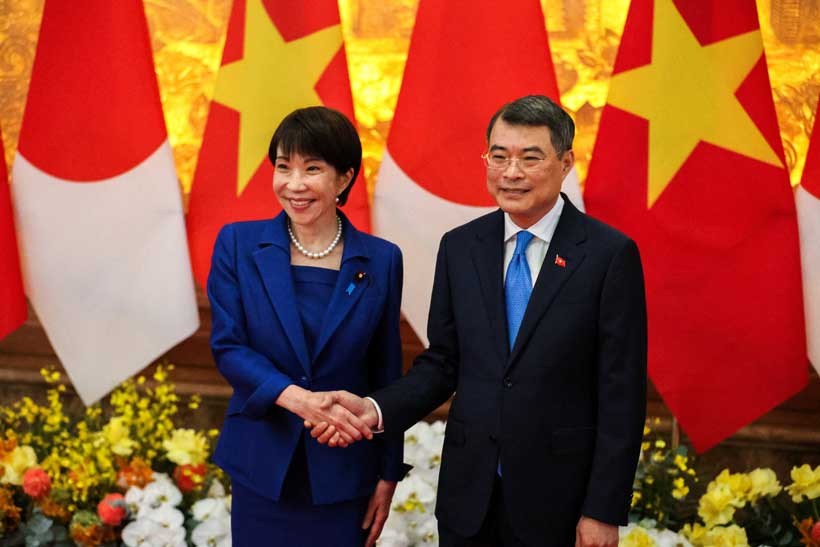
Over the past month, Japan formally joined the United States–Philippines Balikatan military exercises. Under the Reciprocal Access Agreement (RAA) previously signed between Tokyo and Manila, which permits each side’s forces to enter the other’s territory, Japanese Self Defense Forces set foot in Southeast Asia for the first time since the Second World War. Simultaneously, Prime Minister Sanae Takaichi visited Vietnam and unveiled a revised version of the Free and Open Indo-Pacific (FOIP) vision, placing renewed emphasis on Southeast Asia.
This is hardly a one-sided initiative from Tokyo. Southeast Asian states have largely welcomed Japan’s outreach, and both sides have deepened cooperation across security, economics, and people-to-people exchanges. Since the era of Prime Minister Takeo Fukuda, relations between Japan and Southeast Asia have rarely been this close. Yet unlike previous periods of rapprochement, the current phase is defined by substantial security cooperation deliberately designed to avoid explicit treaty obligations or the overt targeting of any particular state.
These seemingly contradictory behaviors point towards a deeper strategic logic emerging among middle powers amid intensifying Sino-American rivalry.
A New Framework: Joint Hedging
Stay ahead of the geopolitical week.
MD Briefing delivers expert analysis across five global fronts — the Indo-Pacific, energy, geoeconomics, European security, and the Middle East — every Monday morning. Free.
One popular interpretation holds that Japan, through FOIP, is attempting to build a ‘democratic coalition’ centered on the US-Japan alliance to balance China, while most Southeast Asian states continue to pursue a hedging strategy aimed at avoiding alignment with either Washington or Beijing, although it becomes more difficult. Yet this framework is becoming inadequate.
Tokyo’s interests do not always align with those of Washington, especially under Donald Trump, while Southeast Asian states have maintained a cautious distance from Japanese-led initiatives such as FOIP and the Quad in order to preserve the centrality of ASEAN. In 2019, ASEAN introduced the ASEAN Outlook on the Indo-Pacific (AOIP), an attempt to redefine Indo-Pacific norms on its own terms. The message was clear: Southeast Asia welcomes inclusive and cooperative regional engagement but rejects becoming a battleground for great power competition.
More importantly, the increasingly erratic foreign policy of the Trump administration has generated deep anxiety across East Asia’s security architecture. Washington’s allies have begun to fear that self-defeating American actions could allow Beijing to prevail by doing nothing at all. As the credibility of American security commitments declines and China’s assertive diplomacy reshapes the region, East Asia’s middle powers are being compelled to develop greater strategic autonomy, and to search for a third option beyond both Washington and Beijing.
The growing convergence between Tokyo and Southeast Asia therefore reflects not simply Japan acting alone, but a process of mutual strategic gravitation. This stems not only from Japan’s decades-long cultivation of an image as a ‘courteous power,’ but also from dual pressures exerted by both Beijing and Washington. Together, these pressures are driving Japan and Southeast Asian states towards what might be called ‘joint hedging’: a sophisticated framework of shared risk management. It is clearly not an alliance, nor is it ordinary multilateral cooperation. Rather, it is a mode of collective action in which multiple middle powers coordinate institutionally, divide strategic functions, and impose normative constraints in order to jointly absorb the pressures generated by intensifying great power competition and the rising costs of unilateral hedging. Crucially, the object of hedging is not only China but also the United States.
The Overlooked Half: Hedging Against Washington
Had the United States maintained the diplomatic style associated with the Obama or Biden administrations, strategic convergence between Japan and Southeast Asia might never have accelerated to this extent. But the first Trump presidency delivered a profound structural lesson: the United States appears increasingly unwilling to bear the full burdens of global hegemony.
Crucially, this shift may be endogenous rather than merely partisan. Although the Biden administration repaired relations with allies rhetorically, it retained many tariffs, declined to reenter the Comprehensive and Progressive Agreement for Trans-Pacific Partnership (CPTPP), and adopted a largely coordinated rather than transformative approach to China. The broader signal remained: Washington increasingly prioritizes its own interests first and is unlikely to fully restore alliance relations to their previous form. Trump’s political return has only intensified this perception.
For Japan, the implications are profound. Tokyo’s diplomacy and security policy have been deeply dependent on American strategic leadership for more than seventy years. A genuine ‘Plan B’ involving independent diplomacy outside the US-Japan alliance was rarely seriously contemplated. At the same time, given the enormous disparity in national power, Japanese policymakers understand that resisting Chinese pressure alone would be nearly impossible.
As a result, Tokyo has pursued a dual-track strategy. Five consecutive administrations from Shinzo Abe to Takaichi have maintained remarkable continuity in preserving close ties with Washington while simultaneously diversifying Japan’s strategic dependencies. Under both Fumio Kishida and Takaichi, relations with Southeast Asia have undergone qualitative upgrades.
Southeast Asia faces analogous pressures. Intensifying Sino-American rivalry in trade and military affairs, particularly in the South China Sea, has compressed the region’s strategic space and undermined traditional hedging strategies, making Tokyo’s outreach increasingly attractive. The Philippines has actively expanded security cooperation with Japan, thereby creating strategic possibilities beyond the US-Philippines alliance. Manila is, in effect, using Japan as an independent strategic pillar to hedge against uncertainties in Washington’s commitments. Vietnam, while upholding its ‘Three Nos’ defense policy, has simultaneously deepened its Comprehensive Strategic Partnership with Tokyo. Meanwhile, states including the Philippines, Vietnam, and Malaysia have accepted Japan’s Official Security Assistance (OSA) to strengthen their defense capabilities and enhance coordination with Tokyo. Collectively, these moves help diversify dependence away from the United States while distributing the burdens of managing South China Sea tensions.
Can Joint Hedging Last?
Hedging is increasingly becoming the new geopolitical normal. As a subset of this trend, the rise of joint hedging is quietly reshaping the underlying logic of the Indo-Pacific security architecture.
China remains the principal object of hedging for many regional actors. Beijing faces difficulty disrupting joint hedging through conventional means, however, because Japan and Southeast Asian states have deliberately avoided overtly anti-China or provocative postures. Southeast Asian states, in particular, would strongly resist any explicit containment logic. For this reason, joint hedging intentionally preserves ambiguity and inclusiveness, leaving space for continued engagement and dialogue with Beijing, an outcome that China itself likely welcomes, insofar as it forestalls outright balancing coalitions.
Counterintuitively, this trend may also serve Washington’s interests. Joint hedging does not represent abandonment of the United States. Indeed, Washington increasingly seeks to reduce the burdens of its alliance system. A reconfigured Indo-Pacific order composed of more flexible regional relationships could prove leaner, more resilient, and less vulnerable to internal instability. That said, Washington must also confront the implications of its own diplomatic behavior: when allies begin hedging against American uncertainty itself, that should be read as a warning.
For the Indo-Pacific more broadly, these dynamics are encouraging the rise of minilateral cooperation and pushing the region towards a distributed, multi-node network structure. Such arrangements may inject greater resilience into the regional security order while constraining unilateral actions by major powers.
What must be recognized is that for non-great powers, security imperatives often outweigh moral or ideological aspirations. As great power rivalry drives up the costs of unilateral hedging, middle powers will naturally gravitate towards one another, not to form alliances, but to preserve order and share risks. What Japan and Southeast Asia are demonstrating is a pragmatic third option born of strategic necessity.
It may yet prove to be one of the most consequential hidden dynamics shaping the future of the Indo-Pacific order. At the very least, until Beijing’s assertive diplomacy and the uncertainty surrounding American security commitments fundamentally change, there is every reason to believe that joint hedging will endure.
