


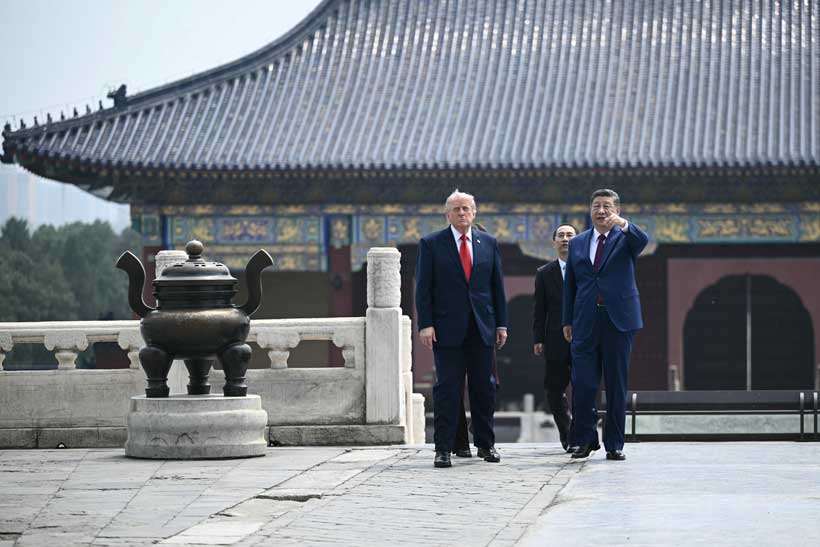
Chinese President Xi Jinping has stressed the need to accelerate the construction of a Chinese intellectual system in the fields of philosophy and social sciences. His recent directives aim to promote high-quality development, effectively address the challenges of the times, and advance modernization in the Chinese style. Xi’s call to expedite the development of this new Chinese intellectual and philosophical system is closely linked to US President Donald Trump’s visit to Beijing. The construction of this system serves as a tool to bolster cultural confidence and solidify Chinese identity in the face of the West, providing the Chinese leadership with ideological and strategic cover for engaging on equal footing after the Sino-US summit.
As for the most prominent points of convergence between the two events (Chinese President Xi Jinping’s call to accelerate the construction of a new Chinese intellectual system in the fields of philosophy and social sciences and Trump’s visit to China), they lie in the desire of the Chinese political leadership to enshrine the principle of parity and China’s soft power in the face of American hegemonic policies. During Trump’s presidency, China called for demonstrating its ability to confront the United States not only economically and politically but also on an intellectual and philosophical level. Therefore, Xi’s call, coinciding with the joint summit with Trump, reflected a Chinese message: the Chinese model and its renaissance possess a unique and independent philosophy (socialism with Chinese characteristics), which cannot be copied or imposed from Western models. With China’s propaganda promoting a strategy of constructive competition and managing relations with the United States, Beijing has called for managing competition with Washington under the umbrella of what it terms constructive strategic stability. This stability requires a strong ideological foundation that prevents any retreat or political concessions to the American administration, especially on sensitive issues such as Taiwan. In this context, the Chinese political leadership under President Xi Jinping supports what is known as the mechanism or path of cultural trust as a tool for negotiation. This was evident during Trump’s visit to China, when President Xi Jinping deliberately took his American counterpart Trump on a historical and philosophical tour of the Temple of Heaven in Beijing, using it to showcase the Chinese worldview and history based on harmony. Xi’s emphasis on building a Chinese intellectual and philosophical system underscores that this historical philosophy of China is the strong foundation upon which China bases its domestic governance and its vision of international relations.
Here we can summarize and analyze the most prominent themes and directives of Xi Jinping by understanding the main objective of President Xi’s thought, which aims to build a Chinese intellectual system in philosophy and social sciences that meets the aspirations of the Party and the state. This is the basis of the Chinese strategy to respond to the aspirations of the Chinese people and to address the questions of China, the world, the people, and the times in a systematic way. President Xi Jinping seeks to provide an interpretation of the new theories of the Communist Party of China through deepening academic research. He offers a phased assessment of this progress, praising the advancements made since the 18th National Congress of the Communist Party of China in 2012, which have contributed to strengthening intellectual and theoretical innovation and producing valuable research results. The ultimate goal remains to provide the wisdom and strength to propel Chinese-style modernization to new horizons within China, in the Global South, and around the world.
Chinese President Xi Jinping’s call aims to establish a new Chinese intellectual system in philosophy and social sciences, based on a theoretical and academic narrative rooted in Chinese particularities. This system seeks to explain China’s unique development experience and the philosophy of the Chinese Communist Party, thereby strengthening cultural confidence and promoting the Chinese-style modernization model as an alternative global benchmark. As for the significance of the call to establish a new Chinese intellectual system, its aim is to provide a theoretical foundation for the Chinese experience, moving beyond Western theories to explain China’s successes (politically, economically, and culturally) based on its historical heritage and socialism with Chinese characteristics. This involves developing Marxist thought by integrating its core principles with practical Chinese realities and traditional Chinese culture, a process known in Chinese literature as “dual integration.” Furthermore, it reflects the Chinese political leadership’s attempt to address the questions of the modern era by offering systematic solutions to the challenges facing humanity today, such as sustainable development, global governance, and the relationship between humanity and nature, all within the framework of President Xi Jinping’s philosophy and concept of a common future for mankind.
Stay ahead of the geopolitical week.
MD Briefing delivers expert analysis across five global fronts — the Indo-Pacific, energy, geoeconomics, European security, and the Middle East — every Monday morning. Free.
As for the importance of this system for Egypt in adopting a new Chinese intellectual and philosophical framework, it helps both Egypt and China exchange developmental experiences. Egypt benefits from studying the Chinese experience in modernization, rapid economic development, and lifting millions out of poverty as a successful model for a developing country that respects its national identity. This approach also supports strengthening the comprehensive strategic partnership between Egypt and China. Here, intellectual and academic convergence provides a deeper understanding of the concepts put forward by China, such as a shared future for mankind and the Belt and Road Initiative, which positively impacts joint projects, such as the Suez Canal Economic Zone. This can support the national narrative of both Egypt and China as partners, emphasizing the right of countries to build their own independent development paths that suit their circumstances and culture, free from ready-made prescriptions imposed by Western and American models.
Here, Egypt’s adoption of the Chinese intellectual framework represents a comprehensive strategic framework that strengthens the developmental and economic partnership between the two countries. This convergence is directly reflected in several areas, including the exchange of developmental expertise, where Egypt benefits from studying the Chinese experience in rapid economic modernization and lifting hundreds of millions out of poverty as a successful model for a developing country that maintains its national identity. It also includes supporting major Chinese projects in Cairo, as the intellectual convergence between Egypt and China fosters a deeper understanding of China’s global initiatives, such as the Belt and Road Initiative, and other global development initiatives related to civilization, security, development, and good governance. This, in turn, supports major joint Chinese projects in Egypt, such as the TEDA China-Suez Canal Economic Zone. Ultimately, this serves to consolidate the national narrative in Egypt by affirming Egypt’s right to build its own independent development paths that suit its circumstances and culture, independent of imposed Western and American models.
This Chinese philosophy, embodied in the wisdom of President Xi Jinping in adopting a new Chinese intellectual and philosophical system and approach, holds particular importance for the Global South (developing countries). It presents a new model of modernity that breaks the West’s and the United States’ monopoly on defining modernity, demonstrating that economic and social development does not necessarily equate to Westernization. This reinforces the principle of intellectual independence for both China and the Global South, as this Chinese philosophical and intellectual approach encourages countries of the Global South to build their own independent intellectual and scientific systems rooted in their local heritage and culture. It also defends the interests of developing countries by providing a theoretical foundation that supports the principles of multipolarity, democracy in international relations, and the achievement of common and equitable development for all peoples without exception.
Chinese philosophy, as reflected in the wisdom of President Xi Jinping in adopting a new Chinese intellectual and philosophical system and approach, is of particular importance to the Global South (developing countries). The dimensions of Chinese philosophy and its influence on the Global South lie in breaking the monopoly of the Western model of modernity. The Chinese approach provides a practical model demonstrating that economic and social development does not necessarily mean Westernization, thus offering developing countries an alternative path to progress that aligns with their specific characteristics. This contributes to strengthening intellectual independence, as this philosophy encourages countries of the Global South to draw upon their heritage and cultural identity to build independent intellectual and scientific systems, free from the imposed dependency of Western and American hegemony. This contributes to building multipolarity, as President Xi Jinping’s vision represents the establishment of a solid theoretical foundation that supports more equitable global governance, defends the rights and interests of developing countries, and promotes democracy and shared development. Here, President Xi’s Chinese philosophy calls for establishing genuine democracy in international relations and achieving equitable and shared development that benefits all peoples without exception.
Based on the preceding understanding and analysis, the thought of Chinese President Xi Jinping is a key driver in reshaping the new world order, offering an independent development model for the Global South and Egypt that breaks the American and Western monopoly on modernity. This approach emphasizes that economic progress is not necessarily linked to Western values, thus encouraging developing countries to forge their own development paths rooted in their unique cultural heritage.
