


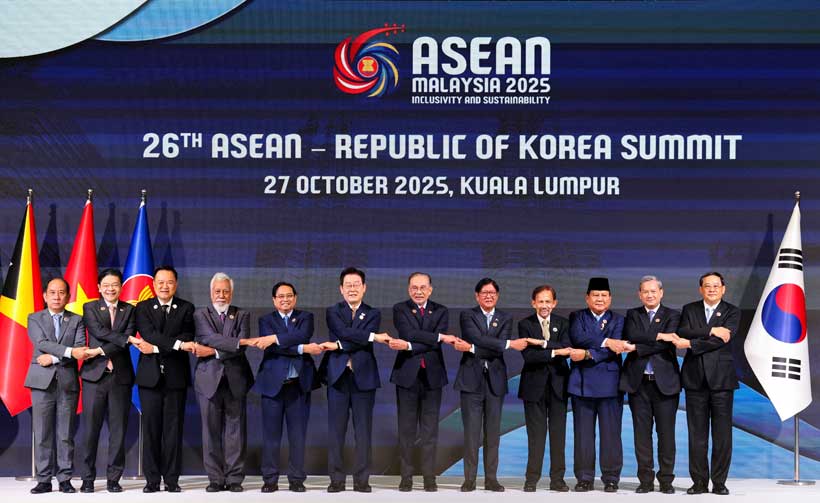
ASEAN leaders were trying to consolidate a vastly different vision for a regional order just days before Donald Trump arrived in Beijing for a widely-publicised summit with Xi Jinping. At the latest ASEAN Summit, the member states advanced cooperation programmes on maritime affairs, reiterated the importance of the United Nations Convention on the Law of the Sea (UNCLOS) and continued to work on institutionalising the South China Sea dispute through ASEAN-led mechanisms (Reuters, 2026).
Subsequently, Trump’s visit to China exhibited a strikingly different political logic. Trump, alongside a line-up of the most influential corporate figures, focused heavily on agricultural purchases, energy deals, Boeing orders, and technology supply-chain issues (Reuters, 2026). The possibility of deferring part of a major U.S. arms deal to Taiwan further underscored a growing belief throughout this region that Trump 2.0 may have a less long-term perspective toward Asia, responding more to domestic political pressures than to long-term strategic interests.
This could be even more alarming for ASEAN than the U.S.-China rivalry itself. In fact, the reason Southeast Asian states have been working for years to institutionalise regional order is that they precisely spot their own structural weaknesses when dealing with major powers. The utmost concern shall never be conflict between Washington and Beijing; it is the chance that the region’s most sensitive security issues could once again become negotiable subjects in direct major-power bargaining.
Over the past decade, ASEAN has pursued a deliberate strategy in the South China Sea: to ‘institutionalise’ regional conflicts before they are completely taken over by raw power politics. Southeast Asian countries, which lack the military power to counterbalance China, have increasingly adopted multilateralism, legal frameworks, and external cooperation as approaches to maintain strategic space (Reuters, 2026).
Stay ahead of the geopolitical week.
MD Briefing delivers expert analysis across five global fronts — the Indo-Pacific, energy, geoeconomics, European security, and the Middle East — every Monday morning. Free.
This was evident at the recent ASEAN Summit. Having seen the intensive pre-summit diplomacy by Beijing, which included visits by Chinese Foreign Minister Wang Yi and Defence Minister Dong Jun to several Southeast Asian states (The Strait Times, 2026); still, the Philippines successfully pushed ASEAN towards a more collective maritime stance. The newly launched maritime cooperation initiatives and the re-emphasis of UNCLOS can be part of Manila’s strategy to transform the South China Sea from a bilateral conflict into a broader regional issue (ASEAN.org, 2026).
Meanwhile, the ASEAN hedging strategy has been taking in more external security actors. The growing defence ties between Japan and the Philippines, Indonesia, Vietnam, and Malaysia are a striking example of Southeast Asian countries seeking to hedge their strategic bets without turning their backs on China’s economic ties. China remains economically indispensable, but economic dependence alone no longer guarantees strategic trust.
ASEAN’s rules-based strategy thus has a deeper meaning than defeating China and fully matching Washington’s interests. It is to prevent Southeast Asia from becoming negotiable terrain between major powers. ASEAN’s strategic space has long depended on a simple assumption: competition between major powers would continue to preserve Southeast Asia’s relevance.
But Trump’s trip to Beijing did not. ASEAN has been making greater efforts to create institutions and multilateral coordination to address regional security, while Trump approached China primarily through the lens of domestic political utility. Entering Beijing, Trump is not acting only as China’s geopolitical rival; he is a president who seeks tangible economic victories before the U.S. midterm elections, as he faces increased pressure of inflation, energy prices, and public fatigue with tensions in the Middle East (Reuters, 2026).
This sheds light on the substance of negotiations and the composition of the American delegation. On the one hand, the agricultural purchases, Boeing orders, expanded Chinese imports of U.S. energy products (Reuters, 2026), and discussions surrounding critical mineral supply chains were foreign policy achievements; on the other hand, they prove to be highly valuable domestic political assets aimed at reassuring practitioners in respective industries back home. From this angle, Trump’s visit to China was less about resolving structural U.S.-China rivalry than stabilising vital political and economic constituencies in the United States.
More importantly, the summit bolstered a broader regional perception that parts of America’s Asia policy may become increasingly negotiable under Trump 2.0. Even if a major U.S. arms package to Taiwan were not deferred, Trump may have been considering it (Reuters, 2026). Acts like this could create a symbolic impact across Southeast Asia. For regional states that have already been uncertain about the long-term reliability of U.S. pledges, this is enough to raise concerns about whether the most sensitive security issues will become subjects of negotiable political exchange.
For ASEAN, it is not simply a matter of “softening up” to Beijing by Washington. The bigger question is whether regional order is slowly shifting from institutional pledges to selective major-power bargaining based on short-term political considerations.
ASEAN’s hedging strategy has always hinged on a mindful balance: major powers would continue competing intensely enough that Southeast Asia remained strategically valuable, but not so intensely that the region became a direct battleground. Diplomatic space was created with this competition. It enabled ASEAN countries to engage in economic relations with China, security relations with the United States and Japan, and institutional relations through the ASEAN-centrality platforms (Reuters, 2026).
However, as tensions between Washington and Beijing evolve into more select bilateral bargains, ASEAN could lose some of this leverage. The concern is not necessarily that the United States and China may instantly reconcile. Instead, the key regional issues, ranging from Taiwan to the South China Sea, could be considered variables in larger negotiations driven by domestic political demands and short-term stability needs.
This is likely a stark challenge to ASEAN’s rules-based strategy. The institutional approach in Southeast Asia is based on the notion that security issues in the region should be addressed and managed not just by direct bargaining among major powers, but among multilateral norms, collective diplomacy and predictable commitments. Major power rivalry may be uncomfortable for ASEAN, but major power coordination without ASEAN could leave it more uneasy.
That does not imply that the governments of Southeast Asia seek perpetual conflict between China and the U.S. Most still prioritise stability, economic growth, and the avoidance of military escalation. But Trump’s China trip underscored a new regional concern: a fear that the future of Asia may be determined, as before, by deals made between major powers rather than institutions and rules. Ultimately, the point today is not only China’s rise or America’s relative decline that Southeast Asia should be concerned about. It is about whether the region can continue to build a rules-based order strong enough to prevent its strategic future from becoming negotiable.
