


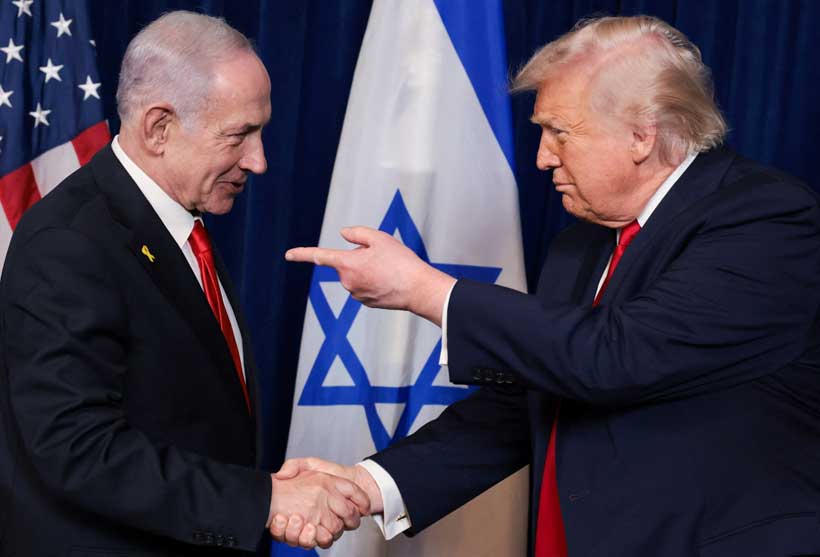
In recent years, U.S. foreign policy has undergone a fundamental shift. With Donald Trump’s return to the White House, the “America First” doctrine is no longer merely an electoral slogan—it has become the principal guiding logic of decision-making in Washington. Under this approach, the real priority is America’s true friends and allies: countries willing to shoulder their share of the burden and engage in reciprocal dealings. As a result, issues such as Ukraine, broad commitments to Europe, and even Taiwan no longer carry the same weight in Trump’s calculations that they once did. After decades of costly foreign entanglements, Americans have decided that the time has come to put their own national interests first.
This shift reflects a deep fatigue among ordinary Americans. Polls consistently show that a large segment of the public—especially working-class voters in the country’s heartland—opposes pouring billions of dollars into distant wars with no clear end. They want that money spent at home: repairing aging infrastructure, securing the borders, and easing the cost-of-living pressures on American families. Trump has repeatedly made clear that the era of the United States playing the role of the world’s policeman is over. He has conditioned military aid to Ukraine, pressured European NATO members to dramatically increase their defense spending, and adopted a more cautious, deterrence-centered approach toward Taiwan. The central strategic focus now is competition with China—but not at the cost of dragging America into yet another endless conflict.
Yet one major exception remains: unconditional support for Israel. This position has provoked growing criticism even from within Trump’s own circle, with some calling it “Israel First” instead of “America First.” Critics ask a simple question: Why should Israel be exempt from the new rule that alliances must be reciprocal? This exception has a long history—billions of dollars in annual military aid, advanced weapons systems, and continuous diplomatic cover in international forums. After the October 7 attacks and the Gaza war, that support intensified sharply, with reports emerging of billions of additional dollars allocated as emergency assistance.
The costs of this one-sided commitment are significant. Financially, it adds a heavy burden to an already strained federal budget—given that the United States provides approximately $3.8 billion annually under a standing agreement, in addition to more than $21.7 billion in supplementary military aid since October 2023. More important, however, is the damage to America’s international credibility and prestige. In many Arab countries, across the Islamic world, and even in parts of Europe and Asia, the United States is increasingly seen as the unconditional backer of one side in a complex conflict. This perception has complicated American diplomacy on other issues and fueled global protests—with nearly 50,000 pro-Palestinian demonstrations recorded around the world since October 2023. Domestic critics argue that this is precisely the kind of endless Middle Eastern entanglement Trump promised during his campaign to avoid.
Stay ahead of the geopolitical week.
MD Briefing delivers expert analysis across five global fronts — the Indo-Pacific, energy, geoeconomics, European security, and the Middle East — every Monday morning. Free.
Inside Washington and conservative media circles, a heated debate is underway. A growing number of realist voices argue that maintaining this exception contradicts the core spirit of “America First.” While acknowledging the power of longstanding lobbies and historical ties, they contend that the time has come for aid to be conditional and based on mutual interests. Trump himself has always favored transactional diplomacy—relationships that bring clear benefits to the United States. Ending the blank-check approach to Israel could free up significant resources that might otherwise be consumed by a prolonged war, redirecting them toward domestic priorities such as border security, technological innovation, or reducing the national deficit.
Many ordinary Trump voters expect this principle to be applied consistently. Working Americans struggling with inflation and daily economic pressures increasingly find it difficult to justify why their tax dollars should fund conflicts that appear to have no clear endpoint and no direct benefit for their own communities. This sentiment is being amplified in new right-wing media and on social media, where voices argue that Israel—as a strong and capable ally—should operate within the same framework of reciprocal interests as other partners.
European capitals and Kyiv have received these signals with visible concern. They understand that the era of unconditional reliance on American support is fading. Taiwan, despite its strategic importance, is also being encouraged to focus more on self-reliance and nonmilitary tools. Yet the Israel file remains the most sensitive and emotionally charged part of this transformation. Behind closed doors, even some figures close to Trump have quietly begun discussing the need to set conditions for future aid. At its core, this debate reflects a broader evolution in American thinking about foreign policy.
After decades of heavy costs and mixed results, Washington is returning to a more realist outlook that places the interests of American citizens at the center. Whether the Israel exception will also be reconsidered under this new framework is one of the most important questions facing the Trump administration. The answer will shape not only the future of the Middle East but also America’s credibility and long-term power in the world.
