


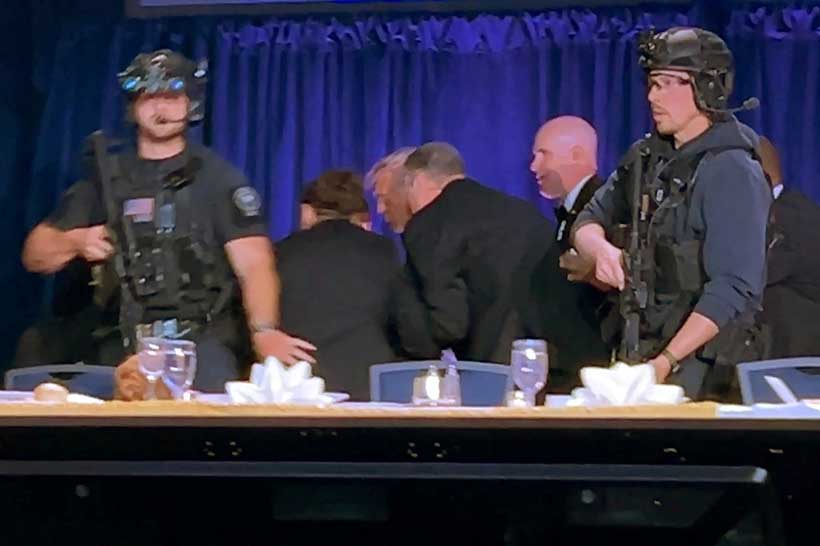
Chinese media outlets, think tanks, and intelligence agencies commented on the assassination attempt against US President Trump, highlighting the sound of gunfire at the White House Correspondents’ Dinner on Saturday, April 25, 2026. This incident prompted the intervention of the Secret Service to evacuate President Donald Trump from the Washington Hilton Hotel. This event adds to a series of serious incidents unprecedented for any US president in modern history. Chinese official and semi-official analyses and reports, based on Chinese sources (official, semi-official, and experts), revealed a multi-dimensional strategic perspective from China, most notably highlighting American security failures. Chinese state media and commentators extensively focused on the assassination attempt as evidence of chaos and armed violence within the United States, using the incident to demonstrate the fragility of the American security system and the decline of internal stability.
The attempted assassination of Trump also reinforced the Trump-China Builder narrative, with Chinese internet users and analysts mocking the incident and reviving the satirical title of Builder of the Chinese Nation (due to his foreign policies, which they considered divisive and helpful to China in expanding its influence). Chinese analyses delved deeper into predictions of a more profound American division, with Chinese experts viewing the incident as a factor exacerbating internal American divisions and simultaneously fueling factors of political polarization and violence in American society, a situation whose consequences ultimately serve China’s strategic objectives. Chinese intelligence agencies and circles closely monitored the American response, particularly the Secret Service’s handling of the investigation, focusing on any failures revealed by the investigation to use them to assess the effectiveness of American security agencies. In short, China viewed the attempted assassination of Trump not as a potential loss, but as an opportunity to highlight the failure of the American democratic model and strengthen its position in the intelligence and media war against the United States.
The recent attempt on Trump’s life at the White House Correspondents’ Dinner on April 25, 2026, elicited widespread reactions in Chinese circles. Chinese analyses focused on deeper dimensions related to American domestic stability. Chinese media, think tanks, and intelligence agencies addressed the event, emphasizing institutional erosion and American security. Chinese reports, including analyses from institutes affiliated with the Chinese Ministry of State Security (MSS), which functions as the Chinese intelligence service, unanimously agreed that the repeated attempts against Trump reflected profound intelligence and logistical shortcomings within the US Secret Service.
The Chinese Ministry of State Security (MSS) and the Chinese state media, such as the People’s Daily of China, suggested that the threat reaching the heart of an elite gathering in Washington proves that the American security system is no longer capable of containing the violent political polarization in Washington. Chinese state media also deliberately highlighted and analyzed the situation using and promoting the concept of political manipulation and the idea of democracy in decline in Washington. Chinese think tanks, such as the China Institute of Contemporary International Relations (CICIR), used the attempted assassination of Trump as evidence of the failure of the American democratic model. These Chinese think tanks believe that the resort to physical violence by political opponents (or extremist individuals) instead of the ballot box is a sign of a cold civil war in the United States, which weakens its prestige as a stable superpower.
Stay ahead of the geopolitical week.
MD Briefing delivers expert analysis across five global fronts — the Indo-Pacific, energy, geoeconomics, European security, and the Middle East — every Monday morning. Free.
Here, the relevant intelligence, military, defense, and security circles in Beijing analyzed the repercussions on bilateral relations with Washington. Chinese analysts expressed concern that these terrorist attacks in Washington might intensify the nationalist rhetoric of Trump and his supporters, potentially leading to more hardline policies toward China should he remain in power. This could be seen as a form of exporting the internal crisis to an external enemy, particularly China. Chinese intelligence also monitored the American public’s reaction to the assassination attempt against Trump. Chinese technical reports indicated close monitoring of American reactions on social media platforms. Chinese intelligence agencies observed a significant increase in the dissemination of conspiracy theories and a deepening of the divide between the Democratic and Republican parties. They considered this internal fragmentation the greatest long-term threat to American national security, a development that serves the Chinese vision of a multipolar world.
Based on the preceding understanding and analysis, we understand that China views the attempted assassination of Trump at a gathering of his officials and supporters not merely as a security breach but as a symptom of a chronic political ailment that renders the United States an unpredictable partner (or adversary) due to its internal turmoil.
