Freedom Edge 26’s nuclear-capable bomber component, paired with unusually explicit official language about North Korea’s “nuclear and missile threats,” is not deterrence signaling aimed at Pyongyang — it is compensatory reassurance aimed at Seoul and Tokyo, timed to offset the credibility Washington just spent by unilaterally gutting Ulchi Freedom Shield for Kim Jong Un’s benefit. That marks a real shift in extended-deterrence doctrine: from a fixed, ambiguous annual guarantee toward a reactive signal issued on Washington’s own diplomatic clock.
On August 27, U.S. Forces Japan announced “Freedom Edge 26” in the blandest language available — a “premier trilateral, multi-domain exercise” to “reinforce cooperative commitment to regional security.” Wire services covering the same announcement reached for a different phrase entirely: a “nuclear missile drill.” That gap between the label and the coverage is not sloppy journalism. Nine days earlier, Donald Trump had unilaterally gutted the allies’ bigger exercise, Ulchi Freedom Shield, cutting it from eleven days to five as a goodwill gesture toward Kim Jong Un — a decision Seoul’s own foreign minister said his government learned about only after the fact. What Freedom Edge is quietly being asked to do in its place is the real story.
THE CONTEXT
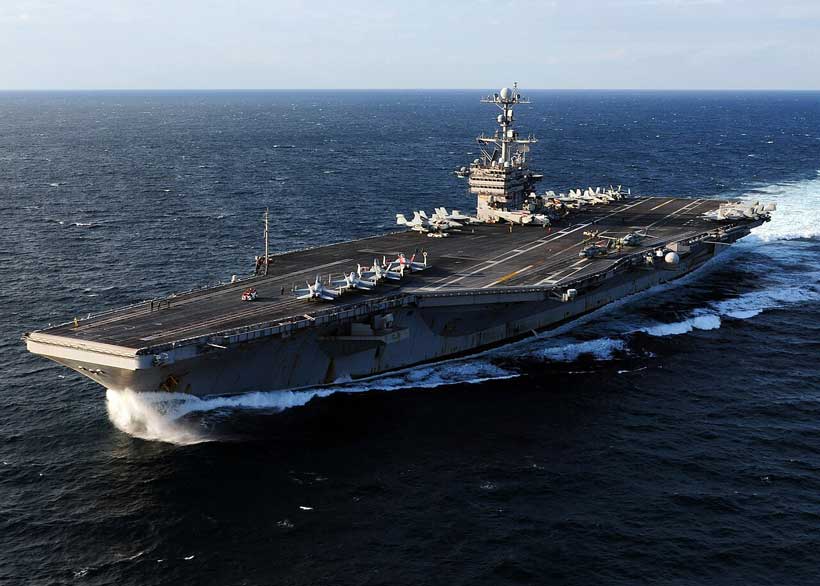
Freedom Edge began in 2024, born out of the Camp David trilateral summit and built around carrier strike group operations. It has grown every year since: 2025 added cyber and special-operations components and stretched from three days to five. This year’s edition, running September 7–11 off Jeju Island, folds in ballistic missile defense, anti-submarine warfare aimed at North Korea’s submarine-launched missiles, integrated air defense — and, notably, sorties by nuclear-capable B-52H and B-1B bombers, aircraft the US has used before specifically to signal extended deterrence.
Stay ahead of the geopolitical week.
MD Briefing delivers expert analysis across five global fronts — the Indo-Pacific, energy, geoeconomics, European security, and the Middle East — every Monday morning. Free.
That expansion lands days after Trump’s August 18 order to cut Ulchi Freedom Shield, a decision he explained as a message to Kim Jong Un, with whom he says he has “a very good relationship” and plans to meet again before the year is out. South Korea’s Joint Chiefs still call the shrunken drill “defensive.” The sequencing — cut one exercise for Pyongyang’s benefit, expand another days later — is what needs explaining.
THE ARGUMENT
Two readings of Freedom Edge 26 dominate the coverage, and both are too simple. The first says this is nothing new — trilateral drills have grown every year since 2024, and this year’s growth just happens to include bombers. The second says Washington is needlessly provoking Pyongyang at the exact moment Trump is courting Kim. Neither explains why the exercise’s own name stayed deliberately generic while everything reported around it got explicitly nuclear.
That gap is the mechanism. USFJ’s press release never uses the word “nuclear” — it talks about “multi-domain” operations and “regional security,” language bland enough that Beijing and Pyongyang cannot easily cite it as proof of new hostile intent, and that keeps a formal channel open for Trump’s parallel outreach to Kim. But the substance underneath the bland name is unambiguous: strategic bombers capable of carrying nuclear weapons, flown specifically because, as regional analysts have long noted, that platform choice sends a message about extended deterrence that fighter jets and destroyers do not. Officials’ own framing of the drill’s purpose — countering North Korea’s “nuclear and missile threats” — is more explicit than the generic “regional stability, not aimed at any third party” language trilateral exercises usually reach for. The name stays quiet. The substance and the briefings do the talking. That split-level signaling, not a rebrand, is what is new.
The audience for that signal is not really Pyongyang. Kim Yo Jong’s response to Washington halving Ulchi Freedom Shield was notably subdued: she insisted “the provocative, aggressive nature of the drills won’t change even though their duration and size were reduced,” but added that Pyongyang has “no interest” in the announcement and that relations between her brother and Trump remain warm. That is not the posture of a government newly worried about a nuclear threat. It is the posture of a government that already understood the drill cut as a gift, and expects more.
The real audience is in Seoul and Tokyo. South Korea’s nuclear-latency debate — quietly building since Trump’s confrontations with allies rattled confidence in Washington’s reliability — is no longer a fringe position. Former foreign minister Yoon Young-kwan has said openly that “there may come a time when it is difficult to rely on the US for our security,” and Seoul is examining the reprocessing and enrichment capacity that would shorten any future path to an independent arsenal. What sharpens that anxiety specifically now is the shape a Trump-Kim deal might take: analysts warn Washington could accept limits on North Korea’s intercontinental missiles, which threaten the American mainland, while leaving Pyongyang’s shorter-range and tactical nuclear-capable systems — the ones aimed at South Korea, not the US — untouched. That is an asymmetric bargain that protects America while leaving its ally exposed, and it is precisely the scenario nuclear-capable bomber sorties are built to preempt: proof, ahead of any summit, that Washington’s nuclear commitment to the region has not been quietly negotiated away.
Seen this way, Freedom Edge’s nuclear substance is not deterrence aimed outward at an adversary’s next missile test. It is reassurance aimed inward at two allies’ growing doubt, timed to a decision — the Ulchi Freedom Shield cut — that Washington made unilaterally and without warning even its own ally’s government. That is a genuine shift in how extended deterrence gets signaled: not a standing, ambiguous guarantee renewed on a fixed annual calendar, but a compensatory signal issued on Washington’s own diplomatic clock, calibrated to whatever concession Trump has just made to Pyongyang.
THE SCENARIOS
Base case (~55%): Freedom Edge runs as planned through September 11 with its bomber component intact, Seoul and Tokyo read it as adequate reassurance for now, and South Korea’s nuclear-latency debate stays a live but managed policy conversation rather than a funded program. Washington continues the pattern it has now set — trimming bilateral, peninsula-facing drills for Kim’s benefit while preserving or expanding the trilateral, nuclear-signaling ones — through the rest of 2026, treating Freedom Edge as the standing offset for whatever it concedes to Pyongyang elsewhere.
Downside case: Trump announces a concrete Kim summit date, or agrees to further exercise concessions, within days of Freedom Edge wrapping up — undercutting the reassurance value of this cycle’s bomber sorties in real time and making the drill look like a one-off gesture rather than a durable offset. South Korean officials, already unnerved at not being warned before the Ulchi Freedom Shield cut, read that sequencing as confirmation that ally reassurance itself is negotiable on short notice. That accelerates momentum in Seoul’s National Assembly toward funding reprocessing or enrichment capacity, moving nuclear latency from debate to budget line within the next legislative session.
Upside case: Washington formalizes the split-signal approach instead of leaving it improvised — briefing Seoul and Tokyo in advance of any future exercise change, the way it conspicuously did not before the Ulchi Freedom Shield cut, and explicitly pairing any reduction in peninsula-facing drills with a scheduled nuclear-capable asset deployment through the trilateral framework. That would convert an ad hoc reassurance patch into a predictable, institutionalized part of extended-deterrence doctrine, and would do more to narrow Seoul’s credibility gap over time than any single bomber flight can on its own.
THE TAKEAWAY
The interesting fact about Freedom Edge 26 was never its name — the Pentagon kept that deliberately boring. It is the divergence between a neutral label and an unmistakably nuclear substance, arriving days after Washington surprised its own ally by gutting their bilateral exercise for Kim Jong Un’s benefit. Extended deterrence used to run on a fixed, calendar-driven signal aimed at an adversary; it is now being issued reactively, timed to whatever reassurance Seoul and Tokyo’s own doubts require after Washington’s diplomatic moves.
Watch whether Trump announces a Kim summit date in the days right after Freedom Edge wraps on September 11 — that sequencing will show whether this drill bought Washington room to make a concession, or was the concession’s replacement.