


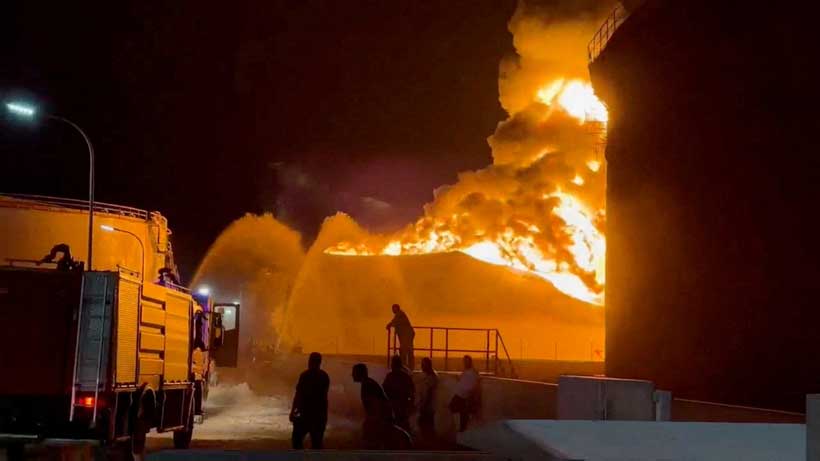
The drone strike that hit a gasoline tank at the Zawiya refinery in August was more than a security incident. Zawiya is Libya’s largest operating refining facility, and the National Oil Corporation warned that continued attacks could force operations to halt. In an economy still built almost entirely around hydrocarbons, a disruption at one major facility rarely stays local. It becomes a national economic risk.
Libya’s dependence on oil has generated enormous wealth, but it has also concentrated economic risk in a relatively narrow network of fields, pipelines, export terminals, and refineries. A disruption at any one of these nodes can threaten fuel supplies, production, and the state revenue that depends on them, reaching well beyond the site itself.
None of this means Libya should move away from oil, which will remain central to the economy for years. The more useful question is whether Libya can build enough productive capacity around it that the country’s economic future isn’t defined by the vulnerability of a handful of facilities. Diversification is often discussed in the abstract. In Libya, it is starting to take a more concrete shape, particularly in cement and steel, where investment is beginning to build an economic base around production, employment, infrastructure, and domestic value rather than around extraction alone.
Why cement is more than a construction material
Stay ahead of the geopolitical week.
MD Briefing delivers expert analysis across five global fronts — the Indo-Pacific, energy, geoeconomics, European security, and the Middle East — every Monday morning. Free.
Cement doesn’t carry the same strategic weight as oil in most conversations about Libya’s economy, but for a country rebuilding its cities and infrastructure, it arguably should. Housing, roads, and public infrastructure all depend on a steady domestic supply of building materials, and meeting that demand locally generates a different kind of value than exporting raw resources: factories, supply chains, jobs at multiple skill levels, and more of the value construction generates staying inside the national economy.
There is also an export dimension. Libya’s location and access to regional markets give a competitive cement industry real potential beyond its own borders. Suhail Abushiha, Libya’s Minister of Economy and Trade, has said the country could eventually export as much as 25 million tonnes of cement annually, a figure that indicates how far this ambition is meant to reach, even if it remains some distance from current output.
A functioning industrial sector depends on engineers, technicians, suppliers, contractors, energy, transport, finance, logistics, and maintenance, and its output in turn supports other industries and the wider construction economy. That is the multiplier effect Libya needs, not just revenue, as oil provides, but economic activity that spreads across businesses, regions, and communities. The foundations for that are already forming.
The industrial base already in place
Libya is not starting from scratch. The Libyan Cement Company in Benghazi remains one of the country’s most established industrial producers, accounting for roughly 20 percent of national cement output and supporting more than 1,000 direct jobs. Over the years, its cement has supplied major infrastructure and reconstruction projects, and its history tracks the broader shift in Libya’s private sector. In 2023 it came under the ownership of businessman Ahmed Gadalla and has since grown to become a defining industrial player in eastern Libya.
The company’s importance extends past what it produces. A major industrial operation generates demand for engineers, contractors, transportation, logistics, maintenance, and energy services, and its output feeds directly into the construction and infrastructure projects that will shape Libya’s future. Gadalla’s industrial interests go beyond cement, in fact. His involvement in the SULB steel venture, alongside Tosyalı Holding, follows the same logic of building productive capacity in sectors that support construction and long-term development.
Alongside these established players, Libya is seeing a new wave of large-scale investment. In Nalut, ALHEDAB Cement Company is developing a major project with an estimated investment of $600 million, designed to produce up to 12,000 tonnes of cement per day, one of the largest industrial projects currently under development in the country. What distinguishes the project isn’t only its scale. Around 25 percent of its capital is expected to open to public and foreign investors, with plans for a future stock market listing, which points to a shift in how large industrial projects in Libya could be financed going forward: less reliant on the state or a narrow group of private interests, and more open to broader participation.
Other producers are expanding the sector as well. Arabian Cement Company, a domestically owned producer based in Khoms, has an annual production capacity of roughly 3.3 million tonnes, and international companies including Pakistan’s Lucky Cement and Oman’s Raysut Cement have identified opportunities in the Libyan market. What matters is less any single project than the combined effect: a growing network of producers, suppliers, contractors, logistics companies, and skilled workers starts to resemble an industrial ecosystem rather than a collection of unrelated ventures.
Diversification depends on projects reinforcing each other
Libya’s economic future won’t be transformed by one factory or one investment announcement. Diversification becomes meaningful when industries start reinforcing each other: cement supports construction, construction creates demand for steel, transport, and engineering services, and new industrial facilities need energy infrastructure, maintenance, logistics, and finance in turn. Industry’s value isn’t limited to what leaves the factory. It lives in the network of activity that builds up around it, which matters for Libya in particular, since oil has financed much of the state for decades without creating a broad productive base on its own. Cement and steel fit that gap reasonably well, given that reconstruction already creates substantial domestic demand and regional markets could add export opportunities over time.
Incentives alone won’t be enough
Projects at this scale need capital, confidence, and long-term commitment. Libya has been working to strengthen the investment environment through incentives and guarantees aimed at domestic and foreign investors. Investment promotion mechanisms backed by the Public Investment Bank are meant to build investor confidence, and the investment framework has tried to encourage the transfer of foreign expertise and technology, including requirements such as health insurance for workers.
These measures matter, but they aren’t sufficient on their own. Market opportunities, natural resources, and favorable terms can draw investors in, but long-term industrial investment depends on something more basic: confidence that regulators apply the rules consistently, and that assets, workers, and supply chains can operate somewhere secure. That is where the Zawiya attack becomes relevant again.
Security, not just incentives, will determine whether this works
The refinery attack points to a challenge that goes beyond any single facility: Libya’s economic prospects can’t be separated from its security and political environment. A country can offer investment guarantees, but uncertainty erodes their value. A manufacturer weighing a multi-million-dollar factory has to account for demand and profitability, but also electricity, logistics, regulation, security, and whether operations can run consistently for years at a time. That is why economic diversification and institutional reform need to move together. Libya needs investment, but investment needs predictability just as much: clear regulations, reliable institutions, and an environment where companies can plan past the next political or security disruption.
The Zawiya attacks make that need difficult to ignore. They show how quickly insecurity can threaten assets central to the national economy, and they strengthen the case for an economy that doesn’t depend on a narrow set of sources. Diversification can’t eliminate political or security risk, but it can reduce how much of the country’s economic life hinges on a limited number of facilities.
Where this leaves Libya
The Zawiya fire is a warning about what happens when a national economy leans too heavily on a narrow group of critical assets. Libya will remain an oil producer for the foreseeable future, and hydrocarbons will continue generating a large share of national wealth. But that doesn’t mean the country’s economic future has to be defined by oil alone.
New cement plants are under development, existing producers continue to back reconstruction and employment, capital is opening to domestic and foreign investors, and international companies are moving in alongside Libyan businesses. These are early signs of a possible shift, not evidence of one already completed. Whether Libya can turn individual investments into a coherent industrial strategy will depend on more than capital and ambition. It will depend on regulatory reform, stronger institutions, security, and sustained commitment to building productive capacity, with Libya’s oil wealth funding the broader transformation rather than substituting for it.
