


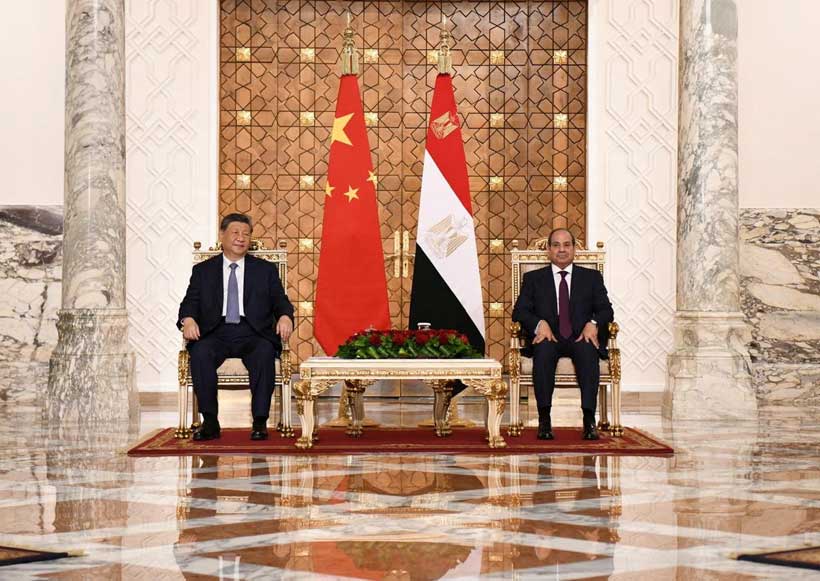
The timing of Chinese President Xi Jinping’s visit to Egypt in September 2026, coinciding with the signing of the (New Strategic Partnership Framework) between Ethiopia and the United States in August 2026, holds significant geopolitical importance. It serves as a crucial tool for rebalancing regional power and preventing American unilateral hegemony in Africa and the Nile Basin. This timing, coinciding with the growing US-Ethiopian military cooperation, represents a key milestone in this regional power rebalancing. This convergence of President Xi’s visit to Cairo and the Ethiopian-American rapprochement reflects the desire of both Cairo and Beijing to forge a multipolar regional security system to counter opposing moves. I can analyze the significance of this convergence and its impact on the balance of power through the following:
– First: The Chinese-Egyptian desire to counter opposing alliances in the Nile Basin region, which is sensitive to Chinese and Egyptian interests, and to restore the balance of power and provide a strategic response to Washington and Addis Ababa
The strategic partnership between Egypt and China supports Egypt’s water security in the Nile Basin and creates a regional and international balance in the face of unilateral policies. The US-Ethiopian defense and security agreement has enhanced Ethiopia’s military and intelligence capabilities. In contrast, the Chinese president’s visit to Cairo provides Egypt with parallel political and military support, preventing any single power from dominating the Horn of Africa and fostering cooperation with countries of the Global South. This sends a clear message that Egypt possesses strong alternatives and is capable of protecting its national and water security by relying on its Chinese partner. For this reason, Egypt and its president affirmed their commitment to the One China principle, while China supports Egypt’s core issues in international forums. This aligns with the policy of diversifying alliances and underscores Egypt’s pursuit of greater political independence through diversifying its partnerships with major powers, thus contributing to regional stability. This was reflected in President Xi Jinping’s explicit acknowledgment that the Nile River is Egypt’s lifeline and his affirmation of Egypt’s legitimate rights to protect its water security. Beijing emphasized Egypt’s legitimate right to safeguard its water and food security and develop its interests within the framework of international law. In their joint statement, the two countries called upon all Nile Basin countries to adhere to international rules and refrain from harming downstream nations.
– Second: China’s desire to bolster Egypt’s leverage in the Nile Basin and Grand Ethiopian Renaissance Dam (GERD) issue and secure international support for Cairo through China
Stay ahead of the geopolitical week.
MD Briefing delivers expert analysis across five global fronts — the Indo-Pacific, energy, geoeconomics, European security, and the Middle East — every Monday morning. Free.
Amidst Ethiopia’s unilateral pronouncements regarding the Nile waters, Egypt, during President Abdel Fattah El-Sisi’s talks with his Chinese counterpart Xi Jinping, received confirmation of its legitimate right to protect its water and food security and to curb Ethiopian maneuvers. Here, China’s growing military and economic influence in Africa provides Cairo with international backing that limits Addis Ababa’s ability to exploit American support to impose a fait accompli in the Nile Basin. China’s desire to strengthen the Egyptian position and secure international support for Cairo was clearly demonstrated in the joint statement issued on September 3, 2026, during President Xi Jinping’s official visit to Egypt. This stance represents a significant shift and strategic support that strengthens Egypt’s leverage in the Nile Basin and GERD issue through the equation of mutual core interests. This reflects the equation of strategic balance and the mutual interests of Egypt and China. This explicit Chinese support for Egypt’s water issue came within a clear reciprocal framework that bolsters the national security of both countries by securing the support of a major international power like China for the Nile water issue and the Grand Ethiopian Renaissance Dam. In return, Egypt reaffirmed its unwavering commitment to the One China principle, considering Taiwan an integral part of Chinese territory and rejecting interference in its internal affairs.
On the other hand, China has offered Egypt numerous development alternatives and technical leverage. Chinese interest has not been limited to a political stance opposing Ethiopia’s rapprochement with Washington, which threatens Egypt’s water security. Rather, it has extended to providing technical solutions that bolster Egyptian water security, such as offering Chinese proposals for seawater desalination. This is part of an agreement between China and Egypt to explore broad cooperation in desalination as a strategic alternative to combat water scarcity and localize advanced Chinese technology in Egypt. This is achieved by linking the water issue to Chinese cooperation with Egypt in areas such as renewable energy, digital transformation, and space applications and remote sensing. This Chinese support carries a strong political message to the Nile Basin countries, and Ethiopia in particular, given the significant influence and massive Chinese investments in Africa and the upstream region. This shift gives Egyptian diplomacy added weight in any future negotiations or actions to ensure that its historical water share is not compromised.
– Third: Formulating a New Security Architecture with a Joint Chinese-Egyptian Vision and Countering Foreign Interference
This is what Chinese President Xi Jinping called for during his visit to Cairo, advocating for the establishment of a new regional security architecture in which the countries of the region and the Global South take the initiative without external dictates, while securing maritime routes and maintaining peace. This was the focus of the joint summit between Presidents El-Sisi and Xi, emphasizing the protection of maritime navigation routes, such as the Bab el-Mandeb Strait and the Red Sea, which are sensitive areas of interest to both China and Egypt and are affected by security disturbances and military movements in the Horn of Africa. Formulating this new security architecture for the Middle East with a joint Chinese-Egyptian vision is based on the principle of regional countries taking charge of their own affairs and rejecting foreign interference. This vision was formally formulated during the talks at the Presidential Palace in Cairo between Chinese President Xi Jinping and Egyptian President Abdel Fattah El-Sisi. This joint security structure is based on a specific Chinese proposal consisting of four key points that complement Egypt’s strategic balance policy. These points are
1) The pillars of the joint security structure (the Chinese four-point proposal), which the Chinese proposal aims to achieve through the following four pillars:
– Unleashing internal drivers: by encouraging direct dialogue between the countries of the region to explore avenues for peace and empower their people to manage their own affairs.
– Developing an integrated and comprehensive approach: by addressing the various conflict zones and hotspots in the region as interconnected issues requiring comprehensive de-escalation.
– Establishing the foundations for development: by linking security to economic and social stability, based on the premise that sustainable development is the true guarantee for preventing conflicts.
– Strengthening International Coordination: By building international cooperation that supports regional solutions without imposing dictates or external power balances.
2) Mechanisms for Countering Foreign Interventions and Protecting Regional Interests, through the Chinese proposal to achieve the following:
– Categorical Rejection of Foreign Projects: By activating the principle of common, cooperative, and sustainable security to counter attempts by external superpowers to impose their influence.
– Securing International Shipping Routes: By Beijing expressing its full readiness to cooperate with Cairo in protecting the security of vital maritime routes, such as the Red Sea and the Suez Canal, against unconventional threats.
– Diversifying Strategic Partnerships: Here, Egypt adopts a policy of strategic balance that allows Cairo and Beijing to find security and economic alternatives that break the unilateral hegemony in the region.
– Eliminating Conflict Hotspots: By activating preventive diplomacy and joint mediation to end regional conflicts that external parties use as a pretext for intervention.
– Fourth: Direct Military Deterrence Through Egyptian-Chinese Military Cooperation, as Evidenced by the Civilization Eagles Maneuvers
The Chinese President’s visit to Cairo was preceded by joint Egyptian-Chinese air exercises, featuring the powerful (Chinese J-16 fighter jets). The powerful Chinese J-16 and the Egyptian Rafale fighter jets. This constitutes a practical military response, demonstrating the readiness of the Egyptian Armed Forces to diversify their arms sources by relying on advanced Chinese technology to counter any disruption to the balance of power. Thus, President Xi Jinping’s visit to Cairo carried several direct military and security dimensions, including the Civilization Eagles 2026 joint Egyptian-Chinese exercises. The visit coincided with joint air training activities between the Egyptian and Chinese air forces. Therefore, the Civilization Eagles joint Egyptian-Chinese exercises represent a clear strategic message to enhance regional deterrence capabilities and diversify arms sources and joint air defense. This prompted China to send a direct political, intelligence, military, and strategic message to Washington and Addis Ababa, emphasizing its insistence on securing maritime routes to protect its investments and vital trade routes through the Suez Canal and the Red Sea, especially after the recent regional turmoil following the Iran-Iraq War and the Strait of Hormuz crisis.
In response, Egypt aimed to convey several strategic messages of deterrence, demonstrating its ability to diversify its arms sources and reduce reliance on a single supplier by exploring advanced technological alternatives and testing integrated Chinese military and air systems. The second iteration of the Civilization Eagles 2026 exercises witnessed the participation of advanced Chinese heavy aircraft, such as the J-16 and the KJ-500 of the early warning aircraft. This marked the first time such aircraft were deployed in Africa. This reflects the independence of Egyptian political and military decision-making. Through this military cooperation with Beijing, Cairo affirms that its military decisions are characterized by flexibility and a diverse range of international partners. Consequently, Egypt has achieved numerous military gains and advantages through the exchange of military expertise and technologies with China. This includes training in modern air operations management, standardizing combat concepts, conducting simulations and evaluations, testing the performance of Eastern and Western fighter jets in a realistic operational environment, and achieving logistical compatibility by exploring the possibility of integrating modern Chinese military air systems into the Egyptian operational structure.
– Fifth: Strengthening Egypt’s economic resilience against US and Western pressure through a robust structural economic partnership with China
Through this vision, Cairo aims to bolster its economic resilience against pressure from the US administration by (locating advanced Chinese industries, diversifying funding sources, and easing pressure on foreign currency reserves through currency swaps between the Central Bank of Egypt and its Chinese counterpart) to enhance the strength of the Egyptian national economy in the face of any potential geopolitical fluctuations. Accordingly, Chinese President Xi Jinping’s visit included the signing of more than 20 cooperation agreements to inject billions of Chinese dollars into the Suez Canal Economic Zone (known in China as TEDA), among other sectors, in fields such as technology, artificial intelligence, and clean energy, while simultaneously expanding China’s financial influence in Egypt. By strengthening the link between the Egyptian economy and China’s Belt and Road Initiative, along with activating local currency swap agreements, Egypt’s economic resilience and ability to withstand any attempts at isolation or Western and American pressure resulting from its rapprochement with Ethiopia will be enhanced. Chinese President Xi Jinping’s historic visit to Egypt (between August 31 and September 3, 2026) represents a pivotal moment in reshaping the balance of power in the Nile Basin and the African continent, given its exceptional importance driven by several strategic dimensions, most notably: (countering American and Ethiopian moves and sending a message of political deterrence). Deepening the alliance between Beijing and Cairo constitutes an indirect geopolitical response to counterbalance the American military rapprochement with Addis Ababa, thus reinforcing Egypt’s right to defend its water and food security.
On the other hand, the Egyptian side used the joint summit between President El-Sisi and Chinese President Xi Jinping to emphasize Egypt’s legitimate right to protect its water security. This provides Cairo with strong international support (from Beijing) regarding the Grand Ethiopian Renaissance Dam (GERD) and the Nile Basin. Furthermore, it aligns with China’s interests in economic and investment expansion within Africa itself, considering Egypt a gateway to the continent. Beijing views Egypt as a key manufacturing and logistics hub for accessing African markets, especially given the increasing volume of trade and joint agreements between Egypt and China. The visit witnessed the signing of more than 20 documents and memoranda of understanding, including those related to technology localization and artificial intelligence. Chinese investments in Egypt are projected to reach approximately $15 billion by the end of 2026. This visit, the first by a Chinese president in 10 years, established a new dynamic, confirming that Cairo rejects unilateral alignment and is successfully diversifying its international partnerships to maintain regional power balance. The pillars of the structural partnership between Egypt and China to enhance economic resilience include the following:
1) Reducing dependence on the dollar and financial cooperation through currency swaps: Egypt and China have agreed to expand the use of their local currencies (the Egyptian pound and the Chinese yuan) in trade and investment transactions to reduce demand for the US dollar. Along with expanding the issuance of alternative debt instruments, Egypt has successfully issued Chinese Panda bonds to lower debt costs and access new Asian financial markets, coinciding with the debt-for-development swap mechanism between Egypt and China. Egypt is the first country to sign a Memorandum of Understanding on debt-for-development swaps with the China International Development Cooperation Agency to convert financial obligations into development projects.
2) Localizing industry and transferring technology: This is achieved through Chinese projects in the Suez Canal Economic Zone. The China-Egypt TEDA Industrial Park in Ain Sokhna represents a strategic industrial hub, housing approximately 150 Chinese facilities and companies with investments approaching $2 billion. With the Egyptian-Chinese partnership focusing on the vital industries sector, attracting Chinese factories specializing in home appliances, such as the Midea factory, solar energy components, such as the Elite Solar project, and the tire and chemical industries. Egyptian-Chinese cooperation also extends to the high-tech sector, with agreements between Egypt and China encompassing collaboration in cloud computing, semiconductors, artificial intelligence, space science, and remote sensing applications.
3) Infrastructure and Sustainable Transportation: Through Egyptian-Chinese cooperation in the electric transportation sector, China is financing and implementing large sections of the light rail system, known as LRT (Light Rail Transit).
This is being done with concessional financing and in partnership with Chinese companies to connect the New Administrative Capital with urban and industrial communities east of Cairo. Global Supply Chains: Leveraging Egypt’s geographical location as a logistics hub connecting China’s Belt and Road Initiative with European and African markets facilitates global supply chain operations for China.
4) Addressing the trade deficit: The volume of trade between the two countries has grown, approaching $23 billion. Both countries are working to reduce the significant trade gap in Beijing’s favor through specific avenues, such as activating the Early Harvest agreement to facilitate ongoing consultations between Egypt and China and ease the entry of Egyptian products into the Chinese market in accordance with local quality standards. Egypt is also leveraging China’s policy of African tariff exemption by capitalizing on China’s initiative to exempt African countries from customs duties to enhance Egyptian trade access to Chinese markets.
Accordingly, this structural partnership with China allows Egypt to build a strong economic safety net by diversifying its international alliances while maintaining a diplomatic balance that safeguards its national interests without becoming entangled in narrow power blocs.
