


The eerie silence of the ocean
When people think of the South China Sea, they usually picture deep blue waters, peaceful waves over beautiful coral reefs, and busy shipping lanes filled with massive cargo ships. However, this calm surface often hides fierce geopolitical races. It is hard to believe that isolated coral reefs hundreds of nautical miles from the mainland could become the center of a new security crisis.
By late August 2026, the security situation in these waters saw alarming new developments as China sped up the militarization of the Paracel Islands. Tensions are rising as Beijing rushes large-scale reclamation and construction at Antelope Reef and Yagong Island. In response, Vietnam has strongly protested, demanding an immediate stop to these serious violations of its sovereignty.
From a regional security perspective, this construction is more than just infrastructure expansion. It is a calculated strategic move to permanently change the facts on the ground, directly threatening Vietnam’s national security and shaking the stability of the entire region. The pristine natural environment is being entirely replaced by solid concrete foundations.
Stay ahead of the geopolitical week.
MD Briefing delivers expert analysis across five global fronts — the Indo-Pacific, energy, geoeconomics, European security, and the Middle East — every Monday morning. Free.
Non-stop construction
To understand the true scale of the issue, we must look past diplomatic language and examine the reality on the ground. According to recent reports and satellite images, the speed of China’s changes is shocking.
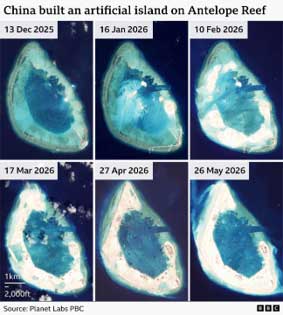
Since early 2026, Beijing has been steadily shipping materials to Antelope Reef. In just four months, a reef that was mostly underwater has been completely turned into an artificial structure with buildings, helipads, docks, and a channel dredged deep enough for large ships.
On August 14, the Asia Maritime Transparency Initiative (AMTI) confirmed that China had finished dredging and land reclamation at Antelope Reef, bringing the total land area to 590 hectares. More importantly, after only eight months of work, the early shape of a standard military runway has clearly appeared. Satellite data shows a strip of land about 1,300 meters long (likely part of a planned 3,000-meter runway) and 55 meters wide being levelled along the northwest edge.
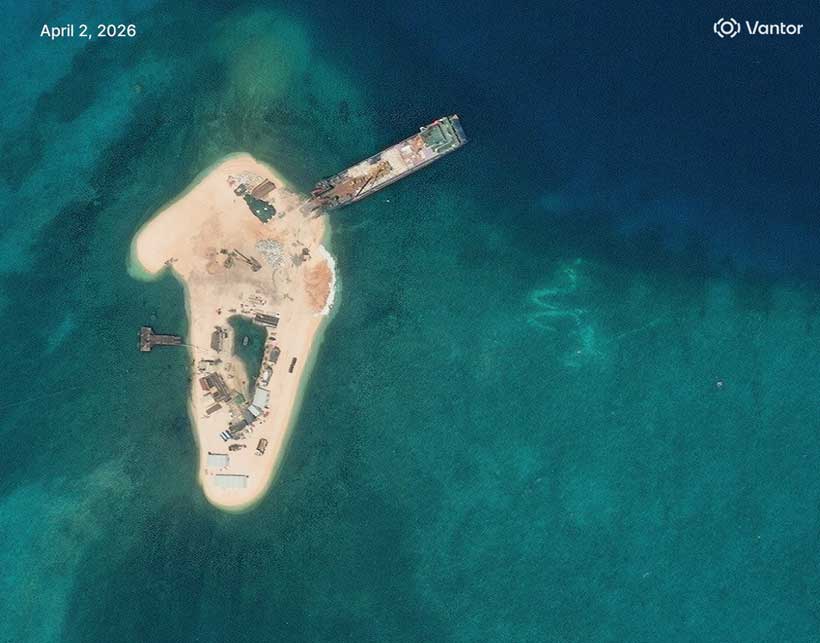
These construction projects are not isolated. They are designed as an interconnected system. On August 25, Reuters, citing Vantor satellite photos, reported that many new structures are also being built on Yagong Island. Analysts say these look like early-warning radar stations, specifically designed to link with and support the military facilities nearing completion at Antelope Reef.
Uncovering Beijing’s strategic goals
By August 19, 2026, the first phase of construction at Antelope Reef was officially finished. While land reclamation is often justified as being for weather forecasting, marine research, fishery protection, or helping local fishermen, the actual size of these projects tells a different story. Building a standard military runway and early-warning radar stations does not fit normal civilian use. Observers and analysts conclude this clearly shows Beijing is carrying out an “active defense” strategy.
This strategy involves creating closed security zones. According to a report titled “Observations on the Strategic Intent and Implications of the CCP’s Recent Land Reclamation in the South China Sea,” Beijing wants to turn the area into a safe “bastion zone” for its submarines, aiming to block potential US intervention routes if a conflict breaks out. By building a security buffer protected by a radar network and forward runways, Beijing is setting up a strong remote defense system to ensure its strategic forces can survive and operate freely.
The report also notes that Beijing has quietly divided the South China Sea into two separate operational zones: the western theater (near Vietnam) and the eastern theater (near the Philippines). In the western theater, Woody Island and Antelope Reef will act as key strategic bases. The prime location of these massive outposts helps Beijing severely limit Vietnam’s legal operating space while keeping a close watch on vital shipping routes heading towards the Taiwan Strait.
Furthermore, these new facilities will directly change how China’s maritime forces operate. Antelope Reef is expected to soon become a forward base for the China Coast Guard and Maritime Militia. This constant presence will sharply cut the reaction time of paramilitary forces near the Vietnamese coast and the Spratly Islands further south, while also saving the massive logistical costs of long-range naval deployments.
The rule of law and maritime order
Legal history and territorial sovereignty cannot be changed by unilateral actions on the ground. China has illegally occupied the Paracel Islands by force since a 1974 naval battle with the Republic of Vietnam. However, the State of Vietnam has consistently and firmly maintained its undeniable sovereignty over this territory ever since.
Facing these growing violations, on August 28, 2026, the spokesperson for Vietnam’s Ministry of Foreign Affairs, Pham Thu Hang, made a firm statement: “Vietnam’s position on the Paracel Islands is clear and consistent. Vietnam has full historical evidence and legal grounds to affirm its sovereignty over the archipelago, including Antelope Reef and Yagong Island, in accordance with international law.” This message confirms that any foreign activity in the Paracel Islands without Vietnam’s permission is completely illegal and void.
The South China Sea is a vital artery for global trade, with trillions of dollars in goods passing through each year. Global supply chains depend heavily on the freedom and safety of these routes.
Therefore, militarizing the Paracel Islands is not just a local land dispute; it is a direct challenge to the rules-based international order, especially the principle of freedom of navigation. If these unilateral uses of force are not stopped, they could set a very dangerous precedent for maritime security worldwide. Allowing a country to freely expand and militarize sea structures without legal consequences will severely weaken international law. Because of this, global powers and regional organizations must stand together and demand strict compliance with the United Nations Convention on the Law of the Sea (UNCLOS).
The harsh reality at sea
Beijing’s efforts to turn Antelope Reef and Yagong Island into military outposts are a carefully calculated escalation. They reveal an ambition to take absolute control of the South China Sea through coercive power. This reality requires Vietnam and the international community to stay highly vigilant and push for strong legal and diplomatic measures to protect the rule of law and the region’s fragile peace.
But as these outposts keep growing, a core question about modern international security must be asked. Concrete and steel can expand underwater reefs and turn them into solid military bases, but can this physical strength replace legitimacy under international law? Will the 21st-century world order continue to be based on multilateral legal agreements, or will it be decided by whichever country can change the facts on the ground the fastest? The answer will not only decide the future of the South China Sea but also shape how the world’s shared waters are governed for decades to come.
