


More than a week after the devastating August 26 flood in Nepal, rescue teams are searching damaged hydropower projects for people who may still be trapped inside tunnels. An engineers’ WhatsApp group has become an important source of real time technical guidance, helping rescuers understand buried tunnel networks and locate possible survivors.
WhatsApp Becomes a Rescue Tool
The group was created by engineers before the flood and later expanded to include more experts. It now has more than 500 members, including engineers and people familiar with the hydropower projects.
Rescue workers have used the group to request technical information, including tunnel layouts and engineering drawings. In one exchange, an official asked for the layout of the Chilime hydropower project, and a group member quickly provided drawings showing the powerhouse and access tunnels.
Searching Buried Hydropower Tunnels
Around 900 people were reported missing from six hydropower plants in the affected valley. Authorities believe some may have survived by escaping into tunnels.
Stay ahead of the geopolitical week.
MD Briefing delivers expert analysis across five global fronts — the Indo-Pacific, energy, geoeconomics, European security, and the Middle East — every Monday morning. Free.
The challenge is that the flood deposited around 2.2 million tonnes of mud and debris, burying tunnel entrances and altering the surrounding terrain.
At Rasuwagadhi, rescuers reached 250 metres into a tunnel before encountering a blockage. Officials believe as many as 46 people could be trapped in one chamber, potentially with access to food and water.
A Sign of Hope
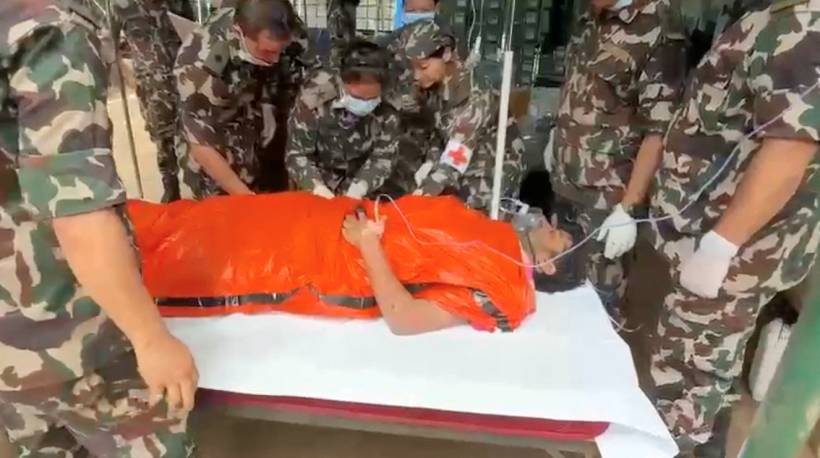
The rescue effort received a major boost when two people were brought out alive from a tunnel connected to the Upper Trishuli 3A hydropower plant nine days after the disaster.
Rescuers had spent days trying to reach the tunnel, while also attempting to supply oxygen through pipes into possible cavities where survivors might be trapped.
Engineers Provide Real Time Guidance
The WhatsApp group has allowed rescue teams to draw on knowledge from engineers and former hydropower workers who understand the complex tunnel systems.
Members have also shared the names and phone numbers of missing workers, asking authorities to pass the information to telecommunications officials in an effort to identify their last recorded locations.
The Scale of the Disaster
More than 1,200 people were killed in the disaster, while more than 4,000 remain missing.
The flood also destroyed around 10% of Nepal’s electricity generation capacity, adding an economic and infrastructure dimension to the humanitarian crisis.
Why It Matters
The rescue operation demonstrates how technical knowledge can become as important as heavy machinery during a disaster. With tunnel entrances buried and their structures altered by mud and rock, rescuers cannot simply rely on conventional search methods.
The WhatsApp network gives teams access to people who know the infrastructure and can provide drawings, layouts and practical guidance while operations are underway.
Key Stakeholders
The main stakeholders are Nepal’s army and government authorities, rescue workers, hydropower engineers, the Nepal Electricity Authority, former plant employees, missing workers and their families.
What’s Next
Rescue teams are continuing to search the tunnel networks of the affected hydropower plants, using excavators, engineering expertise and information supplied through the WhatsApp group.
The search will continue for as long as authorities believe there is a possibility of finding survivors, while efforts are also focused on recovering those who may have died.
Analysis
The most important aspect of the WhatsApp group is that it has effectively created a rapid technical coordination network during a highly complex rescue operation. The disaster changed the physical landscape around the hydropower plants, meaning rescuers could no longer rely entirely on existing knowledge of tunnel entrances and access routes.
The group helps bridge that gap by connecting people on the ground with engineers and former workers who understand the infrastructure. Its value is therefore not simply communication, but the ability to turn specialised knowledge into immediate operational guidance.
The rescue of two people after nine days also demonstrates why detailed knowledge of the underground networks remains critical. As families continue waiting for news, the combination of engineering expertise, technology and physical rescue operations could determine whether more survivors are found.
With information from Reuters.
