


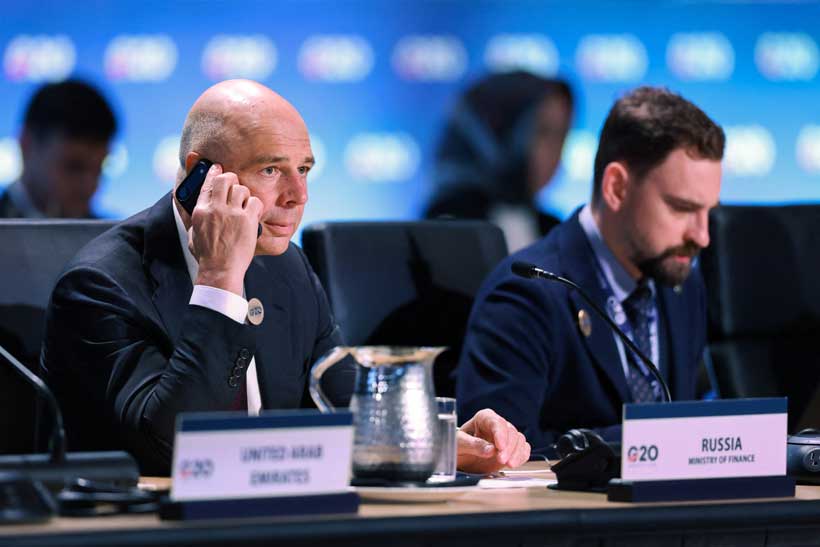
An Accountant in Asheville
On 31 August, in Asheville, North Carolina, Anton Siluanov sat down at a G20 finance ministers’ meeting for the first time since Russia invaded Ukraine. When he tried to open a conversation about areas of mutual interest, US Treasury Secretary Scott Bessent cut him off: nothing is possible until the war is over. European ministers refused to appear beside him in the traditional group photograph, and the photograph was taken without him.
The snub is not the story. The composition of the delegation is. Ten days earlier, Deputy Foreign Minister Sergey Ryabkov had told a Russian outlet that Moscow was ready to hear new ideas for ending the war, provided they aligned with the goals Putin has set and with realities on the ground. Read alongside Asheville, that statement stops looking like an opening and starts looking like an invoice. Moscow is not testing whether it can stop fighting. It is testing what stopping would be worth, and it sent its finance minister to find out.
The Missing Fifth of Donetsk
Stay ahead of the geopolitical week.
MD Briefing delivers expert analysis across five global fronts — the Indo-Pacific, energy, geoeconomics, European security, and the Middle East — every Monday morning. Free.
Four and a half years in, the war has settled into an asymmetry that neither side’s rhetoric captures. Russian forces hold roughly 80 percent of Donetsk oblast and virtually all of Luhansk, according to the Institute for the Study of War. The missing fifth of Donetsk is the “fortress belt”, the fortified urban chain of Kostiantynivka, Druzhkivka, Kramatorsk and Sloviansk that has anchored Ukraine’s eastern defence since 2014. Putin has issued fifteen separate deadlines to take Donetsk since 2022 and missed all of them. The current one expires on 31 December 2026.
Diplomacy has been dormant since March, when a scheduled round collapsed as Washington went to war with Iran alongside Israel. Before that came a 28-point American framework, drafted with Russian input in late 2025, that would have recognised Crimea, Luhansk and the whole of Donetsk as de facto Russian, frozen the southern front, and phased Russia back into the global economy. Kyiv and Europe forced it into revision. In August, Volodymyr Zelensky put forward a joint Ukrainian-American-European counter-proposal built on three planks: a ceasefire, reciprocal withdrawal from the current line, and security guarantees underwritten by the EU and NATO. Moscow has not responded to it.
To read the full analysis, please subscribe to our premium MD Briefing
