The founder and majority shareholder of the Nasdaq-listed fintech company Freedom Holding Corp., Timur Turlov, has announced the global expansion of the company’s ecosystem beyond Kazakhstan. Over the next 3–5 years, the company plans to deploy digital infrastructure in Turkey and Western Europe and does not rule out launching its “super app” in the U.S. market.
Global fintech is moving toward ecosystems where the key asset is the user experience. Freedom Super App, with over 5 million clients, reflects this shift by giving users access to brokerage, banking, and insurance products, alongside a wide range of lifestyle services- from purchasing airline tickets and booking hotels to a marketplace and its own social network. As Timur Turlov puts it, when a user trades through its brokerage, takes out a mortgage from its bank in a single day, and consumes content through its media platforms, the company becomes part of that person’s everyday life.
In essence, this is an attempt to create a global equivalent of WeChat but with a different geographic focus and business logic: while WeChat grew within China, Freedom SuperApp originates in Kazakhstan and is immediately geared toward international expansion
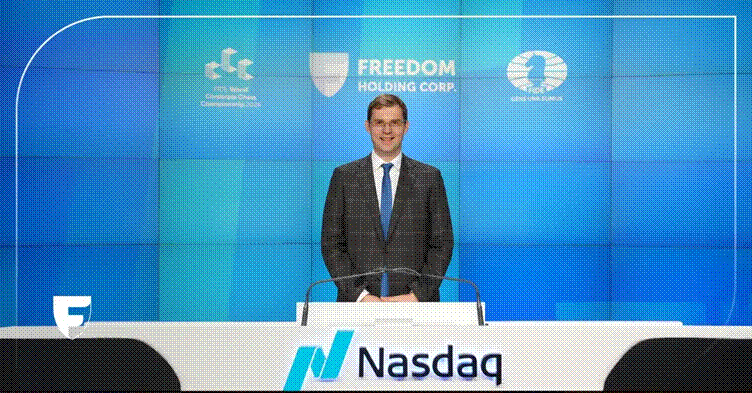
To understand the scale of these ambitions, it is important to look at what the company has already built. Freedom Holding Corp. is present in 21 countries and has been trading on the Nasdaq since October 2019, with a current market capitalization of approximately $9.5 billion, underscoring investor confidence in its growth trajectory.
Stay ahead of the geopolitical week.
MD Briefing delivers expert analysis across five global fronts — the Indo-Pacific, energy, geoeconomics, European security, and the Middle East — every Monday morning. Free.
Freedom Holding has evolved from a brokerage business into a broad digital ecosystem that combines financial services with everyday consumer needs. Its foundation remains its brokerage platform, but over time it has added a fast-growing bank that is now among the leading players in Kazakhstan and is expanding geographically. According to the company, by the end of the third quarter of fiscal year 2026, the ecosystem’s total client base reached 11 million users, including customers of partner companies within the group’s perimeter.
Freedom Holding Corp. has built insurance services, telecommunications and connectivity infrastructure – including data centers – as well as a marketplace focused on electronics and automotive goods. It has also moved into everyday services such as grocery delivery, food delivery from cafes and restaurants, ticket purchasing, and its own media platforms with news and content.
The experience gained in Kazakhstan appears to be accelerating that process. Timur Turlov points to Tajikistan as an example, noting that what took the company ten years to build in Kazakhstan was replicated there in just two years, and that this timeline will continue to shrink as the model matures.
This suggests that Kazakhstan has effectively served as a testing ground where the super app model was developed and refined, and is now ready to be deployed globally.
“Value is created not in individual products, but in the connections between them. The more touchpoints you have in a person’s life, the greater their trust, the deeper their engagement, and the stronger your position,” Turlov notes.
This logic underpins the success of WeChat, which evolved from a messenger into a universal digital platform. Freedom is essentially trying to replicate this model, but in more fragmented and competitive international markets.
Entering Turkey and Western Europe will be the first serious test. Unlike Kazakhstan, these regions already have strong players in individual segments, from neobanks and marketplaces to travel and insurance platforms. What they lack, however, is a single integrated ecosystem that combines all these services into one seamless user experience.
At the same time, Freedom Holding announced potential banking deals in France and Armenia, as well as the planned entry of Freedom Travel into the European market, where it intends to compete directly with established players like Booking and Airbnb. In Kazakhstan, Freedom has also signed an agreement with the Ministry of Healthcare to integrate digital medical services such as doctor appointments, telemedicine, and a unified “My Health” account into its platform. The company is also involved in a $2 billion AI infrastructure project in Kazakhstan, developed in partnership with NVIDIA and supported by the government. Additional initiatives include the launch of a cryptocurrency card, and the introduction of a social-commerce platform called Freedom Lenta within the SuperApp.
Freedom Holding Corp. is challenging the fragmented nature of digital experiences. Its core idea is to integrate into users’ daily routines: shopping, healthcare, education, travel, and communication.
“If a bank is an app people open twice a month, it has already lost – the ecosystem where users live every day wins,” adds Bradley Lim of Goldman Sachs.
Freedom Holding is attempting a more complex task: building such a model simultaneously across multiple markets with different cultures, regulations, and competitive environment. In the long term, entering the U.S. market could be the most ambitious, and most challenging step, given the intensity of competition and regulatory complexity.
The group has been steadily strengthening its international position in recent years. The company was added to the Russell 3000 Index, highlighting its growing presence in global capital markets. It has also been rated by S&P Global Ratings, receiving a B/B+ rating with a positive outlook. At the same time, major institutional investors such as BlackRock and Morgan Stanley have invested in the company. Altogether, this reflects the group’s solid experience in international markets and strengthens its credibility with global investors.