


Authors: Marin Mae Ekstrom and Wilder Alejandro Sánchez*
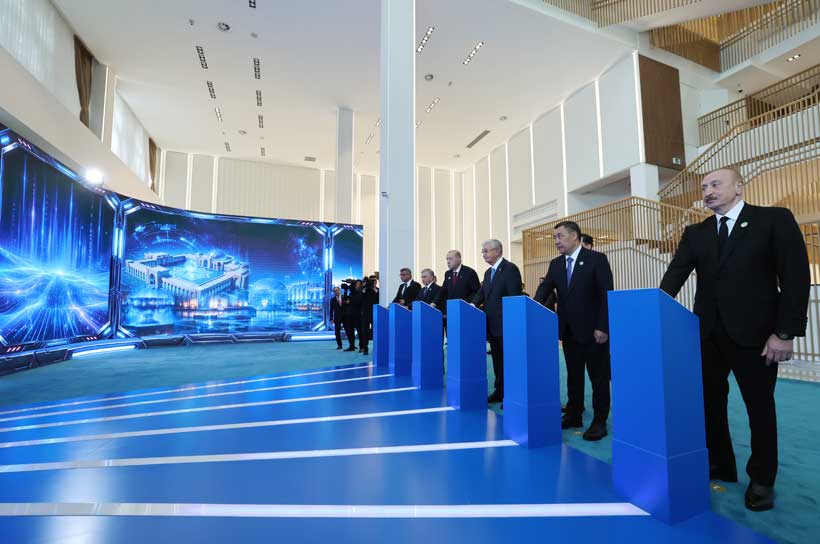
The Organization of Turkic States (OTS) recently held a summit focused on “Artificial Intelligence and Digital Development.” While the May 15 meeting itself did not offer any groundbreaking resolutions, all five heads of the OTS member states participated and reaffirmed their commitment to greater cooperation and integration. This summit was just one example in a series of events that demonstrate growing unity and collaboration among the Turkic states.
How far integration will go between Azerbaijan, Kazakhstan, Kyrgyzstan, Türkiye, and Uzbekistan is debatable. There are several regional initiatives that are bringing these countries, as well as other states across the Caucasus and Central Asia, together, including connectivity projects such as the Middle Corridor and the Uzbek-Kyrgyz-Chinese railway, as well as agencies such as the Shanghai Cooperation Organization and the Eurasian Economic Union.
However, to secure the success of most multilateral initiatives, bilateral relations between participating members must be consolidated. When ties between two countries are stabilized and routinely strengthened, a bilateral friendship serves as a building block for expanding to additional actors and ensuring constant, reliable dialogue and collaboration among all involved players.
Stay ahead of the geopolitical week.
MD Briefing delivers expert analysis across five global fronts — the Indo-Pacific, energy, geoeconomics, European security, and the Middle East — every Monday morning. Free.
Türkiye, the leader of the Turkic world in terms of population, economic strength, and growing global geopolitical influence, is leveraging shared Turkic heritage to deepen and cement engagement with other OTS members. Uzbekistan is a natural and important partner: as the most populous Central Asian state, it is the second-largest majority-Turkic state in terms of both language and population. The landlocked nation has the third-largest economy in the Turkic world and is rapidly developing economically and expanding its membership in international initiatives.
This commentary will thus provide an analysis of Ankara-Tashkent relations. However, while statements by presidents & joint economic and investment projects are important parts of this geopolitical puzzle, the true sign of integration between two nations often occurs at the cultural level.
BILATERAL POLITICAL AND ECONOMIC RELATIONS
Bilateral relations between Türkiye and Uzbekistan are particularly dynamic. It is noteworthy that high-level meetings occur quite regularly: Presidents Recep Tayyip Erdoğan of Türkiye and Shavkat Mirziyoyev of Uzbekistan met in Ankara on January 29, as part of the 4th meeting of the Joint Strategic Planning Group (JSPG). The two leaders signed several agreements, including the “Decision on Cooperation Mechanisms for Comprehensive Strategic Partnership Relations between the Republic of Türkiye and the Republic of Uzbekistan,” an agreement on health cooperation, a memorandum of understanding for the development of international transport corridors, and a memorandum of understanding for promoting cooperation in mining.
The two countries celebrated 34 years of diplomatic relations, and the Turkish state-run news agency Anadolu marked the occasion with a March op-ed; the essay described bilateral relations as evolving into a “comprehensive strategic partnership.” The Uzbek presidency has utilized the same wording to describe the current level of bilateral relations.
Trade between Türkiye and Uzbekistan has nearly tripled over the past decade, rising from USD$1.2 billion in 2016 to over USD$3 billion in 2025. Short and long-term trade targets amount to USD$5 billion and USD$10 billion, respectively. Türkiye is the fourth-largest trading partner of Uzbekistan, accounting for 3.7% of Uzbekistan’s foreign trade. Uzbekistan is not as high a trade priority for Turkiye: even in Central Asia, which is not Turkiye’s primary trade area, Kazakhstan is a larger overall partner. Although neither country is pursuing top trading status with the other, trade and engagement remain high priorities for both Ankara and Tashkent. The evidence clearly displayed that both nations have taken major strides to consolidate both political and economic engagement.
THE CULTURAL FACTOR
From a cultural standpoint, Türkiye has swiftly gained soft power traction in Uzbekistan. Turkish TV series and movies enjoy immense popularity in Uzbekistan: the appeal of Turkish media, coupled with expanded transit options between the two countries, has inspired a tourism boom to Türkiye. From January to October 2025, over 230 thousand Uzbek nationals traveled to Türkiye for various reasons, a 16.3% increase compared to the same period in 2024.
Conversely, Uzbek influence in Türkiye is also increasing. Turkish tourism to Uzbekistan is also rising: between January and April 2025, around 49,400 Turkish citizens visited Uzbekistan for tourism, a 57.4% increase compared to the same time period in 2024. Turkish businesses are also investing in Uzbekistan’s tourism sector: Turkish partners support 12 hotels and over 100 joint restaurants, and in 2025-2026, Turkish investors pledged to help finance 11 additional hotel projects.
Language is another area of soft power, as Turkish is one of the top five most popular foreign languages to learn in Uzbekistan. Factors, including the popularity of Turkish media, academic study, and career opportunities, have bolstered its appeal. Although the study of Uzbek in Türkiye is not as widespread, the linguistic overlap between the two makes it relatively easy for a native Turkish speaker to learn Uzbek and vice versa, making it a less daunting endeavor than the study of other languages.
Cultural relations and people-to-people diplomacy are sometimes overlooked in grand analyses of international relations, as analysts and scholars often focus on presidential summits, trade agreements, investment, or joint military initiatives. However, people-to-people relations, as well as cultural and public diplomacy, are important tools in a country’s toolkit for strengthening grassroots ties.
Generally speaking, the OTS and its member governments support initiatives to promote people-to-people relations and to continue developing a common Turkic identity. During the recent OTS summit, the five leaders reaffirmed their determination to deepen cooperation in digital transformation, innovation, artificial intelligence, connectivity, and sustainable economic development. More broadly, they highlighted their shared commitment to further deepening solidarity, mutual trust, and strategic cooperation within the Turkic World in line with the objectives of the “Turkic World Vision-2040.”
Specifically, the heads of state “laid a time capsule to officially launch the construction of the Center of the Turkic Civilization.” This Center has been described by regional officials as “a groundbreaking architectural complex that will utilize AI, VR, and holography to immerse visitors in the rich philosophy and history of the Turkic World.” Moreover, during the January meeting between Erdoğan and Mirziyoyev, the two heads of state signed a Cultural Cooperation Plan for 2026-2027. Thus, a key strategy for encouraging Turkish-Uzbek bilateral ties is to highlight their commonalities within the wider Turkic cultural and linguistic sphere.
DISCUSSION/CONCLUSIONS
Tashkent-Ankara relations are generally strong, but additional factors complicate their full level of engagement. Although Ankara is very much interested in increasing connectivity with Central Asia via the Middle Corridor and engaging with the Turkic world, those are not its primary objectives. Issues like the Russo-Ukrainian War & the Black Sea; the recent conflict between Iran against the United States and Israel, as well as the related spillover across neighboring Lebanon and Syria; and even the upcoming elections in Armenia, are all arguably higher priorities for Ankara. Domestically, Türkiye is facing its own obstacles, as Erdoğan maintains a tight grip on power while the Turkish economy remains plagued by rising inflation and currency depreciation.
Similarly, Tashkent wants to improve connectivity with Türkiye via the Middle Corridor, but it also wants to increase trade and investment with China and attract investment and partnerships from the Gulf States and India. A good example of this diversification of partnerships is Tashkent’s new airport, to be built via investments and partnerships with Saudi Arabia, Japan, and South Korea. Meanwhile, Moscow remains committed to maintaining its historical influence across Eurasia (President Mirziyoyev visited Moscow for the May celebrations of the Great Patriotic War, one of the few leaders to do so), while the current US administration is focused on transactional diplomacy to secure access to critical minerals and rare earth elements that Uzbekistan has in abundance.
Ankara’s engagement in recent years with Central Asia via the OTS, the Middle Corridor, and bilateral interactions has attracted widespread academic and scholarly interest. However, there is a predictable focus on diplomatic, security, and trade & investment analyses; for example, a 2024 analysis on Tashkent-Ankara relations published by the Central Asia Caucasus Institute did not mention tourism, cultural diplomacy, or education (apart from military education).
That said, the frequently overlooked factors of cultural and public diplomacy will likely be critical to promoting long-term, successful cooperation between Türkiye and Uzbekistan: Turkish pop culture has had a strong influence in Uzbekistan, tourism is growing, and Turkish language study is increasingly popular there. population to learn Turkish. While Uzbekistan’s cultural and language appeal does not hold the same sway in Türkiye, the country is nonetheless growing in terms of global soft power appeal indicators. Uzbekistan’s rebranding as a globally-oriented and dynamic society steeped in rich Islamic and historical heritage -for example, by leveraging the legacy of legendary cities such as Bukhara, Samarqand, and Khiva- echoes the Kemalist model of a Türkiye embracing both modernity and its Ottoman historical legacy. Thus, framing the contemporary Uzbek national narrative as parallel to the Turkish one could help bolster its appeal in Türkiye and strengthen the sense of collective identity in the broader Turkic cultural space.
*Wilder Alejandro Sánchez is president of Second Floor Strategies, a consulting firm in Washington, D.C. He is also a non-resident fellow at Cfive, a think tank headquartered in Astana, Kazakhstan.
The opinions expressed are those of the authors and do not reflect the views or policies of any organizations with which the authors are affiliated.
