


Nepal’s crisis shows why education in emergencies needs both national political leadership and international action, including funding.
For children who have been displaced, lost family members, or seen their schools destroyed, political action is critical to ensure a temporary interruption does not become a lifelong barrier to education.
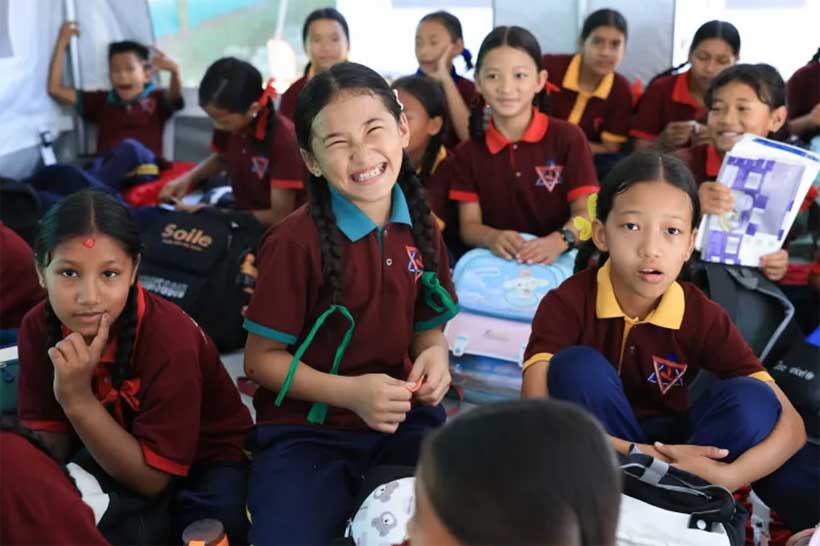
The Bhotekoshi floods in August put learning on hold for over 14,500 children across 63 educational institutions. A total of 1,372 students were displaced and cut off from any form of education, 268 classrooms were damaged, and 11 schools were forced to close completely.
In the worst affected areas in the Bagmati Province, including Rasuwa, Nuwakot and Dhading, this loss of learning will be felt across communities – communities I was proud to represent as a Member of Parliament.
Stay ahead of the geopolitical week.
MD Briefing delivers expert analysis across five global fronts — the Indo-Pacific, energy, geoeconomics, European security, and the Middle East — every Monday morning. Free.
The scale of the disruption is stark, and far reaching. Approximately 2,000 people displaced by the flooding were relocated to holding centres, but 28 of 29 of these centres are housed in school buildings. Classrooms where children should be learning are now where they and their communities are seeking shelter.
For these children, resuming education cannot wait. Education remains one of the most cost-effective investments in the futures of children, communities and societies as a whole.
But the longer children are out of school and unable to learn, the more likely they are to fall significantly behind their peers and be excluded from learning.
As well as protecting children’s long-term opportunities, education provides stability, routine and a sense of normality after crises.
School closures not only disrupt learning, but also essential services that children rely on. These include school food, social connection and psychosocial support which are facilitated by schools and education.
The response to the Bhoketoshi floods must therefore put education at the core of the nation’s recovery, requiring a coordinated approach from the Government and the Ministry for Education, as well as sustained international support.
One mechanism currently in place to support children affected by crisis is Education Cannot Wait (ECW), the global fund for education in emergencies, which parliamentarians play a vital role in supporting.
ECW recently pledged $1 million to fund Nepal’s safe return to learning, which will directly support children whose schools, homes and communities were destroyed by the catastrophic flooding.
This sets a clear example of how international investment can help children recover after disaster and continue learning.
This funding is expected to reach 17,000 children across Rasuwa, Nuwakot and Dhading in the Bagmati Province, the worst affected areas in the nation, providing 5,000 with education and protection support and 12,000 with critical disaster risk reduction interventions.
ECW’s pledge is an important step, but more funding is urgently needed both to ensure children can continue to learn and to help make Nepal’s schools more resilient to climate change.
That’s why ECW’s upcoming replenishment matters, as the global fund can only respond to crises at this scale if it is fully funded.
International commitments made to ECW will determine if the fund can respond quickly when crises strike, and reach its goal of supporting 10 million crisis-affected children.
By urging their governments to ambitiously pledge to ECW on 5 November, parliamentarians in donor countries can ensure education remains a priority in crisis responses.
Only then can parliamentarians ensure emergency education funding reaches children in Nepal and in other crises.
But international funding alone is not enough. It must be matched by strong and collaborative leadership on the national level.
In Nepal, I urge the government and the Ministry of Education to direct this funding to where it is needed most.
Firstly, children must be ensured safe access to education.
Through supporting the rapid establishment of the planned 68 Temporary Learning Centres, the government can enable children to return to a regular learning environment while their schools are being reconstructed to be climate-resilient to withstand future disasters.
Not only will this enable children to resume their education, but will also provide school food and support for those who have faced displacement, seen their schools destroyed or faced the loss of loved ones.
Secondly, ensuring that when children are able to attend school, they receive the support they need to be able to learn.
Providing psychosocial support for children and teachers who have experienced loss, displacement and significant disruption must form a core part of any immediate education response during crises.
Trained counsellors and psychosocial workers should be deployed to temporary learning centres, holding centres and functioning schools if emotional well-being is to be given appropriate priority alongside children’s academic needs.
But the disruption caused to education by the Bhoketoshi flooding has not just affected children and their families. For the 216 teachers affected by the flooding, appropriate psychosocial support must also be provided.
Those who have been affected may be dealing with displacement and bereavement themselves, while also being asked to support pupils and continue with teaching.
Supporting educators must therefore be treated as an essential part the return to learning, which must be both sustainable and effective.
Where necessary and possible, available teachers could be temporarily mobilised or reassigned to Temporary Learning Centres and residential facilities where there is greatest need to maintain the continuity of learning in Nepal.
The Government must ensure that children can return to learning and build a more resilient, sustainable education system for the future of every child.
By combining national action with international investment, parliamentarians can ensure that no child pays for disaster with their education and is at risk of being left behind.
Governments and parliamentarians must work together to protect education during emergencies, support teachers and rebuild safer schools for future generations.
