


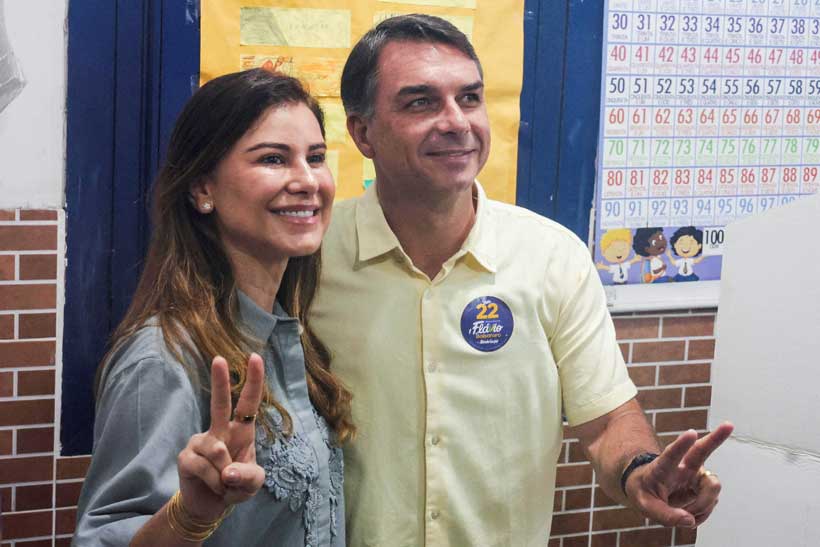
Brazilian Senator Flavio Bolsonaro has left the country for the United States after losing the presidential election, with the US State Department confirming that it will issue entry visas to him and his family. His departure threatens to deepen tensions between Washington and Brasília as Brazilian authorities investigate him in a money laundering case.
Three sources said Bolsonaro had travelled to the United States after refusing to comply with a Supreme Court order requiring him to surrender his passports. A source close to the family said he had landed in Florida, although his exact location remained unclear.
A senior US State Department official said the department would issue visas to Bolsonaro, his wife and their two daughters, allowing them to enter the United States.
The move comes amid growing friction between US President Donald Trump and Brazilian President Luiz Inácio Lula da Silva. Lula has accused Washington of working with the Bolsonaro family to restore its political influence following the election defeat.
Stay ahead of the geopolitical week.
MD Briefing delivers expert analysis across five global fronts — the Indo-Pacific, energy, geoeconomics, European security, and the Middle East — every Monday morning. Free.
Trump Backs Bolsonaro as Brazil-US Tensions Escalate
Trump said on Wednesday that he would approve of Flavio Bolsonaro travelling to the United States, describing the Bolsonaro family favourably while criticising the Brazilian election.
The US president questioned the result and said he had longstanding familiarity with both Lula and the Bolsonaro family. He also reiterated his view that former Brazilian President Jair Bolsonaro, Flavio’s father, had been treated unfairly by Brazil’s judicial system.
Trump’s support adds another dimension to an already strained relationship between the two countries. Reuters had previously reported on a US State Department campaign aimed at restoring the Bolsonaro family to power.
Lula, speaking in Brasília, condemned Flavio Bolsonaro’s departure, saying he should have remained in Brazil to prove his innocence.
The dispute raises questions about the extent to which Washington is willing to support political figures facing legal scrutiny in Brazil. It also risks turning a domestic investigation into a broader diplomatic confrontation over judicial independence and political interference.
Supreme Court Order Raises Questions Over Bolsonaro’s Departure
The senator’s departure came after Brazil’s Supreme Court gave him 24 hours on Monday to surrender his passports. The documents were subsequently cancelled after the deadline expired, according to two sources.
In its ruling, the court cited concerns that Bolsonaro might flee the country, pointing to his substantial financial resources. The senator denies wrongdoing in the money laundering investigation.
Bolsonaro had publicly rejected suggestions that he intended to leave Brazil, saying he would surrender his passports and defend himself against what he described as an attempt to intimidate him.
His departure now raises questions about how he managed to leave despite the court order. A senior Federal Police official said Bolsonaro had not departed through a regular immigration checkpoint.
The timing is politically significant because Bolsonaro is due to lose his immunity from prosecution when his Senate term ends in February. His departure could complicate efforts to resolve the investigation, although its precise legal implications remain unclear.
Election Defeat Leaves Bolsonaro Family at a Crossroads
Flavio Bolsonaro had been considered a strong contender in Sunday’s presidential election but suffered an unexpected defeat against Lula. He has not formally conceded, and on Sunday said he would seek to annul the result over alleged voting irregularities.
His Liberal Party subsequently acknowledged Lula’s victory, creating a contrast between the party’s position and the senator’s continued objections.
The departure also appeared to surprise his campaign manager, Senator Rogerio Marinho. He told reporters that the campaign had discussed the need for Flavio to lead the opposition, given the approximately 60 million votes he had received.
Instead, the senator’s move to the United States leaves questions about his future role in Brazilian politics and whether he intends to continue leading the opposition from abroad.
His younger brother, Eduardo Bolsonaro, who lives in the United States, had indicated before the election that Flavio should leave Brazil if he lost.
Jair Bolsonaro’s Experience Offers a Political Parallel
Flavio’s departure echoes the actions of his father, Jair Bolsonaro, who travelled to the United States after losing the 2022 presidential election to Lula and refusing to concede.
The elder Bolsonaro eventually returned to Brazil but was later sentenced to 27 years in prison for plotting a coup following his supporters’ storming of government buildings in Brasília. He has maintained that he was the victim of judicial persecution.
The family’s repeated confrontation with Brazil’s institutions has become a central feature of the country’s political polarisation. Flavio’s decision to leave amid a court investigation may reinforce concerns among critics that the family is seeking to avoid accountability, while supporters may portray the move as protection against politically motivated prosecution.
The distinction between those competing narratives is likely to shape the political and diplomatic response.
What Happens Next?
The immediate questions concern the legal consequences of Flavio Bolsonaro’s departure, the status of the money laundering investigation and whether Brazilian authorities will seek further action against him.
The episode could also intensify tensions between Lula’s government and the Trump administration, particularly if Washington’s decision to admit Bolsonaro’s family is interpreted in Brasília as political support.
For Brazil, the case presents a challenge involving judicial authority, opposition politics and public confidence in the electoral process. For the United States, it tests the balance between welcoming a foreign political figure and avoiding the appearance of interference in another country’s domestic affairs.
Bolsonaro’s departure does not resolve the political dispute surrounding the election. Instead, it shifts the confrontation onto an international stage, where legal proceedings in Brazil and Washington’s relationship with the Bolsonaro family could influence the next phase of bilateral relations.
With information from Reuters.
