


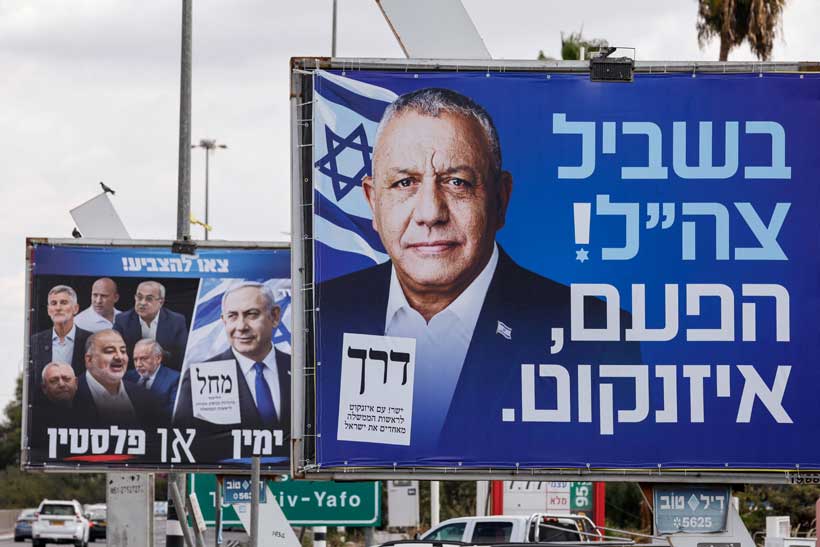
Israeli Prime Minister Benjamin Netanyahu and his main challenger, Gadi Eisenkot, have both claimed a path to leadership after an inconclusive election left Israel’s political future uncertain. Exit polls showed the two rival blocs falling short of the majority needed to form a government, setting the stage for potentially prolonged coalition negotiations.
The projected results represent a setback for Netanyahu and his nationalist-religious coalition, but they do not guarantee his removal. The 77-year-old prime minister could remain in office as caretaker leader while political parties negotiate a new coalition. If no viable government emerges, Israel could face another election.
Exit polls from Kan 11 and Channel 13 showed Netanyahu’s bloc and its rivals tied at 51 seats each. Channel 12 projected a narrow 52-49 advantage for Netanyahu’s Likud-led bloc. Neither side was close to the 61 seats required for a majority in the 120-member Knesset, Israel’s parliament.
The election was the first since the Hamas-led attack of October 7, 2023, and the subsequent wars in Gaza, Lebanon and Iran. Voters assessed Netanyahu’s record on national security, the consequences of the conflicts and the direction of Israel’s political leadership.
Stay ahead of the geopolitical week.
MD Briefing delivers expert analysis across five global fronts — the Indo-Pacific, energy, geoeconomics, European security, and the Middle East — every Monday morning. Free.
Why Is Netanyahu Facing a Political Setback?
Netanyahu’s coalition, which once controlled 68 seats, was projected to fall well short of a parliamentary majority. Far-right religious parties led by Itamar Ben-Gvir and Bezalel Smotrich were expected to win a combined 13 seats within his bloc, without making significant gains.
The results reflected the political difficulties facing Netanyahu after Israel’s major security failure in October 2023. The prime minister has also faced criticism over his handling of the subsequent wars and his government’s increasingly divisive domestic policies.
Netanyahu has defended his record by pointing to Israeli military operations against senior leaders of Hamas, Hezbollah and Iran. He has presented himself as the leader best equipped to confront Israel’s regional adversaries and argued that the country faces an opportunity to eliminate the Iranian threat through cooperation with US President Donald Trump.
Addressing supporters at Likud’s election headquarters in Jerusalem, Netanyahu called for a strong right-wing national government. He also suggested that renewed joint action with Washington against Iran could remain a central priority.
However, the exit polls indicated that his security arguments had not translated into a clear electoral mandate.
Can Gadi Eisenkot Form a Government?
Eisenkot, a former military chief and leader of the Yashar party, emerged as Netanyahu’s strongest challenger. He argued that voters had rejected the prime minister’s continued leadership and called on him to leave politics.
Describing Netanyahu as a caretaker prime minister without the public’s trust, Eisenkot warned against using national security for political purposes. He also urged Israel’s security establishment to resist attempts to subordinate security decisions to political interests.
Eisenkot has sought to distinguish himself from Netanyahu and his far-right allies while maintaining a hawkish position on national security. He opposes Palestinian statehood and argues that Hamas’s military wing must be destroyed or dismantled.
He has nevertheless criticised Netanyahu’s handling of the Gaza war, arguing that the campaign has failed to achieve its objectives because Hamas remains in control.
Eisenkot’s route to power remains complicated. Arab parties outside the two main political blocs could hold the balance of power, but his reluctance to form a government with them limits his coalition-building options.
The Joint List, an alliance of several Arab parties, welcomed the exit polls amid a strong turnout among Palestinian citizens of Israel. Its candidates expressed hope that their parliamentary representation could help prevent Netanyahu’s coalition from returning to power.
Security and the Gaza War Dominate the Election
The election took place against the backdrop of the October 7 attack, when Hamas killed approximately 1,200 people in Israel and took 251 hostages, according to Israeli figures. The attack triggered the Gaza war and was followed by wider confrontations involving Hezbollah in Lebanon and Iran.
Netanyahu faced criticism over intelligence and security failures that allowed the attack to occur. His opponents also questioned the effectiveness of his government’s military strategy and its ability to secure a lasting outcome in Gaza.
The war has killed more than 74,000 Palestinians, according to Gaza health authorities, while deepening Israel’s international isolation and intensifying domestic divisions.
Netanyahu has repeatedly survived political crises throughout his career. He has served as prime minister for nearly 19 of the past 30 years and returned to office after a previous period of political instability. He also entered this election facing corruption charges, which he denies.
Eisenkot, meanwhile, has drawn on his military background to challenge Netanyahu’s security credentials. He lost a son and two nephews in the Gaza war, a personal loss that has informed his criticism of the government’s conduct of the conflict.
What Happens Next?
Final election results are expected on Thursday or Friday. Israel’s fragmented political system means that smaller parties could become decisive during coalition negotiations, which have previously lasted weeks or months.
If neither major bloc can assemble a parliamentary majority, Netanyahu could remain caretaker prime minister while negotiations continue. Another election may become necessary if all attempts to form a government fail.
Yohanan Plesner, president of the Israel Democracy Institute, described the exit polls as a major defeat for Netanyahu’s coalition but cautioned that Eisenkot had not secured a clear victory. The final distribution of seats could change as the vote count progresses.
Turnout reached 77.7%, according to Israel’s Central Elections Committee, the highest level in more than two decades and approximately seven percentage points above the 2022 election.
The result therefore presents a mixed political verdict. Netanyahu has suffered a setback but remains a central figure in the coalition negotiations, while Eisenkot has yet to demonstrate that he can assemble a viable alternative government.
The decisive question is whether Israel’s opposition can translate public dissatisfaction into a parliamentary majority. Until that becomes clear, Netanyahu’s political future remains uncertain, and Israel’s direction on Iran, Gaza and regional security will continue to depend on the outcome of the coalition negotiations.
With information from Reuters.
