


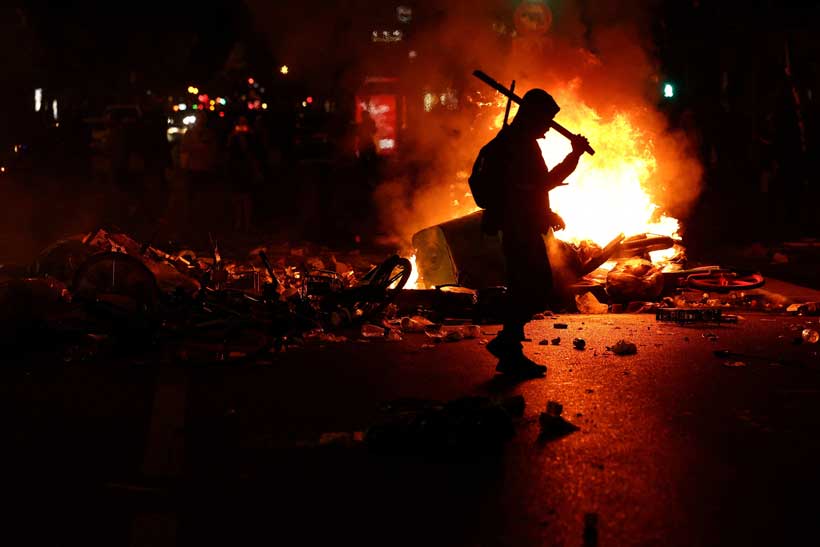
A growing wave of youth-led protests is challenging political leaders across Europe, as Generation Z expresses frustration over rising living costs, poor education, limited job opportunities and corruption. From France and Belgium to Italy, Albania and Serbia, young demonstrators are demanding governments that listen to their concerns and offer a credible path to a better future.
For 19-year-old Maya Gourdel, a student in Brussels, the frustration is captured in a slogan adopted by youth movements around the world: “If we burn, you burn with us!” Inspired by the film The Hunger Games, the phrase reflects growing anger among young people who believe established political institutions have failed to address their needs.
The protests have taken different forms across the continent, ranging from peaceful student demonstrations to violent confrontations with police. In France, thousands of shops have reportedly been damaged or looted in recent weeks, while security forces have deployed water cannons and stun grenades to disperse crowds.
Yet the demonstrations are not simply expressions of youthful discontent. In Serbia, nearly two years of student-led protests against alleged corruption and growing authoritarianism culminated in an election that removed long-time leader Aleksandar Vucic from power.
Stay ahead of the geopolitical week.
MD Briefing delivers expert analysis across five global fronts — the Indo-Pacific, energy, geoeconomics, European security, and the Middle East — every Monday morning. Free.
The developments have raised a broader question for European governments: why are younger generations increasingly turning to the streets to demand political and economic change?
Economic Insecurity Is Driving Youth Anger
For many young Europeans, the transition from education to employment no longer offers the financial security or independence they expected. Rising prices, expensive housing and uncertainty over future earnings have reinforced the perception that hard work and qualifications may not be enough to achieve a stable life.
A European Union survey published in 2025 found that rising prices and the cost of living were concerns for 40% of people aged 16 to 30.
The wider economic picture adds to those anxieties. Among the 92.7 million people in the European Union facing the risk of poverty or social exclusion in 2025, young adults aged 18 to 24 recorded the highest risk, at 26.3%. The corresponding figure for people aged 65 and over was 18.8%.
These pressures help explain why demonstrations frequently extend beyond a single policy demand. Students protesting about school conditions are also concerned about employment prospects, housing costs and whether they will be able to remain in the cities where they grew up.
In Milan, 21-year-old student Chiara described the damage she believes the political establishment has done to her generation’s expectations.
She argued that young people were losing their ability to imagine a future, pointing to underfunded schools, deteriorating buildings, poorly paid jobs and housing that has become unaffordable for many.
Her concerns reflect a growing sense that the traditional promise of education leading to economic advancement is becoming increasingly difficult to fulfil.
Education Cuts Deepen Generational Frustration
Poor school infrastructure and staff shortages have become prominent grievances in France and Belgium, where students argue that governments are failing to provide the conditions necessary for their education.
Bilal Narjissi, a 17-year-old student in a suburb north of Paris, described deplorable conditions at his school, including a previous rat problem and a roof collapse that forced students to evacuate a courtyard.
For Narjissi, the protests have demonstrated that young people across Europe share common concerns despite their different national circumstances. He also criticised the tendency of political leaders to treat young people as children whose opinions do not deserve sufficient consideration.
In Belgium, Gourdel said students had initially tried to protest peacefully but felt ignored until more disruptive demonstrations attracted media attention.
Her account highlights a central tension confronting European governments. When young people believe conventional channels of political participation produce little response, disruptive protest can appear to be the only way to secure public attention.
However, the escalation of demonstrations into violence also creates a challenge for protest movements. Damage to businesses and clashes with police can undermine public support, even when the grievances behind the demonstrations are widely shared.
The challenge for both governments and demonstrators is to ensure that the underlying demands receive attention without allowing confrontations to overshadow them.
The Generational Divide Over Public Spending
Economic insecurity is also intersecting with a broader debate over how governments distribute public resources between younger and older generations.
In France, pension spending has become a particularly contentious issue as the population ages and successive governments struggle to balance retirement benefits with other public priorities.
A French government report published in October found that pension spending had increased by 2.5 percentage points of gross domestic product between 2000 and 2023, while education spending had declined by 0.5 percentage points. The report also found that pensions accounted for 32% of the education ministry’s budget.
The figures have strengthened concerns that existing spending commitments are restricting governments’ ability to invest in schools and other services important to younger citizens.
The distribution of wealth adds another dimension. France’s OFCE economic research institute has highlighted the concentration of wealth among older people, while younger adults face high housing costs and uncertain employment prospects.
The issue is not simply that older citizens receive public benefits. Pension systems reflect decades of contributions and established social commitments. The difficulty is that younger generations may feel they are being asked to finance existing arrangements while receiving fewer opportunities to build comparable economic security themselves.
That perception can turn disagreements over budgets into a deeper dispute about fairness, representation and the responsibilities governments owe to different generations.
Why the Protests Are Spreading Across Europe
Although national circumstances differ, demonstrations in several European countries share a common theme: young people believe political institutions are failing to respond adequately to their concerns.
In Albania, student-led protests against Prime Minister Edi Rama’s government have been fuelled by allegations of corruption, limited employment opportunities and dissatisfaction with education standards.
Xyke Kurti, a 19-year-old architecture student, criticised the government for failing to listen to young demonstrators. She said many Albanian students saw emigration as their best prospect for building a future, arguing that personal connections could outweigh talent and qualifications at home.
Her remarks point to a problem extending beyond immediate financial hardship. When young people believe advancement depends on political connections rather than merit, they may lose confidence in the institutions responsible for governing them.
The same broader frustration is visible in demonstrations elsewhere, where demands over living standards increasingly overlap with concerns about political accountability and the quality of democracy.
Youth-led protests in Bangladesh in 2024, Nepal in 2025 and India in 2026 have also demonstrated how economic and political grievances can mobilise younger populations. Europe’s current unrest is part of this wider pattern, although each movement has its own domestic causes and objectives.
A planned demonstration in Germany over living costs, inequality, war and education further illustrates how youth activism is expanding beyond individual national disputes.
Serbia Shows the Power and Limits of Youth Movements
Serbia offers the most significant political example of what sustained student mobilisation can achieve.
After nearly two years of demonstrations against perceived corruption and creeping authoritarianism, student-led opposition efforts helped bring about an electoral defeat for Vucic, who had dominated Serbian politics for years.
For student protester Stasa Piletic, the result brought relief and a sense of victory. She described it as a transition from protesting against political leaders to accepting responsibility for the country’s future.
Yet electoral success introduces a different set of challenges. Mobilising public anger against an established political leadership does not automatically produce the experience, policies or institutional support required to govern effectively.
Serbia’s student movement must now demonstrate that it can translate its demands into practical improvements in public services, accountability and democratic institutions.
Luka Stojakovic, another protester, dismissed concerns about the movement’s lack of governing experience, arguing that experienced politicians had already demonstrated the limitations of their leadership.
His response captures the depth of distrust driving the protests. For many demonstrators, the shortcomings of established political figures are themselves an argument for giving new voices a chance.
Whether Serbia’s political transition delivers lasting change will depend on the movement’s ability to move beyond mobilisation and establish credible alternatives.
What Comes Next for Europe’s Governments?
The spread of Gen Z-led protests presents European governments with both a political warning and an opportunity to rebuild public trust.
Addressing the underlying grievances will require more than public statements of sympathy. Governments face pressure to improve school infrastructure, expand access to affordable housing, strengthen employment opportunities and demonstrate that public spending reflects the needs of younger generations.
They must also address concerns about corruption and political accountability. Where young people believe that connections matter more than competence, economic policies alone may not restore confidence in public institutions.
At the same time, protest movements will face their own test. Sustained political influence requires clear objectives, organisational capacity and proposals that can be translated into policy. The experience of Serbia demonstrates the potential impact of collective action, but also the difficulties that emerge once movements move from opposing established leaders to assuming responsibility.
Europe’s youth protests should therefore not be dismissed as a temporary expression of generational frustration. They reflect deeper concerns about economic opportunity, democratic representation and the distribution of public resources.
The central message from the streets is that many young Europeans no longer believe existing political arrangements adequately represent their interests. Whether governments respond through meaningful reforms or allow dissatisfaction to deepen may shape the continent’s political landscape for years to come.
With information from Reuters.
